
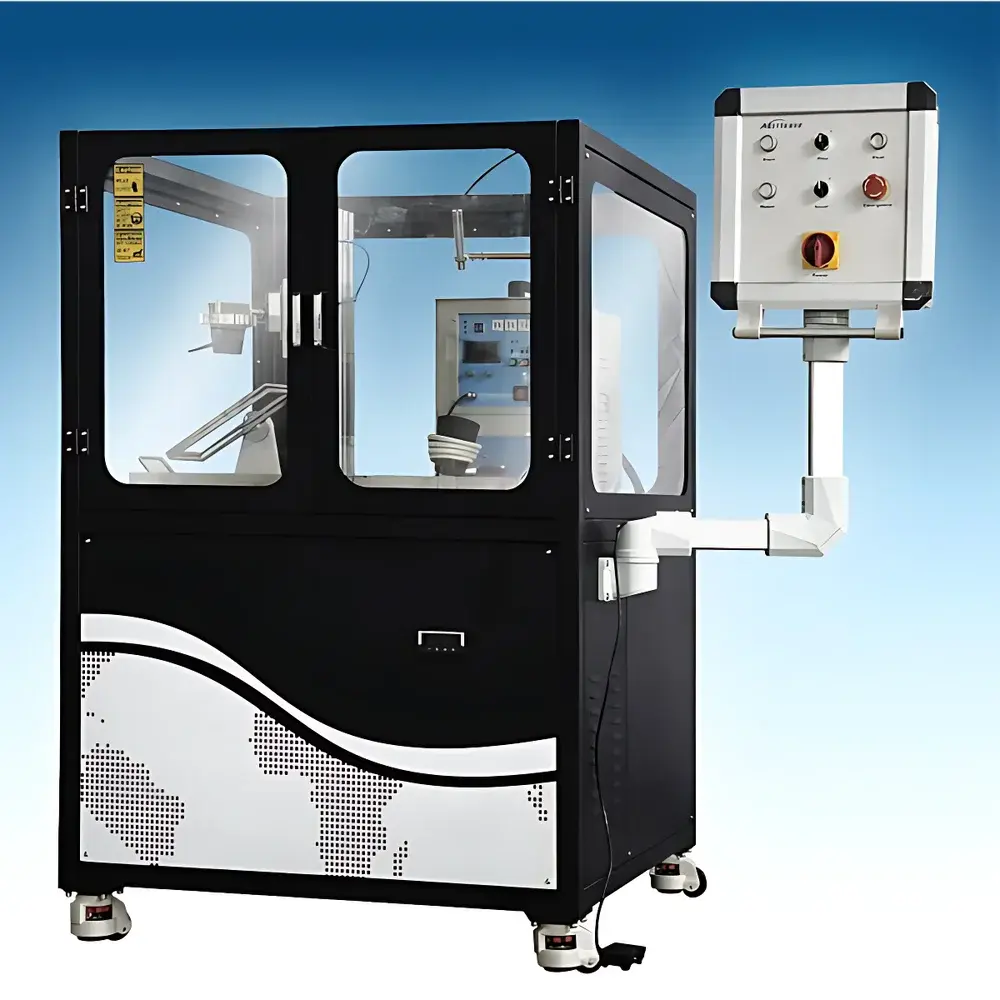
NYX MET Molten Metal Splash Resistance Tester
| Brand | NYX |
|---|---|
| Model | MET |
| Origin | Tianjin, China |
| Manufacturer | Yes |
| Type | Domestic |
| Price Range | USD 28,500 – 35,600 |
| Standards Compliance | EN 373, ISO 9185, EN 407, ISO 11612, GB 2811:2019, BS EN 397:2012, EN 14052:2012+A1:2012, GB/T 38306:2019 |
| PVC Film Spec | 300 ± 30 g/m² |
| Crucible Capacity | 190 mL |
| Crucible Dimensions | Ø80 mm (top), Ø56 mm (bottom), H = 97 mm |
| Melting Temperature Range | 700–1800 °C |
| IR Pyrometer Range | Up to 2400 °C, Accuracy ±1% |
| Tilt Mechanism | Stepper motor–controlled angle and speed |
| Cooling | Integrated recirculating water cooling system |
| Frame | Stainless steel sample holder with integrated PVC film mounting |
Overview
The NYX MET Molten Metal Splash Resistance Tester is a purpose-built physical property testing instrument engineered for quantitative evaluation of thermal barrier performance in personal protective equipment (PPE) against high-energy molten metal splashes. It operates on the principle of controlled, reproducible metal splash exposure—where precisely metered volumes of molten aluminum (Grade D) or molten iron (Grade E) are gravitationally directed onto inclined fabric or composite specimens under standardized thermal and geometric conditions. The test endpoint is determined not by direct specimen failure, but by secondary damage assessment: a standardized PVC film (300 ± 30 g/m²), placed in intimate contact with the specimen’s reverse side, captures heat transfer signatures—including blistering, melting, or perforation—providing an objective, traceable metric for thermal energy penetration. This methodology aligns with internationally recognized hazard simulation protocols defined in EN 373, ISO 9185, and ISO 11612, ensuring results are directly translatable to real-world occupational risk scenarios in foundries, metallurgical processing, and high-temperature welding environments.
Key Features
- High-temperature induction melting furnace with integrated high-frequency generator, capable of sustained operation up to 1800 °C—sufficient for full liquefaction of aluminum (660 °C), copper (1085 °C), and cast iron (1150–1200 °C).
- Calibrated far-infrared pyrometry system (range: 0–2400 °C, accuracy ±1% of reading) with real-time feedback to a programmable temperature controller, enabling precise stabilization and documentation of splash temperature prior to release.
- Motorized tilt mechanism with stepper-driven actuation ensures repeatable control over specimen inclination angle (typically 45° per EN 407) and consistent dynamic response during splash impact.
- Stainless steel sample frame assembly designed to rigidly secure both test specimen and PVC evaluation film in fixed, orthogonal alignment—minimizing positional variability across replicates.
- Water-cooled crucible mount and integrated recirculating chiller system maintain structural integrity of critical components during repeated high-heat cycles, extending service life and measurement stability.
- Modular crucible geometry (Ø80 mm top / Ø56 mm bottom / 97 mm height) optimized for 190 mL melt volume, supporting standardized mass delivery while minimizing thermal lag and oxidation artifacts.
Sample Compatibility & Compliance
The MET tester accommodates flat, rigid, or semi-rigid PPE materials including flame-resistant woven fabrics, laminated composites, aluminized textiles, and molded thermoplastic helmets per EN 14052 and BS EN 397. Specimen dimensions conform to ISO 11612 Annex B (minimum 200 × 200 mm) and EN 407 Clause 6.2. All test procedures strictly adhere to the pass/fail criteria and reporting requirements outlined in EN 373 (aluminum splash), ISO 9185 (iron splash), and GB/T 38306–2019 (Chinese national standard for molten metal resistance classification). Instrument validation includes documented calibration of pyrometer traceability to NIST-traceable blackbody sources, and tilt-angle verification via digital inclinometer. Full compliance documentation supports GLP-aligned laboratory audits and ISO/IEC 17025 accreditation workflows.
Software & Data Management
While the MET operates as a hardware-integrated benchtop system without embedded touchscreen software, it supports comprehensive data governance through external PC-based acquisition. Temperature profiles, tilt timing sequences, and ambient environmental logs (via optional USB-connected sensors) are exportable in CSV and PDF formats compliant with FDA 21 CFR Part 11 requirements when paired with validated third-party LIMS or ELN platforms. Audit trails record operator ID, test date/time, calibration status, and parameter overrides—enabling full traceability for regulatory submissions or internal quality reviews. Raw thermal imaging data (when used with optional IR camera integration) may be archived in DICOM or TIFF format for forensic reanalysis.
Applications
- Classification testing of heat-resistant gloves (EN 407:2020, Performance Level 1–4 for molten metal splash)
- Validation of aluminized face shields and hoods against radiant + convective heat coupling in arc-flash and foundry settings
- Material screening for ASTM F2703-compliant molten iron splash resistance in primary metal production PPE
- Developmental benchmarking of novel ceramic-coated textiles and aerogel-reinforced laminates
- Third-party certification testing per CNAS-accredited laboratories serving CE marking and CCC certification pathways
- Root-cause analysis of field-reported PPE failures through controlled replication of incident thermal profiles
FAQ
What metals can be tested with the MET system?
Aluminum (Grade D per EN 407), cast iron (Grade E), and other industrially relevant alloys—including copper, brass, and stainless steel melts—within the 700–1800 °C operational range.
Is the PVC film supplied with the instrument?
Yes—certified 300 ± 30 g/m² PVC film is provided as part of the standard consumables kit, with batch-specific certificate of conformance included.
How is temperature uniformity verified across the melt pool?
Pre-test verification is performed using dual-point pyrometric scanning; post-test residual melt analysis via thermocouple immersion (optional accessory) confirms thermal homogeneity within ±2% across the crucible cross-section.
Can the MET be integrated into an automated test cell?
Yes—the unit features RS-485 and TTL-level I/O ports for synchronization with robotic specimen handlers, safety interlocks, and centralized lab automation systems.
Does the system meet electromagnetic compatibility (EMC) requirements for industrial labs?
It complies with IEC 61326-1:2013 Class A emission limits and IEC 61000-4 series immunity standards, verified via third-party EMC testing report (available upon request).



