
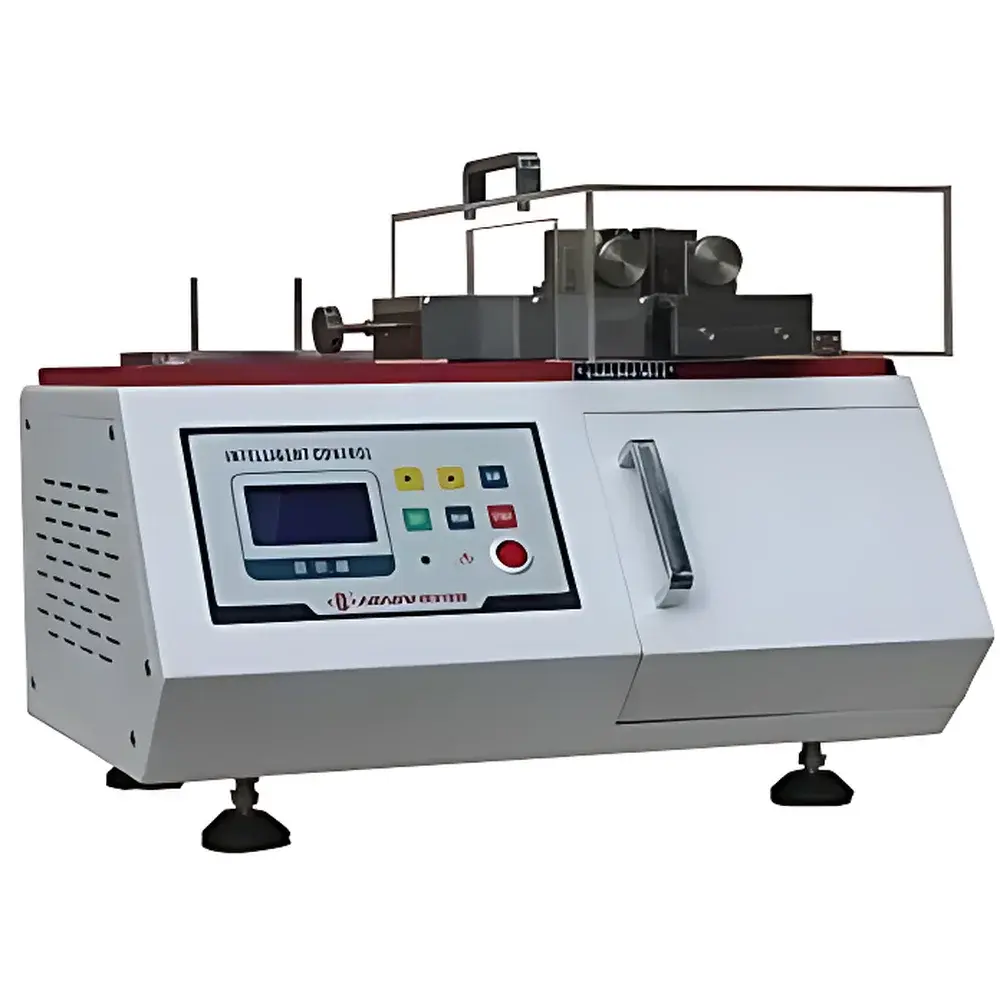
Scott Tester Abrasion and Flexing Tester HY-726
| Origin | Tianjin, China |
|---|---|
| Manufacturer Type | Authorized Distributor |
| Origin Category | Domestic (PRC) |
| Model | HY-726 |
| Price Range | USD 14,000 – 43,000 |
| Instrument Type | Specialty Flex-Abrasion Fatigue Tester |
| Maximum Test Load | 2000 g |
| Oscillation Frequency | 120 cycles per minute (cpm) |
| Net Weight | 60 kg |
| Specimen Mounting | Single specimen |
| Clamp Width | 45 mm |
| Max Clamp Spacing | 35 mm |
| Stroke Length | Adjustable up to 50 mm |
| Applied Load Range | 0.2–2.0 kg (via calibrated weights) |
| Load Application | Dead-weight loading with incremental mass sets |
| Display | 6-digit LCD digital counter |
| Power Supply | AC 220 V, 50 Hz |
Overview
The Scott Tester Abrasion and Flexing Tester HY-726 is a precision-engineered mechanical fatigue testing instrument designed to evaluate the resistance of flexible sheet materials to repetitive flexing, creasing, and surface abrasion under controlled compressive load and cyclic motion. Based on the standardized Scott-type (also known as “Sutherland” or “Scotch” type) reciprocating flex-abrasion principle, the device subjects a vertically clamped specimen to unidirectional oscillatory motion between two parallel, fixed-width jaws—simulating real-world mechanical degradation mechanisms such as folding, rubbing, and edge wear encountered in automotive interiors, protective apparel, medical packaging, and synthetic leather applications. Unlike high-frequency servo-hydraulic fatigue systems, the HY-726 employs a robust cam-driven mechanism delivering consistent 120 cpm motion with minimal harmonic deviation, ensuring high test-to-test reproducibility for comparative material screening and QC pass/fail assessment.
Key Features
- Compliance-ready mechanical architecture validated against GB/T 8948–2008 (PVC artificial leather), GB/T 8949–2008 (PU artificial leather), JIS L 1096 B-method (Scotch-type flex-abrasion), JIS K 6404-6, JASO M403, and GMW 3217 test protocols
- Adjustable stroke length (up to 50 mm) and clamp spacing (max 35 mm) to accommodate varying specimen geometry and deformation profiles
- Precision-machined 45 mm wide stainless-steel clamps with uniform pressure distribution and repeatable jaw alignment
- Calibrated dead-weight loading system (0.2–2.0 kg range) using traceable stainless-steel masses—eliminating spring hysteresis and enabling GLP-compliant load documentation
- 6-digit LCD digital cycle counter with non-volatile memory, supporting programmable test termination and batch-wise data logging
- Stable cast-iron base and vibration-dampened frame (60 kg total mass) minimizing resonance interference during extended-duration tests
Sample Compatibility & Compliance
The HY-726 accommodates flat, flexible specimens up to 45 mm wide and 1–3 mm thick—including coated textiles, laminated films, thermoplastic elastomers, napped synthetics, anodized polymer sheets, and composite leather substitutes. Its fixed single-specimen configuration ensures strict adherence to inter-laboratory standardization requirements. All mechanical tolerances align with ISO/IEC 17025 calibration traceability pathways when used with NIST-traceable weights and verified displacement gauges. The tester supports full audit trails for GMP-relevant environments when integrated with external lab notebooks or LIMS via manual entry of cycle counts, load values, and visual failure criteria (e.g., cracking, delamination, fiber pilling, coating transfer).
Software & Data Management
The HY-726 operates as a stand-alone electromechanical platform with no embedded firmware or proprietary software. All operational parameters—including cycle count, applied load, and test duration—are manually recorded and entered into laboratory documentation systems. This design eliminates cybersecurity vulnerabilities associated with connected instruments and satisfies regulatory expectations for deterministic, human-verified data acquisition under FDA 21 CFR Part 11 Annex 11 and EU GMP Annex 11 where electronic records require supplementary signature workflows. Optional accessories include calibrated reference specimens, wear-rating comparison charts (per JIS L 1096 visual grading scale), and certified calibration certificates issued by accredited third-party metrology labs.
Applications
- Quality control of automotive trim materials (door panels, seat covers, headliners) per GMW 3217 and JASO M403
- Evaluation of medical glove and isolation gown substrate integrity under repeated donning/doffing stress
- Comparative ranking of synthetic leather durability for footwear and furniture manufacturing
- Validation of waterproof membrane adhesion strength in technical outerwear laminates
- Pre-screening of printed flexible electronics substrates for flex-circuit reliability
- Regulatory submission support for ISO 10993-10 biocompatibility assessments involving physical degradation endpoints
FAQ
What standards does the HY-726 directly support?
GB/T 8948–2008, GB/T 8949–2008, JIS L 1096 B-method, JIS K 6404-6, JASO M403, and GMW 3217.
Can multiple specimens be tested simultaneously?
No—the HY-726 is configured for single-specimen evaluation to ensure strict compliance with referenced standard methodologies.
Is the stroke length adjustable during operation?
Yes; stroke is manually set prior to test initiation using a calibrated micrometer-adjustment mechanism—no tools required.
Does the unit include calibration documentation?
Factory calibration verification is provided; full ISO/IEC 17025-certified calibration requires optional third-party service.
What maintenance is required for long-term repeatability?
Biannual lubrication of cam shaft and clamp pivot points using ISO VG 32 mineral oil; periodic verification of weight set accuracy and clamp parallelism.



