
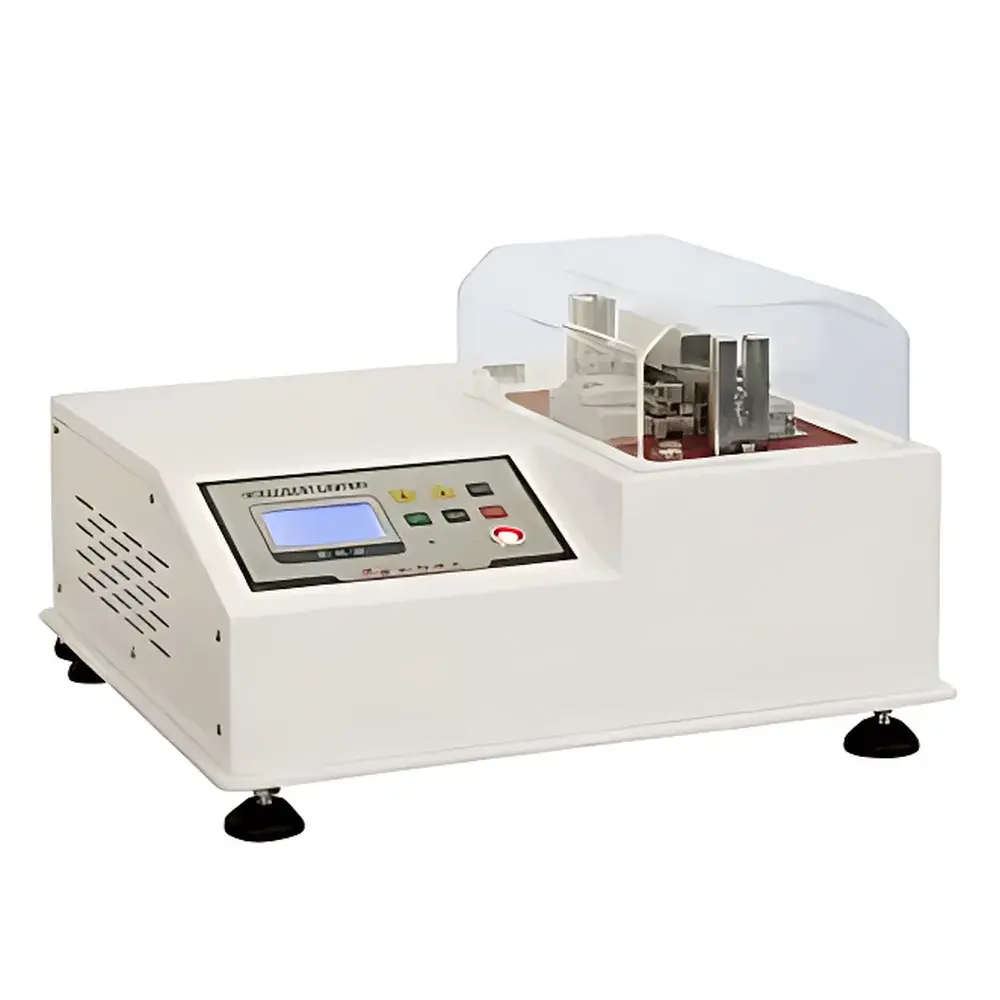
ISO 5981 Flex Abrasion Tester HY-727
| Origin | Tianjin, China |
|---|---|
| Manufacturer Type | Authorized Distributor |
| Origin Category | Domestic (PRC) |
| Model | HY-727 |
| Price Range | USD 140–4,300 |
| Standards Compliance | ISO 5981, CITIOEN D42 1007, EASC 9904 0180-A08 (Rev. 3.25) |
| Specimen Capacity | 1 test specimen per cycle |
| Clamp Spacing | 12.0 ± 0.3 mm |
| Pressure Plate Dimensions | (100.0 ± 1.0) × (10.0 ± 0.2) mm |
| Applied Loads | 5.0 ± 0.1 N and 10.0 ± 0.2 N (dual-weight configuration) |
| Stroke Distance | 40.0 ± 1.0 mm |
| Frequency Range | 144–180 cycles/min (2.4–3.0 Hz) |
| Display | 6-digit LCD interface |
| Overall Dimensions | 385 × 500 × 225 mm (W × D × H) |
| Power Supply | AC 220 V, 50 Hz |
Overview
The HY-727 ISO 5981 Flex Abrasion Tester is a precision-engineered instrument designed to evaluate the resistance of coated textile substrates—particularly polyurethane-coated fabrics—to repeated bending and surface shear under controlled mechanical stress. Based on the principle of cyclic flexural deformation coupled with tangential frictional contact, the tester subjects specimens to quantifiable, reproducible bending fatigue while maintaining defined load, stroke, and frequency parameters. This method simulates real-world service conditions where flexible coated materials undergo repeated creasing, folding, or dynamic flexing—such as in protective workwear, automotive upholstery, medical textiles, or technical outdoor gear. The device operates in strict accordance with ISO 5981:2004 (“Textiles — Determination of resistance to flex abrasion of coated fabrics”), as well as supplementary specifications including CITIOEN D42 1007 and EASC 9904 0180-A08 (Revision 3.25), ensuring alignment with international quality assurance frameworks for coated fabric performance validation.
Key Features
- Two standardized test modes: Method A (pressure plate loading) and Method B (non-loaded interfacial friction), enabling comparative evaluation of shear-dominated versus bending-dominated wear mechanisms.
- Dual-load capability with calibrated weights (5.0 ± 0.1 N and 10.0 ± 0.2 N) for graded stress application—critical for assessing threshold failure points across material thicknesses and coating adhesion strengths.
- Precision-machined pressure plate (100.0 ± 1.0 mm × 10.0 ± 0.2 mm) with parallel alignment control ensures uniform force distribution across the bend zone.
- Fixed clamp spacing of 12.0 ± 0.3 mm guarantees consistent bending radius and strain localization—minimizing variability between replicate tests.
- Adjustable oscillation frequency (144–180 cycles/min; 2.4–3.0 Hz) with digital LCD interface (6-digit resolution) supports both accelerated screening and extended durability profiling.
- Robust aluminum-alloy frame and low-inertia drive mechanism ensure long-term mechanical stability and minimal thermal drift during extended operation.
Sample Compatibility & Compliance
The HY-727 accommodates single-specimen testing of coated fabrics—including thermoplastic polyurethane (TPU), polyvinyl chloride (PVC), silicone-impregnated textiles, and elastomeric laminates—with nominal thicknesses up to 2.5 mm. Specimens may be preconditioned per relevant protocols (e.g., ISO 139 for atmospheric conditioning, ISO 6330 for domestic laundering simulation, or ASTM D3935 for accelerated aging) prior to abrasion exposure. Test reporting complies with ISO/IEC 17025 documentation requirements, supporting traceability to national metrology institutes (NIM, CNAS). The instrument’s mechanical design and operational repeatability meet the minimum performance criteria specified in ISO 5981 Annex B for inter-laboratory reproducibility (RSD ≤ 8.5% for coating integrity loss at 5,000 cycles).
Software & Data Management
While the HY-727 operates via embedded microcontroller-based logic without proprietary PC software, its 6-digit LCD interface logs total cycle count, elapsed time, and selected load mode—enabling manual entry into LIMS or ELN platforms compliant with 21 CFR Part 11 (when paired with validated electronic record procedures). Cycle counters retain values through power interruption, and all parameter settings are non-volatile. For laboratories implementing GLP or GMP workflows, optional external data loggers (RS-232 or USB TTL interface compatible) can be integrated to capture timestamped cycle progression, facilitating audit-ready trend analysis and deviation investigation.
Applications
- Quality control of PU-coated synthetic leathers used in footwear and handbag manufacturing.
- Validation of coating adhesion strength in flame-retardant (FR) treated technical textiles for industrial PPE.
- Comparative assessment of flex-abrasion resistance between solvent-based and waterborne polyurethane systems.
- Pre-release testing of medical barrier fabrics subjected to repeated donning/doffing cycles.
- Supporting R&D efforts in developing high-flexibility smart textiles with embedded conductive coatings.
- Conformance verification for OEM specifications requiring ISO 5981 pass/fail thresholds (e.g., ≥10,000 cycles without coating cracking or delamination).
FAQ
What standards does the HY-727 fully support?
The instrument is mechanically and functionally aligned with ISO 5981:2004, CITIOEN D42 1007, and EASC 9904 0180-A08 (3.25), including all dimensional tolerances, load accuracy, and motion profile requirements.
Can the HY-727 perform both Method A and Method B per ISO 5981?
Yes—Method A utilizes the calibrated pressure plate and deadweight loading system; Method B omits the plate and relies solely on specimen-to-specimen contact under fixed clamp geometry.
Is calibration certification included with delivery?
A factory calibration report (traceable to CNAS-accredited reference standards) is provided; annual recalibration using NIST-traceable force and displacement gauges is recommended.
What maintenance is required for long-term reliability?
Monthly inspection of clamp alignment, periodic lubrication of cam follower bearings (using ISO VG 32 mineral oil), and biannual verification of weight mass tolerance (±0.2%) constitute the core preventive maintenance protocol.
Does the unit comply with electrical safety directives for export to EU markets?
The HY-727 meets IEC 61010-1:2010 requirements for laboratory equipment; CE marking is available upon request with accompanying DoC and EMC test reports.






