
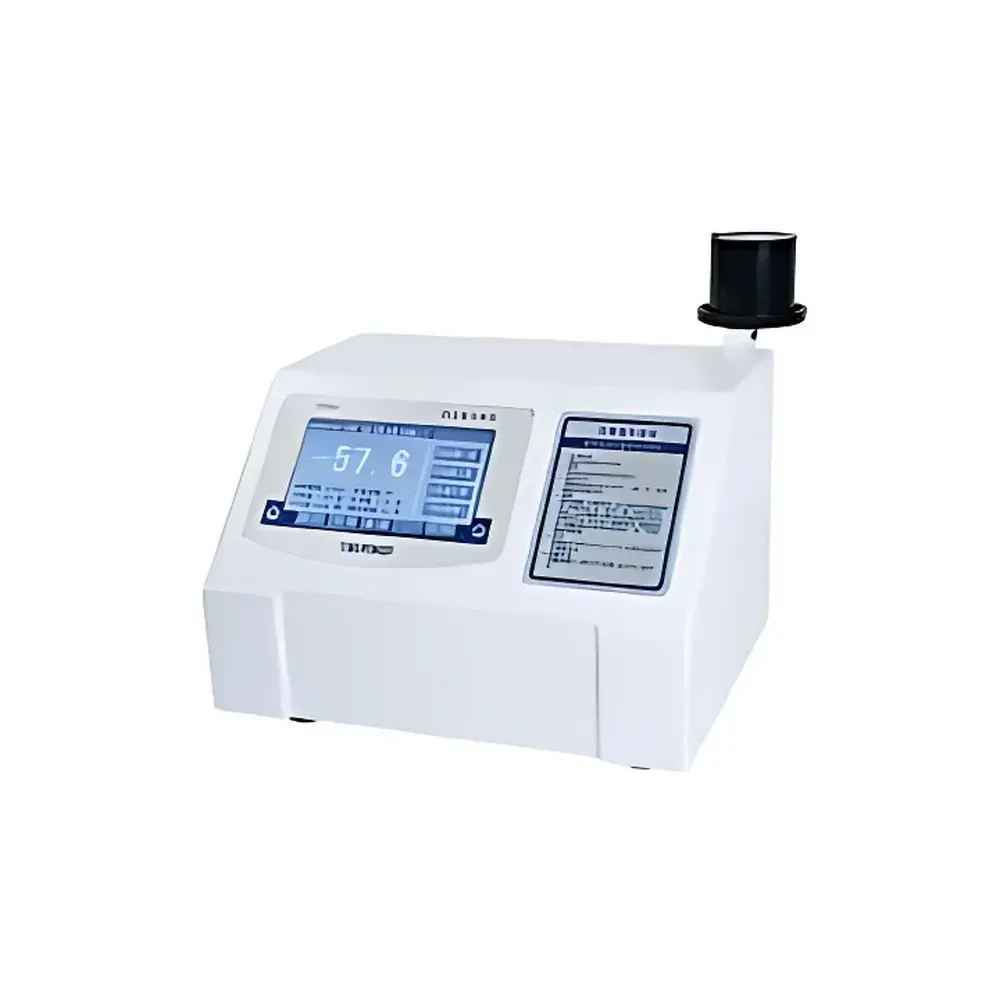
TimePower TP304 Iron Content Analyzer
| Brand | TimePower |
|---|---|
| Origin | Beijing, China |
| Manufacturer Type | Direct Manufacturer |
| Country of Origin | Domestic (China) |
| Model | TP304 |
| Pricing | Upon Request |
Overview
The TimePower TP304 Iron Content Analyzer is a benchtop photometric analyzer engineered for trace-level quantification of dissolved ferrous (Fe²⁺) and total iron (Fe) in ultra-pure water matrices critical to power generation and industrial steam-water cycles. It operates on the principle of visible-light spectrophotometry—specifically, the formation of a stable colored complex between iron ions and 1,10-phenanthroline under controlled pH and reducing conditions, followed by absorbance measurement at 510 nm. This method conforms to established analytical frameworks including ASTM D1068 (Standard Test Methods for Iron in Water) and ISO 6332 (Water quality — Determination of iron — 1,10-phenanthroline spectrophotometric method). The instrument is purpose-built for continuous monitoring and periodic verification of iron concentration in boiler feedwater, condensate, steam, generator stator cooling water, drum boiler water, and natural surface/groundwater sources—where sub-ppb to low-ppb iron control is essential to prevent corrosion product deposition, turbine fouling, and exfoliation in high-pressure thermal systems.
Key Features
- Integrated optical architecture featuring a precision-calibrated imported cold LED light source (510 nm nominal peak), delivering exceptional signal stability, low thermal drift, and >50,000-hour operational lifetime.
- High-density surface-mount PCB design with embedded microcontroller unit (MCU), enabling deterministic real-time signal processing, low-power standby mode (<5 W), and immunity to electromagnetic interference typical in plant environments.
- 5.0-inch capacitive touch TFT-LCD display with native Chinese UI—optimized for field technicians operating in control rooms or sampling labs without requiring English fluency.
- Onboard automatic timing sequence for colorimetric reaction development, eliminating manual stopwatch dependency and ensuring consistent incubation intervals per ASTM D1068 Section 9.3.
- Dual-point calibration protocol: zero-point blank compensation (using high-purity deionized water from mixed-bed resin systems) and full-scale span adjustment—minimizing baseline drift from photodiode aging or ambient temperature fluctuations (5–45 °C operating range).
- Circular data buffer supporting up to 256 measurement records with timestamp, auto-rollover overwrite logic, and USB export capability for offline QA/QC review.
Sample Compatibility & Compliance
The TP304 accepts aqueous samples with turbidity <1 NTU and suspended solids <1 mg/L. It requires pretreatment via membrane filtration (0.45 µm) for turbid or particulate-laden streams such as raw river water. All reagents—including 1,10-phenanthroline, hydroxylamine hydrochloride, and sodium acetate buffer—must meet ACS-grade or higher purity and be stored in certified polyethylene containers to prevent trace metal leaching. The analyzer complies with GLP documentation requirements for calibration log retention, user-accessible audit trails, and operator ID tagging (via optional firmware upgrade). While not FDA 21 CFR Part 11–certified out-of-the-box, its data export structure (CSV/ASCII) supports integration into validated LIMS platforms used in regulated utility QA laboratories.
Software & Data Management
No proprietary PC software is bundled; however, the device exports time-stamped datasets via USB mass-storage emulation. Each record includes: date/time stamp, measured absorbance (mAU), calculated iron concentration (µg/L), calibration status flag, and operator ID (if manually entered). Firmware supports configurable alarm thresholds (e.g., >15 µg/L for feedwater action limits) with visual alert on screen and optional dry-contact relay output (add-on module). Data integrity is preserved through non-volatile flash memory with write-cycle protection—ensuring no loss during AC power interruption.
Applications
- Real-time surveillance of iron ingress in once-through and drum-type boiler feedwater circuits (target: ≤5 µg/L per EPRI guidelines).
- Routine analysis of condensate polishing system effluent to verify resin exhaustion onset.
- Commissioning validation of steam cycle cleanliness prior to turbine roll-in (ASTM D4627).
- Corrosion monitoring in closed-loop generator cooling water systems where magnetite dispersion correlates directly with Fe concentration trends.
- Baseline iron profiling in reservoir intake water to inform coagulant dosing and pretreatment optimization.
FAQ
What is the required water purity for blank calibration?
Deionized water must be generated from a mixed-bed ion exchange system achieving resistivity ≥15 MΩ·cm at 25 °C—equivalent to ASTM Type I reagent water.
How often must calibration be performed?
A blank calibration is mandatory daily; a full multi-point calibration curve using certified iron standards (0, 10, 50, 100 µg/L) is recommended every 14 days or after reagent batch change.
Can the TP304 measure both Fe²⁺ and total Fe?
Yes—total iron requires prior reduction of Fe³⁺ to Fe²⁺ using hydroxylamine hydrochloride; ferrous-only measurement omits this step and relies on immediate complexation.
Is the instrument suitable for outdoor deployment?
It is rated for indoor laboratory or control room use only (IP20 enclosure); ambient humidity must remain below 90% RH without condensation.
What consumables are required for routine operation?
1,10-Phenanthroline reagent kit, hydroxylamine hydrochloride, sodium acetate buffer, high-purity calibration standards (NIST-traceable), and disposable sample cups (polypropylene, low-metal extractables).
Related Products




