
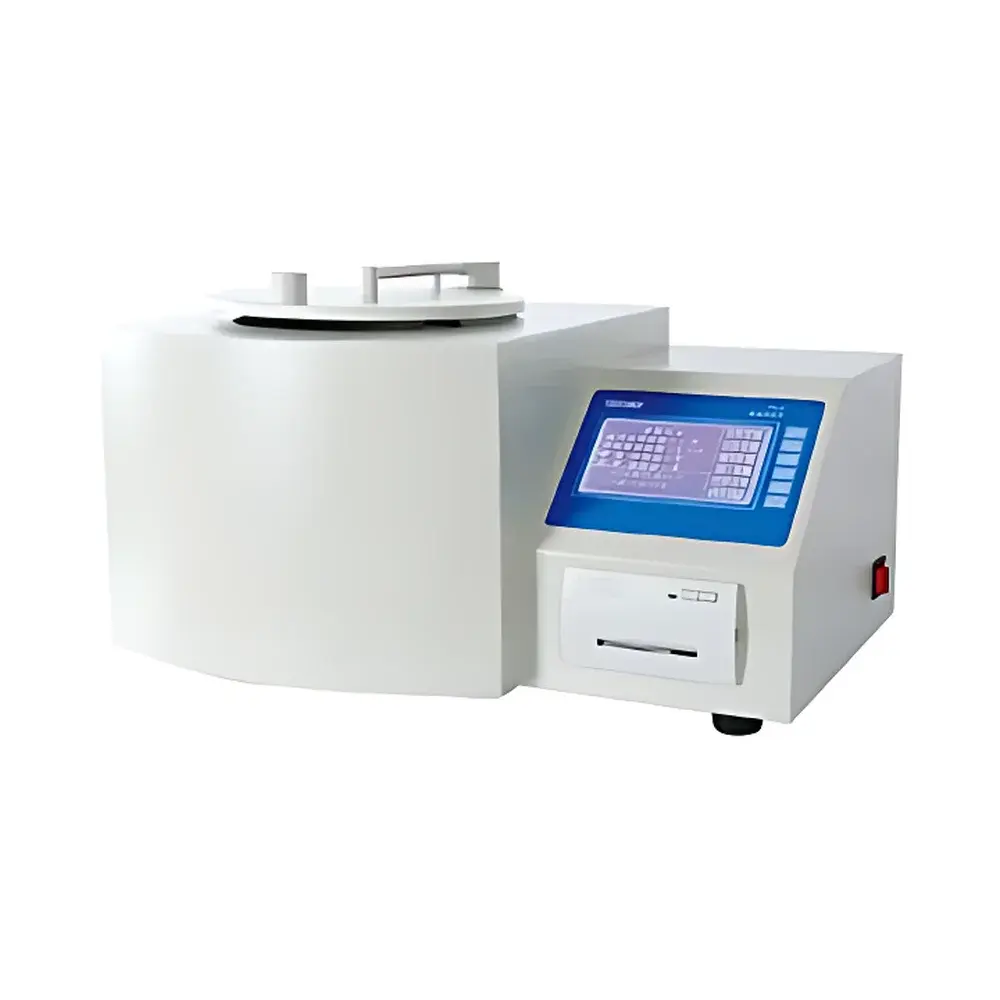
Timepower TP532 Acid Number Analyzer
| Brand | Timepower |
|---|---|
| Model | TP532 |
| Origin | Beijing, China |
| Manufacturer Type | Direct Manufacturer |
| Product Origin | Domestic (China) |
| Measurement Principle | Potentiometric Endpoint Detection via Laser Photometry |
| Measurement Method | ASTM D664 / GB/T 258–2016 Neutralization Titration |
| Measurement Range | 0.0001–0.9999 mg KOH/g |
| Resolution | 0.0001 mg KOH/g |
| Accuracy | ±0.01 mg KOH/g (for acid number < 0.1 mg KOH/g) |
| Repeatability | 0.02 mg KOH/g (0–0.1), 0.05 mg KOH/g (0.1–0.5), 0.07 mg KOH/g (0.5–1.0), 0.1 mg KOH/g (1.0–2.0) |
| Sample Capacity | 6 positions |
| Power Consumption | ≤60 W (operational), ≤100 W (peak) |
| Operating Temperature | 5–35 °C |
| Relative Humidity | ≤80% RH (non-condensing) |
| Display | LCD with tactile membrane keypad |
| Printer | Impact dot-matrix printer |
| Power Supply | AC 220 V ±10%, 50 Hz ±10% |
| Dimensions (W×D×H) | 480 × 340 × 200 mm |
| Net Weight | 12.5 kg |
| Control System | Dual-CPU microprocessor architecture |
| Optical Sensor | Imported low-power laser diode (long-life, stable output) |
| Automation Level | Fully automated extraction, titration, cup rotation, endpoint detection, and reporting |
Overview
The Timepower TP532 Acid Number Analyzer is an automated potentiometric titration system engineered for precise determination of total acid number (TAN) in petroleum-based and bio-derived liquid fuels and lubricants. It implements the standardized neutralization titration method per ASTM D664 (electrode-based) and GB/T 258–2016 (colorimetric endpoint detection), adapted here with a high-stability optical endpoint recognition subsystem. A collimated laser beam is directed onto the reaction mixture during titration; as the indicator—typically p-naphtholbenzein or similar—changes from yellow to green at the stoichiometric endpoint, the absorbance shift induces a measurable photodiode signal change. This optoelectronic transduction enables robust, operator-independent endpoint detection without manual color interpretation. The instrument is specifically designed for routine quality control and condition monitoring in power generation, refinery QC labs, turbine oil maintenance programs, and academic research on fuel oxidation stability.
Key Features
- Fully automated workflow: integrated solvent extraction (toluene–isopropanol), reagent delivery (KOH in ethanol), magnetic stirring, cup indexing (6-position carousel), optical endpoint detection, and report generation.
- Dual-CPU embedded control architecture ensures deterministic timing, fault-tolerant operation, and real-time coordination between fluidic, optical, and thermal subsystems.
- Imported laser diode optical sensor with calibrated photodetector array—designed for minimal thermal drift and >50,000-hour operational lifetime under continuous duty cycles.
- No physical buttons: sealed membrane keypad with backlight LCD interface supports multilingual menu navigation (English default) and intuitive parameter configuration.
- Onboard impact dot-matrix printer provides permanent, tamper-evident hardcopy reports including sample ID, date/time stamp, measured TAN value, repeatability flag, and operator code (if configured).
- Compliant with ISO/IEC 17025 documentation requirements: full audit trail of calibration events, reagent lot tracking, and user login logs (with optional password-protected admin mode).
Sample Compatibility & Compliance
The TP532 is validated for use with mineral oils, synthetic lubricants, phosphate ester-based anti-wear fluids (e.g., turbine control fluids), biodiesel (B100), biodiesel blends (B5–B20), and aviation turbine fuels. It meets the functional equivalence of ASTM D974 (color-indicator titration) and supports method adaptation to ASTM D664 when paired with optional pH electrode module (sold separately). All hardware and firmware comply with IEC 61010-1:2010 safety standards for electrical equipment in laboratory use. Data integrity safeguards align with FDA 21 CFR Part 11 expectations—including electronic signature capability, non-erasable audit trails, and role-based access control—making it suitable for GLP and GMP-regulated environments.
Software & Data Management
The analyzer operates via embedded firmware with no external PC dependency. Measurement data are stored internally (≥1,000 test records) with timestamp, environmental conditions (ambient temperature/humidity), reagent batch IDs, and endpoint curve metadata. USB host port enables export of CSV-formatted datasets to external drives for LIMS integration or statistical process control (SPC) analysis. Optional Timepower LabLink software (Windows-based) provides remote instrument monitoring, custom report templates (PDF/XLS), trend charting across multiple instruments, and automated compliance reporting for ISO 9001 internal audits.
Applications
- Condition-based maintenance of steam and gas turbine lubricants in power plants—tracking acid buildup as an early indicator of oxidation degradation.
- Quality assurance of new and reclaimed insulating oils used in transformers and switchgear per IEEE C57.106.
- Biodiesel producers’ conformance testing to EN 14214 and ASTM D6751 specifications for maximum allowable TAN (≤0.50 mg KOH/g).
- R&D laboratories studying hydrolytic stability of ester-based synthetic lubricants under accelerated aging protocols.
- Third-party testing labs performing certified reference material (CRM) verification and interlaboratory comparison studies.
FAQ
What titration method does the TP532 implement?
It uses a modified colorimetric endpoint detection based on ASTM D974, enhanced with laser photometry for objective, reproducible endpoint identification—eliminating subjectivity inherent in visual titration.
Can the instrument be used for samples with high water content?
No. Samples must be anhydrous or pre-dried per ASTM D6304; residual water interferes with indicator solubility and endpoint sharpness.
Is calibration traceable to NIST standards?
Yes. Certified potassium hydrogen phthalate (KHP) reference standards and NIST-traceable KOH titrant solutions are recommended for daily system verification and calibration.
How often should the acid value pump tubing be replaced?
Under typical usage (20 tests/day), replace every 6 months; extended exposure to alkaline ethanol accelerates elastomer degradation—inspect weekly for cracking or swelling.
Does the system support regulatory audit requirements?
Yes. Full electronic record retention, user authentication, and immutable audit logs satisfy GLP, ISO/IEC 17025, and FDA 21 CFR Part 11 data integrity mandates.




