
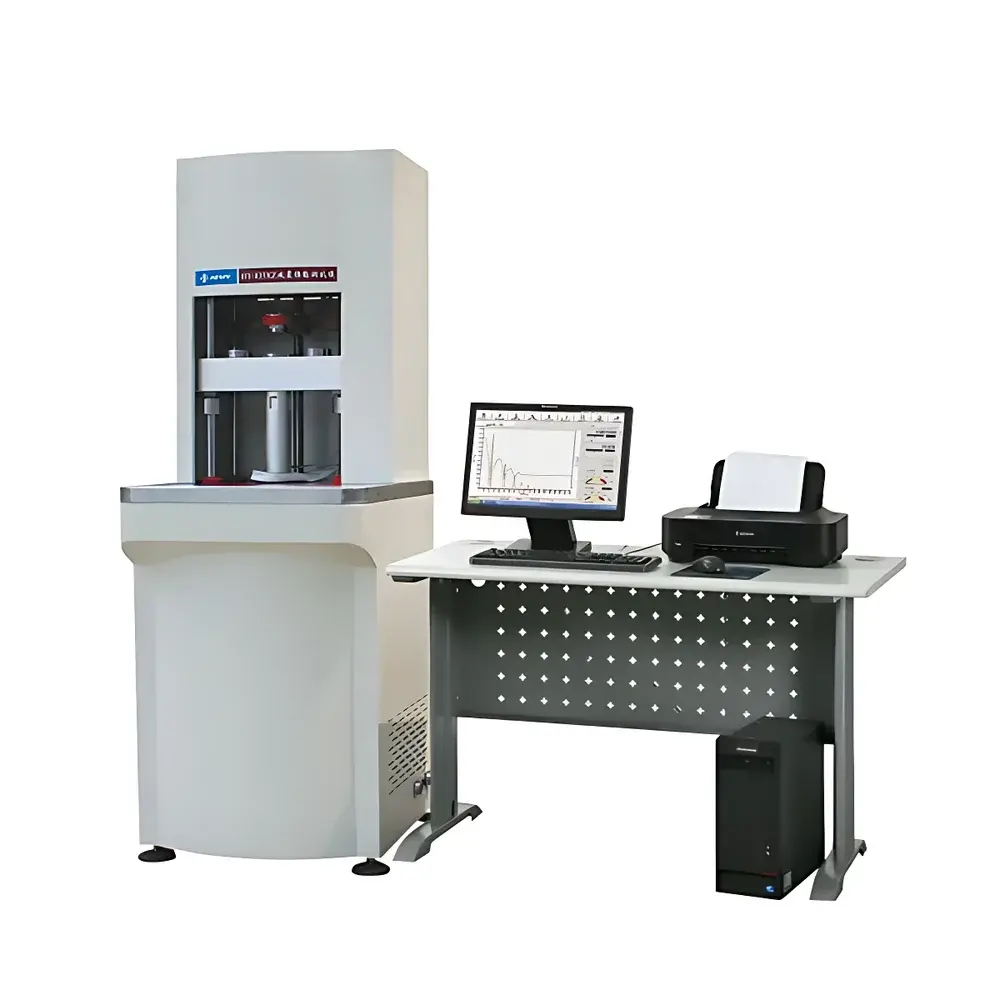
NYX HY-835XZ GB/T 30907 Shock Absorption Testing Machine
| Brand | NYX |
|---|---|
| Origin | Tianjin, China |
| Manufacturer Type | Direct Manufacturer |
| Product Category | Domestic |
| Model | HY-835XZ |
| Price Range | USD 20,000–25,500 |
| Instrument Type | Specialized Vertical Free-Fall Impact Tester |
| Nominal Impact Energy | 2000 J |
| Impact Velocity | 10 m/s |
| Pendulum Moment (Impact Constant) | 0.14 N·m/(J)¹ᐟ² |
| Force Sensor Range | 0–999 N |
| Maximum Lifting Height | 1 m |
| Drop Height Adjustment Range | 0–200 mm |
| Standardized Test Mass | 8.5 kg (impact head + integrated load cell) |
| Impact Head Geometry | Circular top, Ø45 mm, tip radius R = 1.0 ± 0.25 mm, mass < 0.2 kg |
| Displacement Measurement Range | 0–100 mm |
| Sampling Frequency | >1000 Hz |
| Cycle Time | ≤3 s per test (2 s drop + 1 s reset) |
Overview
The NYX HY-835XZ GB/T 30907 Shock Absorption Testing Machine is an electromechanically controlled vertical free-fall impact system engineered for precise quantification of dynamic energy absorption and force–displacement response in footwear midsoles, protective footwear components, and elastomeric damping materials. It operates on the principle of gravitational acceleration, where a calibrated mass (8.5 kg total, including integrated load cell and impact head) is elevated to a user-defined height (0–200 mm), released, and allowed to strike a horizontally mounted specimen under repeatable boundary conditions. The machine conforms to the mechanical test methodology specified in GB/T 30907—Chinese National Standard for “Footwear—Test Methods for Shock Absorption Performance”—and supports parallel validation against GB/T 24152 (sports footwear), FZ/T 74006–2017 (athletic shoe functional testing), and GB/T 20991 (equivalent to EN ISO 20344 for safety footwear). Its design emphasizes metrological traceability, mechanical rigidity, and temporal resolution, enabling high-reproducibility acquisition of transient impact curves critical for material qualification, product development, and regulatory compliance.
Key Features
- Computer-controlled vertical drop mechanism with programmable lift height (0–200 mm) and automatic release sequence
- Integrated high-fidelity force sensor (0–999 N range) and linear displacement transducer (0–100 mm), both sampled at >1000 Hz for synchronized force–displacement capture
- Standardized impact head geometry: Ø45 mm circular contact surface with R = 1.0 ± 0.25 mm tip radius; mass < 0.2 kg ensures minimal inertial distortion during deceleration phase
- Rigid C-frame structural architecture with vibration-damped base plate to minimize parasitic resonance and ensure signal integrity
- Dual-mode energy calibration: fixed-height drop for standardized 5 J / 7 J (athletic footwear) and 50 J (safety footwear) protocols, plus variable-height configuration for custom energy input up to 2000 J
- Real-time waveform visualization and post-test parameter extraction (peak force, maximum deformation, energy absorption ratio, hysteresis loss, rebound coefficient)
Sample Compatibility & Compliance
The HY-835XZ accommodates flat or contoured midsole specimens (up to 150 mm × 100 mm footprint) and full-assembly footwear units mounted on standardized test fixtures. Specimen clamping is non-deforming and adjustable to maintain consistent contact area and boundary constraint across test series. The system complies with the mechanical and procedural requirements of GB/T 30907, GB/T 24152, FZ/T 74006–2017, and GB/T 20991 (EN ISO 20344). While not certified to ASTM F2413 or ISO 20344 by default, its measurement methodology is technically aligned with Clause 6.4 (Impact Resistance) and Annex B (Energy Absorption Testing) of those standards. All hardware and software configurations support GLP-compliant documentation workflows, including audit-trail-enabled test logs, operator ID tagging, and timestamped raw data export (CSV, ASCII).
Software & Data Management
The proprietary high-speed control and analysis suite runs on Windows-based industrial PCs and provides real-time synchronization of force, displacement, and time channels. Software modules include automated test sequencing (predefined energy levels, height presets, cycle counts), live waveform overlay, and batch processing for comparative analysis across material lots or design iterations. Data output includes peak load (N), max compression (mm), absorbed energy (J), residual deformation (mm), and normalized energy return ratio (%). Export formats comply with laboratory information management system (LIMS) ingestion requirements: CSV with header metadata, XML for structured reporting, and PDF test certificates with digital signature support. Audit trails record all parameter modifications, calibration events, and user actions in accordance with FDA 21 CFR Part 11 principles for electronic records.
Applications
- Quantitative evaluation of EVA, PU, TPU, and thermoplastic rubber midsole compounds under dynamic compression
- Comparative shock absorption benchmarking between competing athletic shoe models per ISO/GB sportswear performance criteria
- Regulatory pre-certification testing for safety footwear manufacturers targeting GB/T 20991 or EN ISO 20344 compliance
- R&D validation of novel damping architectures (e.g., lattice structures, multi-density foams, fluid-filled bladders)
- Quality control screening of incoming raw materials and finished midsole stock prior to assembly
- Failure mode analysis via force–displacement hysteresis loop characterization under repeated impact loading
FAQ
What standards does the HY-835XZ directly support?
It is fully configured to execute test protocols defined in GB/T 30907, GB/T 24152, FZ/T 74006–2017, and GB/T 20991 (equivalent to EN ISO 20344).
Can the system be used for non-footwear applications?
Yes—its modular fixture interface and programmable drop parameters allow adaptation for testing polymer gels, packaging cushioning, orthopedic insoles, and other viscoelastic materials requiring controlled impact response characterization.
Is calibration traceable to national metrology institutes?
Force and displacement sensors are supplied with factory calibration certificates traceable to CNAS-accredited laboratories; optional annual recalibration services include NIM (National Institute of Metrology, China) traceability documentation.
Does the software support multi-user access with role-based permissions?
Yes—administrator, technician, and viewer roles can be assigned with configurable access rights to test methods, calibration settings, and report generation modules.
What maintenance intervals are recommended?
Mechanical inspection and guide rail lubrication every 500 test cycles; annual verification of sensor linearity, drop height repeatability (±0.2 mm), and timing accuracy (±1 ms) is advised for GLP/GMP environments.



