
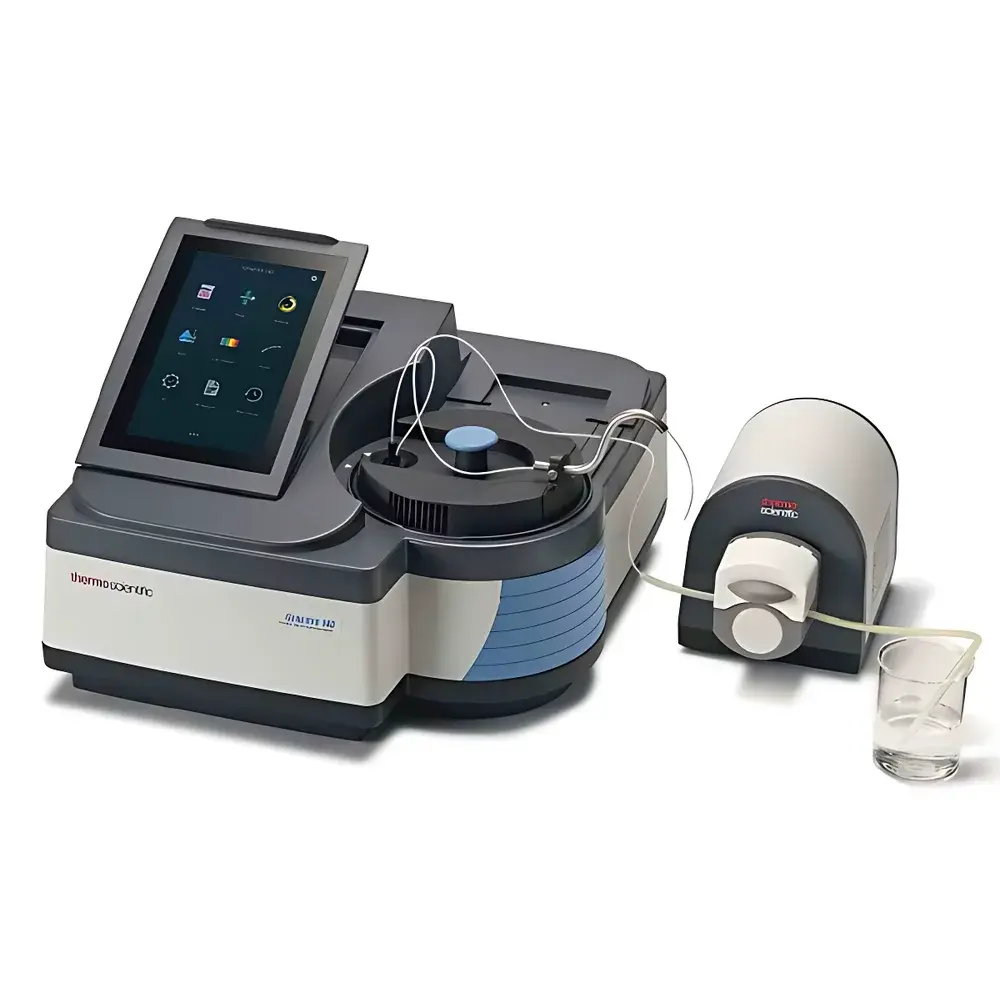
Thermo Fisher GENESYS 180 UV-Vis Spectrophotometer
| Brand | Thermo Fisher |
|---|---|
| Origin | USA |
| Distributor Type | Authorized Distributor |
| Import Status | Imported |
| Model | GENESYS 180 |
| Instrument Architecture | Double-Beam |
| Detector Type | Photodiode Array (PDA) |
| Wavelength Range | 190–1100 nm |
| Wavelength Scanning Mode | Automatic |
| Spectral Bandwidth | 2 nm |
| Wavelength Accuracy | ±0.5 nm |
| Stray Light | <1.0%T at 198 nm (KCl), <0.05%T at 220 nm (NaI), <0.03%T at 340 nm (NaNO₂) |
Overview
The Thermo Fisher GENESYS 180 UV-Vis Spectrophotometer is a high-performance, double-beam scanning spectrophotometer engineered for precision absorbance, transmittance, and concentration measurements across the ultraviolet, visible, and near-infrared spectral regions (190–1100 nm). Its optical architecture employs a stable xenon flash lamp source—eliminating warm-up delays and enabling true instantaneous measurement—paired with a high-resolution photodiode array (PDA) detector for rapid full-spectrum acquisition in under one second. The double-beam design continuously corrects for source intensity drift and environmental fluctuations by simultaneously monitoring reference and sample beams, ensuring exceptional baseline stability and measurement reproducibility—particularly critical for kinetic assays, multi-point calibration, and long-duration time-course experiments. Designed for integration into regulated laboratory environments, the instrument complies with fundamental requirements of ISO/IEC 17025 and supports documentation practices aligned with GLP and GMP frameworks.
Key Features
- Xenon flash lamp illumination: No preheating required; enables immediate start-up and reduces lamp aging effects over time.
- Double-beam optical path with real-time reference correction: Minimizes photometric drift and enhances data fidelity during extended runs.
- 2 nm spectral bandwidth: Optimized for resolution and signal-to-noise balance across diverse sample matrices.
- Wavelength accuracy of ±0.5 nm certified per NIST-traceable standards: Ensures metrological confidence for method validation and regulatory submissions.
- Low stray light performance: <0.03%T at 340 nm (NaNO₂), supporting accurate quantitation of highly absorbing samples and high-dynamic-range applications.
- Integrated 8-cell autosampler carousel: Facilitates unattended sequential analysis of standards and unknowns without manual intervention.
- Fiber-optic coupling capability: Enables remote, non-contact measurements via optional fiber probes—ideal for hazardous, temperature-sensitive, or physically inaccessible samples.
Sample Compatibility & Compliance
The GENESYS 180 accommodates standard 10 mm pathlength cuvettes as well as microvolume, flow-through, and solid-sample accessories. Its modular design supports seamless integration with Thermo Fisher’s Peltier temperature-controlled cell holders (±0.1 °C stability), automated liquid handlers, and intelligent pipetting modules for volumetric precision down to 1 µL. All hardware and firmware meet electromagnetic compatibility (EMC) requirements per IEC 61326-1 and safety standards per IEC 61010-1. While not inherently 21 CFR Part 11-compliant out-of-the-box, the instrument operates within validated software environments (e.g., Thermo Scientific INSIGHT Software v3.x+) that support audit trails, electronic signatures, and user-access controls when deployed under appropriate IT governance protocols.
Software & Data Management
Controlled via Thermo Scientific INSIGHT Software, the GENESYS 180 delivers intuitive method setup, real-time spectral visualization, kinetic profiling, and quantitative analysis with built-in calibration curve fitting (linear, quadratic, cubic, and non-linear models). Data export conforms to ASTM E1381 and ASTM E1489 standards, generating CSV, XML, and JCAMP-DX files compatible with LIMS and ELN platforms. Version-controlled method templates, password-protected user roles, and timestamped operation logs facilitate traceability. Raw spectral data are stored with metadata including lamp usage hours, wavelength calibration history, and detector gain settings—enabling retrospective verification and instrument performance trending.
Applications
- Pharmaceutical QC: Assay of active pharmaceutical ingredients (APIs) per USP and EP 2.2.25.
- Environmental analysis: Nitrate, phosphate, and heavy metal speciation using EPA-approved colorimetric methods (e.g., EPA 365.3, EPA 366.1).
- Life sciences: Protein quantification (Bradford, BCA), nucleic acid purity assessment (A260/A280), and enzyme kinetics (e.g., NADH oxidation at 340 nm).
- Materials science: Thin-film thickness estimation via interference fringe analysis and bandgap determination in semiconductor nanomaterials.
- Food & beverage: Colorimetric determination of antioxidants (e.g., DPPH assay), preservative content (sorbates, benzoates), and Maillard reaction products.
FAQ
Does the GENESYS 180 support GLP-compliant data handling?
Yes—when used with INSIGHT Software configured for audit trail logging, user authentication, and electronic signature enforcement, it meets core GLP data integrity expectations.
Can the instrument perform kinetic measurements without a dedicated accessory?
Yes—the integrated double-beam architecture and fast PDA readout enable native kinetic acquisition at user-defined intervals from 0.1 s to 60 min per point.
Is wavelength calibration traceable to NIST standards?
Yes—factory calibration uses NIST-traceable holmium oxide and didymium filters; users may perform periodic verification using supplied reference standards.
What is the maximum scan speed for full-spectrum acquisition?
Full 190–1100 nm scans are completed in ≤0.8 seconds at 1 nm data interval, with configurable resolution down to 0.1 nm.
Are fiber-optic probes validated for quantitative use?
Fiber-optic configurations require system-specific validation per ICH Q2(R2); Thermo Fisher provides probe characterization reports and application notes to support method development.





