
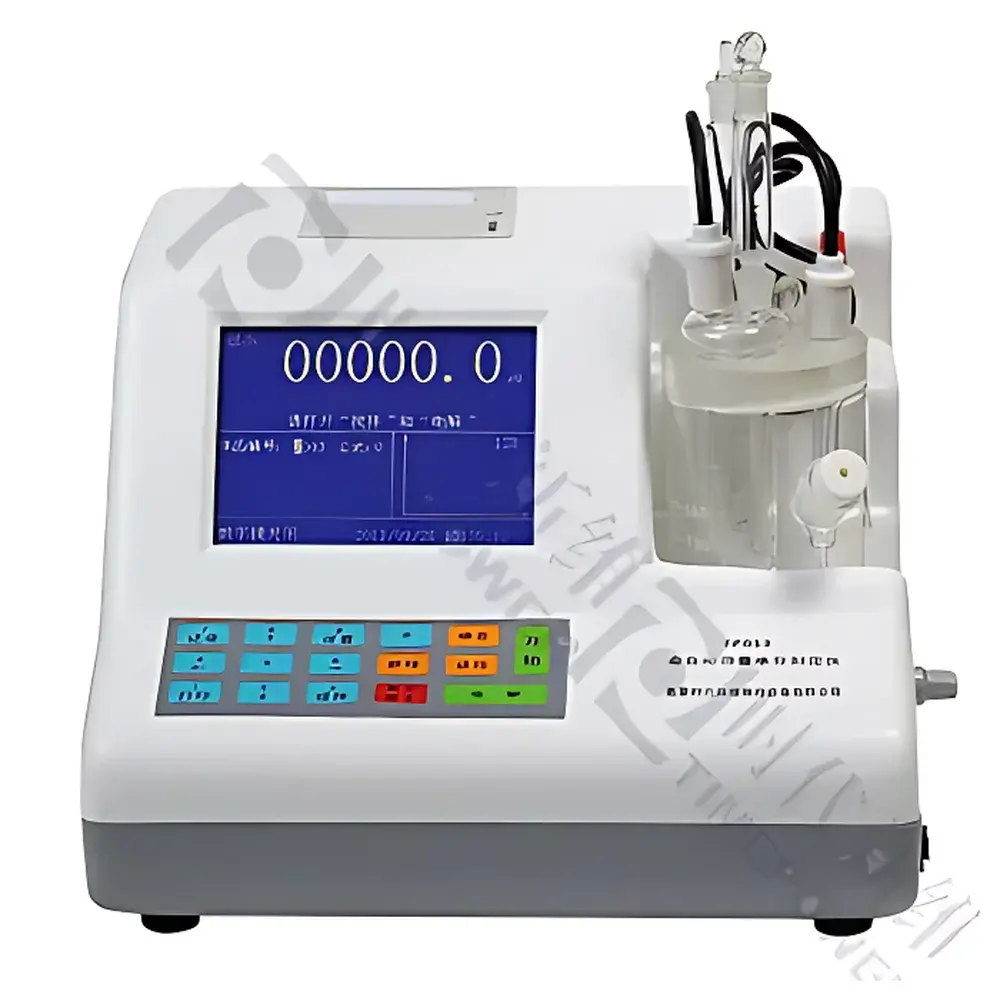
Timepower TP653 Intelligent Karl Fischer Coulometric Moisture Analyzer
| Brand | Timepower |
|---|---|
| Origin | Beijing, China |
| Manufacturer | Timepower Measurement & Control Co., Ltd. |
| Model | TP653 |
| Titration Method | Coulometric Karl Fischer |
| Electrolysis Current Range | 0–400 mA |
| Water Measurement Range | 3 µg – 100 mg |
| Resolution | 0.1 µg |
| Accuracy | ±20% at 3 µg H₂O |
| Display | Chinese-language LCD |
| Printer | Thermal, 36-character, Chinese-capable |
| Operating Temperature | 5–40 °C |
| Power Supply | AC 220 V ±10%, 50 Hz ±10% |
| Power Consumption | <40 W |
| Dimensions | 300 × 290 × 200 mm |
| Weight | 3.7 kg |
| Compliance | GB/T 1600, GB/T 7600, GB/T 683, GB/T 11133, SH/T 0246, SH/T 0255 |
Overview
The Timepower TP653 Intelligent Karl Fischer Coulometric Moisture Analyzer is a precision laboratory instrument engineered for trace water quantification in liquid and soluble solid samples using the coulometric Karl Fischer titration principle. Unlike volumetric KF systems, the TP653 generates iodine electrochemically within the titration cell via controlled current application—ensuring stoichiometric accuracy, minimal reagent consumption, and exceptional sensitivity down to 0.1 µg of water. This method eliminates calibration drift associated with burette delivery and delivers high reproducibility for low-moisture matrices (<100 ppm), making it suitable for quality control in pharmaceutical excipients, hygroscopic active pharmaceutical ingredients (APIs), battery-grade solvents, transformer oils, and high-purity monomers. The analyzer operates under strict adherence to internationally recognized standard test methods—including ASTM D6304 (equivalent to GB/T 11133), ASTM D1364 (GB/T 7600), and IEC 60814 (for insulating oils)—and supports full auditability required under GLP and GMP environments.
Key Features
- 32-bit embedded microprocessor with real-time operating system for deterministic response and stable algorithm execution
- Coulometric titration architecture with dual-circuit balanced electrolysis, minimizing polarization effects and enhancing endpoint detection fidelity
- Integrated baseline compensation algorithm that dynamically corrects for background current drift during prolonged analysis sessions
- Hermetically sealed, moisture-resistant electrolytic cell design with optimized electrode geometry—reducing equilibration time to <60 seconds and extending electrolyte service life by up to 40%
- Automated reagent dispensing and waste evacuation system, eliminating manual pipetting and reducing operator exposure to toxic KF reagents
- Real-time graphical display of electrolysis current vs. time, enabling visual verification of reagent activity and endpoint stability
- Large backlit LCD interface with intuitive Chinese-language navigation and six programmable calculation formulas for custom moisture reporting (e.g., % w/w, ppm, mg/kg)
- Durable engineering plastic enclosure resistant to chemical splashes and mechanical impact—rated IP20 for laboratory benchtop use
- Onboard non-volatile memory storing ≥1,000 measurement records with timestamp, sample ID, result, and method parameters
Sample Compatibility & Compliance
The TP653 accommodates a broad spectrum of organic and inorganic matrices, including but not limited to alcohols (methanol, ethanol), hydrocarbons (n-hexane, toluene), chlorinated solvents (chloroform, dichloromethane), esters (ethyl acetate), ethers (THF, dioxolane), carboxylic acids, amines, and halogenated hydrocarbons. It is validated for use with samples conforming to GB/T 1600 (pesticide formulations), GB/T 7600 (electrical insulating oils), SH/T 0246 (light petroleum products), and SH/T 0255 (additive-containing lubricants). All firmware logic and data handling comply with ALCOA+ principles (Attributable, Legible, Contemporaneous, Original, Accurate, Complete, Consistent, Enduring, Available) as interpreted in FDA 21 CFR Part 11 Annex 11 contexts. Audit trails are retained with user login metadata and immutable timestamps.
Software & Data Management
While the TP653 operates as a standalone unit, its RS-232 serial interface enables bidirectional communication with LIMS or laboratory informatics platforms. Exported data includes raw current-time curves, calculated water mass (µg), normalized concentration (ppm or %), method identifier, operator ID, and environmental temperature at time of analysis. Internal storage maintains full traceability without requiring external software—each record is digitally signed upon finalization and cannot be edited post-confirmation. Optional PC-based configuration utility (Windows 10/11 compatible) allows method cloning, report template customization, and firmware updates—all logged in the device’s internal audit trail.
Applications
- Pharmaceutical QC: Residual moisture testing in lyophilized powders, tablet granulations, and solvent residues per USP <921>
- Electrical industry: Water content assessment in transformer and turbine oils per IEC 60814 and ASTM D1533
- Petrochemical R&D: Quantification of trace water in biofuels, jet fuels, and synthetic lubricants prior to oxidation stability testing
- Agrochemical manufacturing: Moisture verification in pesticide concentrates and emulsifiable concentrates (ECs) per GB/T 1600
- Electrolyte formulation: Critical control of H₂O in Li-ion battery electrolytes where <20 ppm is mandatory for SEI layer integrity
- Chemical synthesis: In-process monitoring of dehydration reactions and solvent drying efficiency
FAQ
What is the difference between coulometric and volumetric Karl Fischer titration?
Coulometric KF generates iodine electrochemically at the anode in precise stoichiometric proportion to applied charge (1 mole I₂ ≡ 2 × 96,485 C), ideal for samples containing ≤1000 µg water. Volumetric KF delivers pre-standardized iodine solution from a burette—better suited for higher water concentrations (>1000 µg) but subject to burette calibration drift.
Does the TP653 support compliance with 21 CFR Part 11?
The device meets foundational requirements—including electronic signatures, audit trails, and data integrity controls—but requires integration with a validated third-party LIMS or ELN to achieve full Part 11 compliance for regulated submissions.
Can the TP653 analyze solid or viscous samples?
Yes—when dissolved or suspended in approved KF-compatible solvents (e.g., chloroform/methanol mixtures) per GB/T 11133 Annex B protocols. Direct solid injection is not supported; sample homogeneity and dissolution kinetics must be verified per method validation.
How often should the electrolyte be replaced?
Under typical usage (≤10 analyses/day), the dual-compartment electrolyte remains stable for ≥3 weeks. Replacement is indicated when baseline current exceeds 5 µA or endpoint slope degrades beyond ±15% of initial calibration.
Is calibration verification required before each analysis?
No—coulometric systems do not require daily standardization. However, periodic verification using certified water standards (e.g., 1.00 ± 0.02 mg H₂O in 100 µL methanol) is recommended every 24 hours or after 20 samples, per ISO/IEC 17025 clause 7.7.
Related Products







