
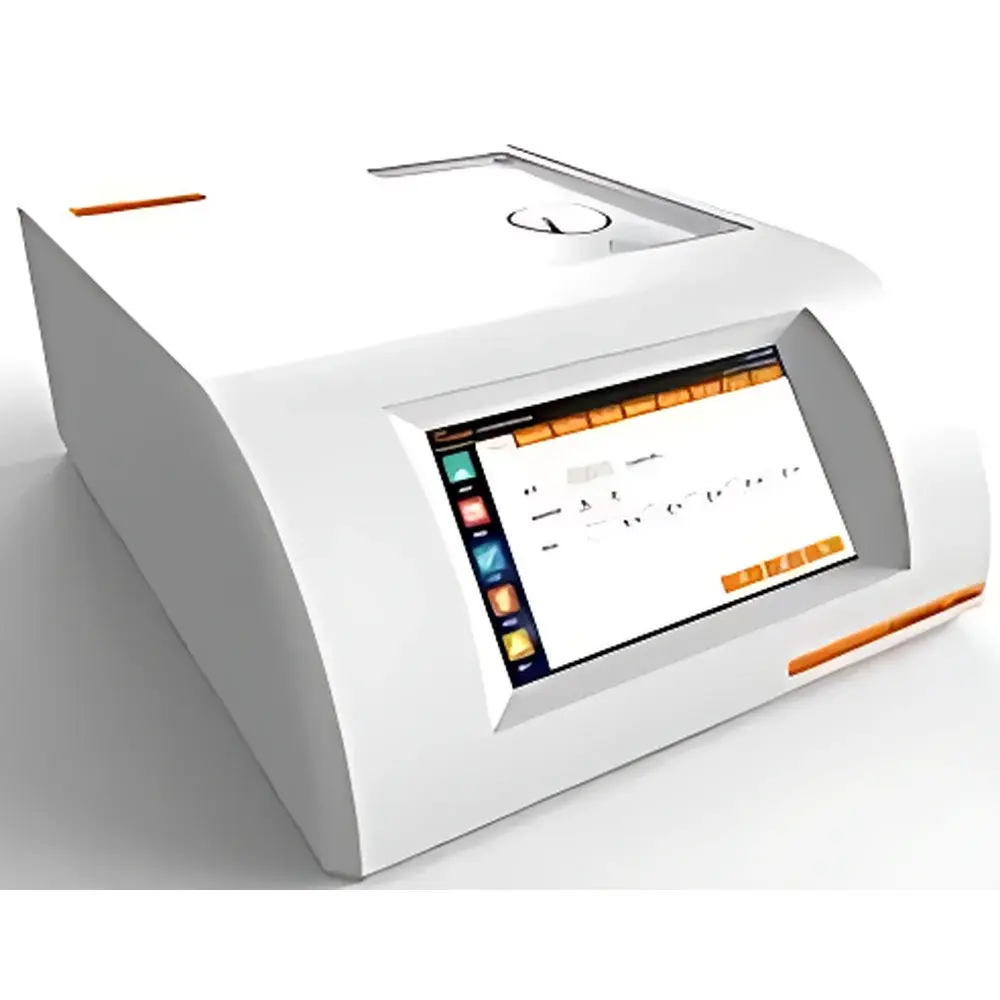
Hanon A670 Automated Digital Refractometer
| Brand | Hanon |
|---|---|
| Origin | Shandong, China |
| Model | A670 |
| Instrument Type | Benchtop Refractometer |
| Temperature Control | Peltier-based, 5–70 °C (±0.05 °C accuracy) |
| Display | 7-inch TFT color touchscreen |
| Measurement Range | 1.30000–1.70000 (nD) |
| Accuracy | ±0.0001 (nD) |
| Resolution | 0.0001 / 0.00001 (nD) selectable |
| Brix Range | 0–100.0% |
| Brix Accuracy | ±0.1% |
| Brix Resolution | 0.1% / 0.01% selectable |
| Light Source | High-intensity LED (>100,000 h lifetime) |
| Detector | High-resolution CCD array |
| Prism Material | Sapphire-grade optical glass |
| Data Storage | 4 GB internal + cloud-enabled |
| Interfaces | 2× USB, RS232, Ethernet, SD card slot, U-disk port |
| Compliance | Fully compliant with FDA 21 CFR Part 11 (audit trail, electronic signatures, data integrity) |
Overview
The Hanon A670 Automated Digital Refractometer is a precision benchtop instrument engineered for high-accuracy refractive index (nD) and Brix measurements in regulated and research-intensive laboratory environments. It operates on the principle of total internal reflection at the sample-prism interface, where a collimated LED beam is directed onto a sapphire-grade prism surface; the critical angle of reflection is detected by a high-resolution CCD sensor and converted into refractive index values via calibrated optical algorithms. Temperature-dependent measurements are stabilized using an integrated Peltier thermoelectric module, enabling precise thermal control from 5 °C to 70 °C with ±0.05 °C stability—critical for reproducibility across ISO 21748, ASTM D1218, and USP compliant workflows. Designed for routine QC/QA in pharmaceutical, food & beverage, chemical, and petrochemical laboratories, the A670 delivers traceable, auditable results without manual interpolation or operator-dependent alignment.
Key Features
- Integrated Peltier temperature control system with real-time feedback loop ensures measurement consistency across thermal gradients—eliminating external water baths and reducing cycle time by up to 40% compared to passive thermostatted units.
- Sapphire-grade measurement prism offers exceptional hardness (Mohs 9), chemical inertness, and scratch resistance—enabling aggressive cleaning with solvents (e.g., acetone, chloroform) without degradation of optical performance over >100,000 measurement cycles.
- High-sensitivity CCD detector coupled with a stabilized, long-life LED light source (≥100,000 h MTBF) enables automated critical-angle detection with sub-microradian resolution, supporting both nD and Brix quantification in a single measurement sequence.
- 7-inch capacitive touchscreen running a Windows-based embedded OS provides intuitive one-touch operation, contextual help overlays, and multi-language UI support (English, German, French, Chinese)—reducing operator training time and minimizing input errors.
- Onboard 4 GB flash memory supports ≥500,000 result records with full metadata (timestamp, user ID, method name, temperature, instrument ID); all entries timestamped and cryptographically hashed to prevent post-acquisition modification.
- Hardware-enforced 21 CFR Part 11 compliance includes role-based access control (three-tier user hierarchy), electronic signature capture with biometric or token-assisted authentication, and immutable audit trails with granular event logging (login/logout, parameter change, data export, calibration).
Sample Compatibility & Compliance
The A670 accommodates a broad spectrum of liquid samples—including transparent, translucent, deeply colored (e.g., crude oil fractions, caramelized syrups), and highly viscous media (up to 20,000 cP)—without dilution or filtration. Its wide dynamic range (nD: 1.30000–1.70000) covers applications from aqueous electrolytes and ethanol-water blends to aromatic hydrocarbons and polymer solutions. The instrument conforms to international standards including ISO 2859-1 (sampling plans), ISO/IEC 17025:2017 (calibration traceability to NIST SRM 1412a), and pharmacopeial requirements under USP , EP 2.2.6, and JP 2.05. All factory calibrations are documented with uncertainty budgets per GUM (JCGM 100:2008) and accompanied by UKAS-accredited certificates upon request.
Software & Data Management
Data integrity is maintained through dual-path storage architecture: local 4 GB NAND flash (with automatic wear leveling and ECC correction) and optional secure cloud synchronization via TLS 1.3–encrypted HTTPS endpoints. Raw measurement logs include full spectral trace data (angle vs. intensity), temperature profiles, and environmental metadata. Export formats include CSV (for LIMS integration), PDF reports with digital signatures, and XML structured for ELN systems (e.g., LabArchives, Benchling). The embedded software supports method templates with configurable pass/fail limits, statistical process control (SPC) charts (X-bar/R), and automated report generation with company branding and regulatory headers. Remote firmware updates are digitally signed and verified prior to installation to ensure supply-chain security.
Applications
- Pharmaceutical QC: Excipient concentration verification (e.g., glycerin, propylene glycol), solvent purity screening (IPA, ethanol), and API solution density correlation.
- Food & Beverage: Brix determination in fruit juices, soft drinks, and honey; sugar inversion monitoring in syrup production; alcohol content estimation in fortified wines.
- Petrochemical Analysis: Hydrocarbon blend characterization (naphtha, kerosene), lubricant base oil classification, and biodiesel (FAME) purity assessment.
- Chemical Manufacturing: Quality release testing of ethylene glycol, diethylene glycol, and polyol solutions; reaction endpoint detection in esterification processes.
- Academic Research: Thermodynamic modeling of binary/multicomponent mixtures, refractive index–composition correlations, and temperature-dependent dispersion studies.
FAQ
Does the A670 support GLP/GMP-compliant audit trails?
Yes—the instrument generates timestamped, immutable audit logs covering all user actions, parameter modifications, calibration events, and data exports. Logs are retained for ≥10 years and exportable in tamper-evident PDF/A format.
Can the sapphire prism be recalibrated in-house?
No—prism calibration is performed at the factory using NIST-traceable refractive index standards (SRM 1412a, 1414b). Field verification is supported via certified reference liquids; full recalibration requires return to authorized service centers.
Is network connectivity mandatory for 21 CFR Part 11 compliance?
No—Part 11 compliance is fully functional in standalone mode. Cloud connectivity enhances data redundancy and remote oversight but does not affect local audit trail generation or electronic signature validity.
What Brix accuracy is achieved for high-viscosity samples like molasses?
±0.1% Brix is maintained across viscosity ranges up to 15,000 cP when using the optional sample spreader accessory to ensure uniform film thickness and eliminate air bubble artifacts.
How frequently must the instrument be recalibrated?
Annual calibration is recommended per ISO/IEC 17025. However, daily verification with two-point standard check (e.g., distilled water + sucrose reference) is required in GxP environments and logged in the audit trail.




