
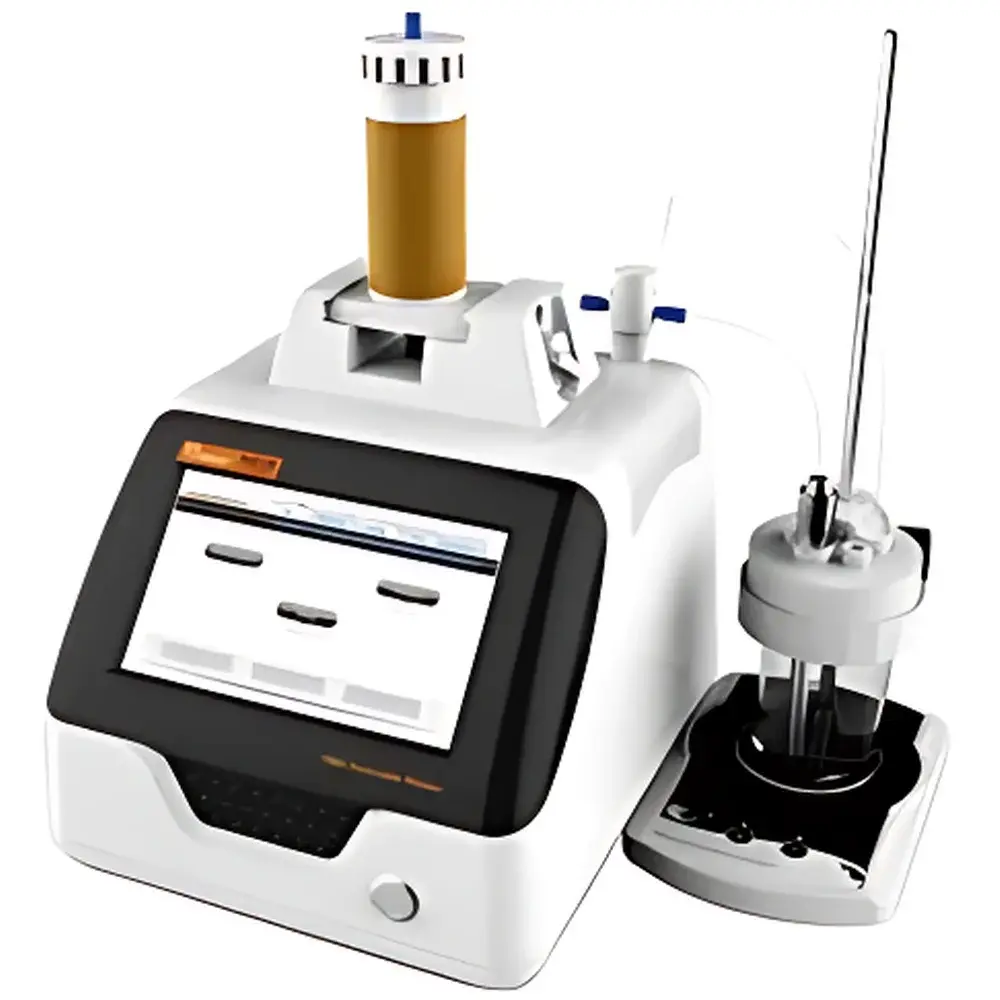
Hanon T860 Fully Automatic Potentiometric Titrator
| Brand | Hanon |
|---|---|
| Origin | Shandong, China |
| Model | T860 |
| Instrument Type | General-purpose Potentiometric Titrator |
| Application Scope | Universal |
| Measurement Range | ±1,999 mV / 0.00–14.00 pH |
| Potentiometric Accuracy | ±0.2 mV / ±0.02 pH |
| Resolution | 0.1 mV / 0.01 pH |
| Titration Repeatability | ≤0.2% |
| Temperature Measurement Range | 0–100 °C (PT1000) |
| Resolution | 0.1 °C |
| Max Error | ±0.2 °C |
| Burette Capacities | 15 mL (±0.025 mL tolerance), 25 mL (±0.035 mL tolerance) |
| Display | 7-inch color TFT touchscreen |
| Power Supply | 110–240 V AC, 50/60 Hz |
| Weight | 10 kg |
Overview
The Hanon T860 Fully Automatic Potentiometric Titrator is a precision laboratory instrument engineered for high-reproducibility volumetric analysis based on potentiometric endpoint detection. It operates on the fundamental principle of monitoring potential change (mV) or pH shift across a redox, acid–base, precipitation, or complexometric titration reaction, enabling objective and operator-independent endpoint determination. Designed for compliance with standard analytical workflows in quality control, research, and regulatory environments, the T860 integrates three core functional modules—titration drive unit, electrochemical measurement unit, and intelligent control system—into a unified, modular architecture. Its dual-burette configuration (15 mL and 25 mL), combined with closed-loop volume delivery control and real-time potential feedback, ensures consistent reagent dispensing and robust endpoint recognition under varying sample matrices. The system supports both classical equivalence-point detection and user-defined endpoint criteria (e.g., fixed mV/pH threshold, first-derivative maxima, or inflection-based algorithms), making it suitable for routine testing as well as method development in pharmaceutical, food, environmental, and chemical laboratories.
Key Features
- Zero-dead-volume solenoid valves and PTFE-compatible fluidic pathways minimize carryover and enable rapid, tool-free burette tube replacement;
- Closed-loop titrant delivery system with real-time volume verification, achieving ≤0.2% volumetric repeatability per titration cycle;
- High-resolution burette drive mechanism calibrated to ±0.005 mm positional accuracy, supporting precise micro-dispensing down to 0.01 mL increments;
- Modular mechanical design with detachable magnetic stirrer unit—featuring ultra-thin profile and optimized coil geometry for uniform vortex formation in 100 mL titration vessels;
- 7-inch capacitive TFT touchscreen interface with intuitive icon-driven navigation, multi-language support (English, Chinese, Spanish), and context-sensitive help;
- Universal power supply (110–240 V AC, 50/60 Hz) certified to IEC 61010-1 for safe operation across global laboratory infrastructures;
- Dual independent electrode ports (pH/mV sensing + reference) plus dedicated PT1000 temperature input for automatic temperature compensation in thermally sensitive titrations.
Sample Compatibility & Compliance
The T860 accommodates a broad range of aqueous and non-aqueous samples compatible with standard glass pH electrodes, redox (Pt), silver (Ag/AgCl), and ion-selective electrodes. Its 100 mL titration cup capacity and adjustable stir speed (100–1,200 rpm) ensure homogeneous mixing for suspensions, viscous solutions, and heterogeneous reaction systems. The instrument complies with key international standards governing electrochemical instrumentation, including ISO 8655-3 (burette performance), ASTM E2087 (potentiometric titration practice), and USP (acid–base titrimetry). All measurement data—including raw mV/pH traces, derivative curves, titrant volume logs, and calibration records—are timestamped and stored with audit trail capability, supporting GLP and GMP-aligned documentation requirements. While not natively 21 CFR Part 11 compliant out-of-the-box, the system’s data export architecture (CSV, PDF, XML) enables integration with validated LIMS or ELN platforms for electronic signature and retention workflows.
Software & Data Management
Embedded firmware provides five standardized titration modes: MEAS (real-time mV/pH monitoring), CAL (multi-point pH calibration with NIST-traceable buffers), SET (fixed endpoint mode), MET (fixed-volume addition), and AUTO (dynamic endpoint search). Users may define custom methods via the onboard editor—including conditional logic (e.g., “if ΔpH > 0.5 within 30 s, pause and recalculate”), pre-titration conditioning steps, and post-endpoint stabilization protocols. Data are displayed in synchronized dual-axis plots (volume vs. mV/pH; volume vs. dE/dV), with on-screen curve fitting and manual endpoint override. All results—including mean, SD, RSD, and confidence intervals for replicate runs—are auto-calculated. Raw datasets and method files export directly via USB to external storage or networked printers. Firmware updates are delivered via secure HTTPS download and verified using SHA-256 checksums.
Applications
- Acid–base titrations: Total acidity in wines, dairy products, and edible oils (AOAC 973.05, ISO 9200); free fatty acid quantification;
- Oxidation–reduction titrations: Iron(II) determination in pharmaceuticals (USP ), iodometric analysis of vitamin C, permanganate titrations;
- Precipitation titrations: Chloride content in water (ISO 9297), halide analysis in polymers and catalysts;
- Complexometric titrations: Calcium and magnesium hardness in drinking water (ISO 6059), EDTA-based metal ion assays in electroplating baths;
- Non-aqueous titrations: Weak base analysis in acetic anhydride media (e.g., amine content in epoxy resins).
FAQ
What electrode types are supported by the T860?
The instrument features dual isolated BNC inputs: one for the indicator electrode (e.g., glass pH, Pt, Ag, or ISE) and one for the reference electrode (e.g., double-junction Ag/AgCl). A separate 4-pin DIN port accepts PT1000 temperature sensors.
Can the T860 perform back-titrations or multi-step titrations?
Yes—custom methods allow sequential reagent additions, intermediate pauses, and conditional branching, enabling back-titrations, Kjeldahl nitrogen determination, and multi-equivalence-point analyses (e.g., carbonate/bicarbonate mixtures).
Is method validation documentation available?
Hanon provides IQ/OQ documentation templates, metrological traceability statements for critical components (burettes, ADCs), and performance verification protocols aligned with ISO/IEC 17025 requirements.
How is data integrity ensured during power interruption?
The system employs non-volatile flash memory with automatic save-on-interrupt functionality; all active titration states, including volume dispensed and measured potential, are retained and resumed upon restart.
Does the T860 support remote operation or network connectivity?
While the base configuration uses USB host and printer interfaces only, optional RS-232 or Ethernet modules (sold separately) enable SCPI command control and TCP/IP data streaming to centralized lab systems.





