
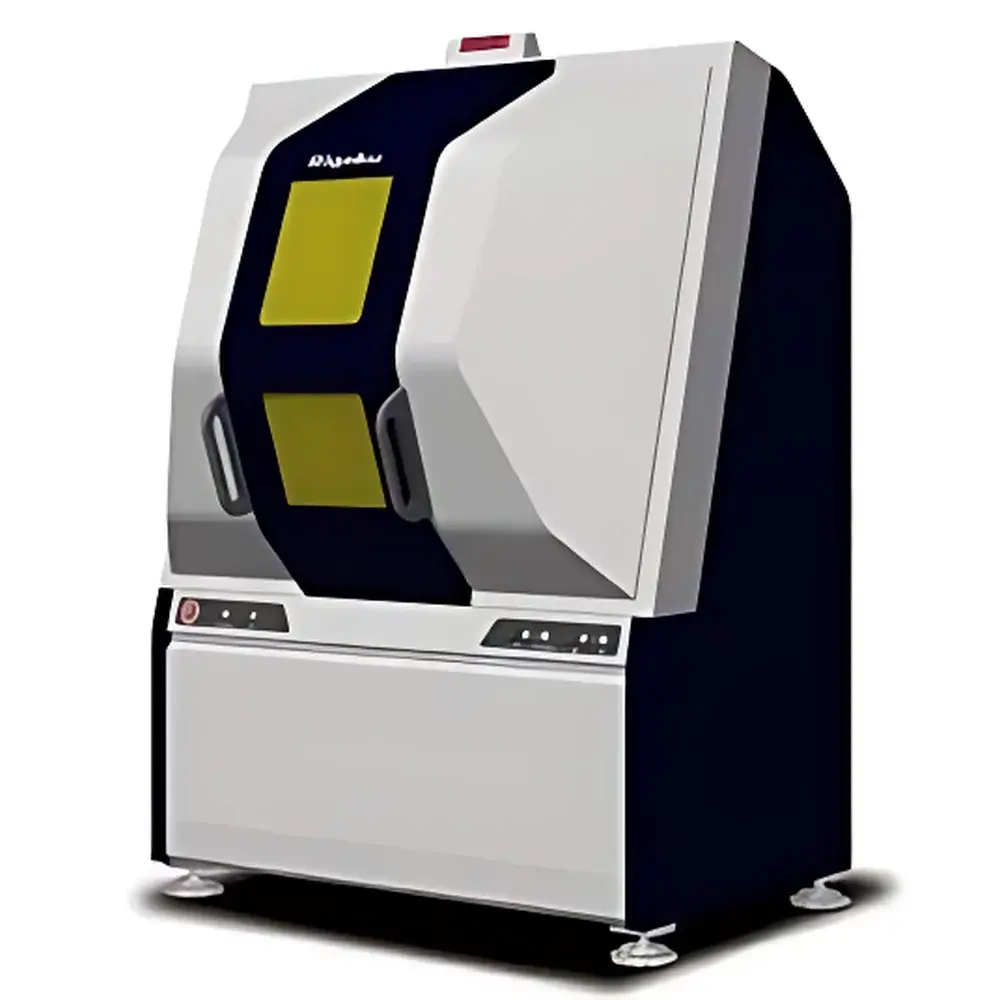
Rigaku SmartLab Series Intelligent X-ray Diffractometer
| Brand | Rigaku |
|---|---|
| Origin | Japan |
| Model | SmartLab Series |
| Instrument Type | Powder X-ray Diffractometer |
| X-ray Generator Power | 3 kW (standard), optional 9 kW rotating anode |
| Goniometer | Horizontal, high-precision dual-optical-encoder with direct-on-axis positioning |
| Minimum Step Angle | 0.0001° (0.1 arcsec) |
| Optical System | CBO Cross-Beam Optics (focusing & high-intensity parallel-beam with mirror) |
| Detector Options | D/teX-Ultra (energy resolution <20%), PILATUS 100K/R (2D pixel array, direct-beam capable) |
| Software | SmartLab Guidance (intelligent workflow-driven analysis) |
| Optional Modules | SAXS/Ultra-SAXS, Thin-Film (out-of-plane & in-plane), Micro-area (CBO-F), Ka₁ monochromator |
| Compliance | Designed for ISO 17025-compliant labs |
Overview
The Rigaku SmartLab Series Intelligent X-ray Diffractometer is a high-performance, fully automated powder X-ray diffractometer engineered for precision structural characterization across academic, industrial, and regulatory laboratory environments. Based on Bragg’s law and X-ray diffraction physics, the system delivers quantitative phase identification, crystallite size and microstrain determination, lattice parameter refinement, and thin-film structural analysis via θ–2θ scanning, rocking curves, and grazing-incidence geometries. Its core architecture integrates Rigaku’s proprietary Cross-Beam Optics (CBO) — a dynamically reconfigurable optical pathway enabling seamless switching between focusing geometry (for high sensitivity in powder analysis) and high-flux parallel-beam optics (with multilayer mirror) for thin-film and small-angle measurements. The horizontal goniometer employs dual optical encoders and direct-on-axis angular positioning, achieving traceable angular resolution down to 0.0001° (0.1 arcsecond), ensuring exceptional reproducibility in peak position and intensity measurement.
Key Features
- Intelligent hardware recognition: Automatic detection and calibration of all optical components (monochromators, slits, mirrors), sample stages, and detector configurations upon installation or exchange.
- CBO Cross-Beam Optics platform: Supports interchangeable beam paths — focusing, parallel-beam, and low-divergence geometries — without manual realignment.
- High-power X-ray source options: Standard 3 kW sealed-tube generator; optional 9 kW high-brilliance rotating anode for enhanced signal-to-noise in demanding applications such as nanomaterial SAXS or weakly scattering thin films.
- Advanced detector suite: Includes the D/teX-Ultra high-speed silicon strip detector (energy discrimination <20% FWHM at Cu Kα) and the PILATUS 100K/R hybrid pixel array detector — radiation-hardened, single-photon counting, capable of direct-beam exposure and 2D pattern acquisition for texture, strain mapping, and time-resolved studies.
- Modular add-ons: Factory-integrated accessories include Ultra-SAXS capability (q-range down to ~0.001 Å⁻¹), in-plane/out-of-plane thin-film stage, micro-area CBO-F optics (spot size <100 µm), and incident-beam Ka₁ monochromator for improved peak separation.
Sample Compatibility & Compliance
The SmartLab accommodates diverse physical forms: free-flowing powders, pressed pellets, bulk solids, liquid suspensions (in capillary or flat-plate cells), epitaxial and polycrystalline thin films (1 nm–5 µm thickness), nanostructured composites, and micro-regions (e.g., grain-boundary cross-sections). Sample handling is supported by motorized XYZ stages, programmable variable divergence slits, and environmental chambers (optional heating/cooling stages up to 1600°C or cryogenic operation). From a compliance standpoint, the instrument’s firmware and SmartLab Guidance software support electronic signatures, user-access controls, full audit trails, and metadata-rich data files — aligning with FDA 21 CFR Part 11, ISO/IEC 17025:2017, and pharmaceutical GLP documentation standards. All calibration procedures follow NIST-traceable reference materials (e.g., SRM 640e Si standard).
Software & Data Management
SmartLab Guidance is a context-aware, wizard-driven software environment that guides users from experimental design through publication-ready reporting. It embeds crystallographic databases (ICDD PDF-4+), Rietveld refinement engines (PDXL, TOPAS integration), and automated phase search-match algorithms. Workflows are configurable for routine QC (e.g., polymorph screening in APIs) or advanced research (e.g., combined XRD/SAXS modeling). Raw and processed data are stored in vendor-neutral HDF5 format with embedded experimental parameters, instrument logs, and versioned processing history — facilitating long-term archival, third-party analysis, and LIMS integration. Batch processing, script automation (Python API), and cloud-synced method libraries further enhance lab-wide reproducibility.
Applications
- Quantitative phase analysis (QPA) and Rietveld refinement of multiphase mixtures (e.g., catalyst formulations, battery cathodes).
- Crystallinity assessment and Scherrer–Williamson analysis of nanocrystalline domains in MOFs, quantum dots, and amorphous–crystalline composites.
- Thin-film metrology: layer thickness, interfacial roughness, stress/strain mapping, and out-of-plane/in-plane texture quantification using pole-figure and φ-scan modes.
- SAXS/WAXS hybrid experiments for hierarchical structure characterization — from polymer lamellae spacing (1–100 nm) to atomic-scale lattice distortions.
- Pharmaceutical solid-state analysis: polymorph identification, hydrate/solvate differentiation, and stability monitoring under thermal/humidity stress.
- Micro-diffraction of heterogeneous materials: localized phase distribution in weld zones, corrosion products, or semiconductor heterostructures.
FAQ
Is the SmartLab compatible with ISO 17025 quality management systems?
Yes — its software enforces role-based access, electronic signature capture, and immutable audit trails for all measurement and analysis steps.
Can it perform both XRD and SAXS on the same sample without realignment?
Yes — the CBO platform and modular collimation allow rapid transition between wide-angle (2θ = 5–120°) and ultra-small-angle (q = 0.001–0.5 Å⁻¹) configurations using motorized optics.
What detector options support time-resolved studies?
The PILATUS 100K/R enables millisecond-frame-rate 2D acquisition; D/teX-Ultra supports sub-second 1D scans for kinetic monitoring of crystallization or phase transitions.
Does SmartLab Guidance support third-party refinement packages?
Yes — it exports CIF, XYE, and raw binary formats compatible with TOPAS, GSAS-II, FullProf, and Materials Studio.
How is calibration maintained over extended operation?
Automatic daily alignment checks against internal reference channels; optional external calibration with NIST SRMs and periodic verification per ASTM E975 or ISO 17873.



