
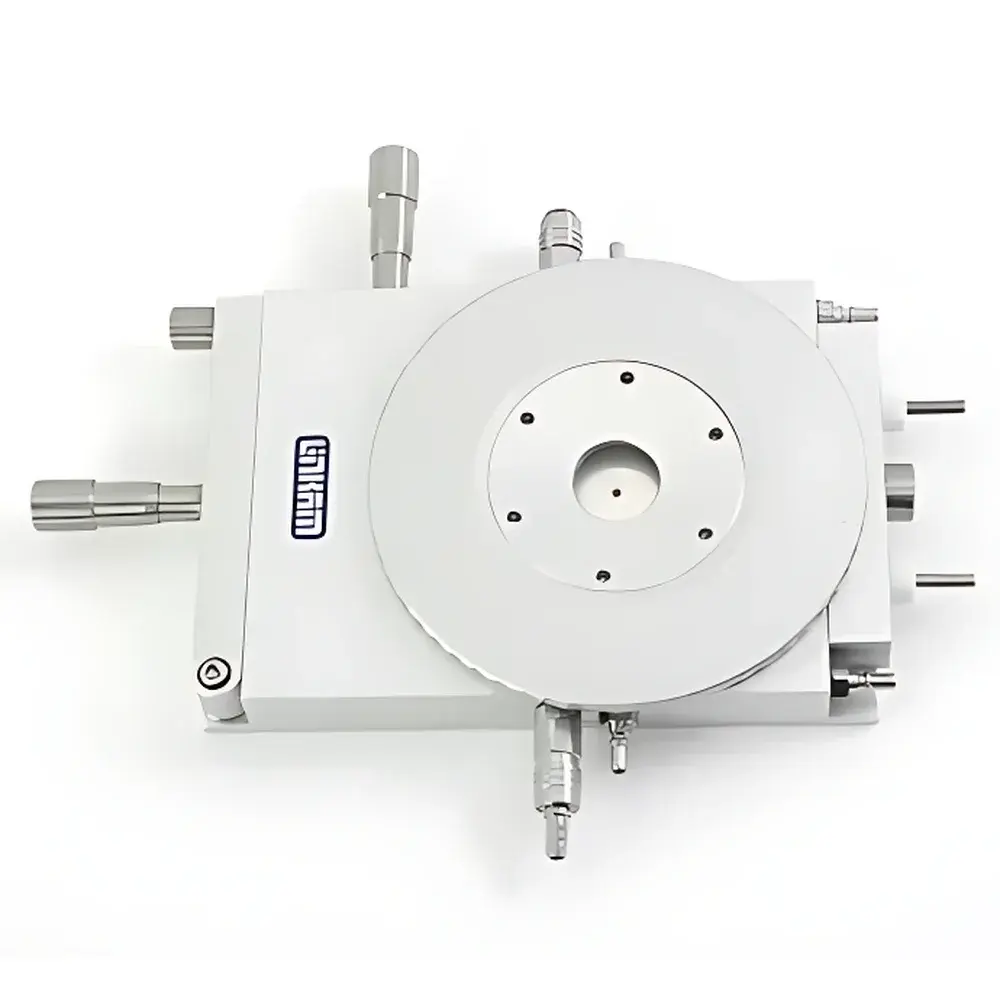
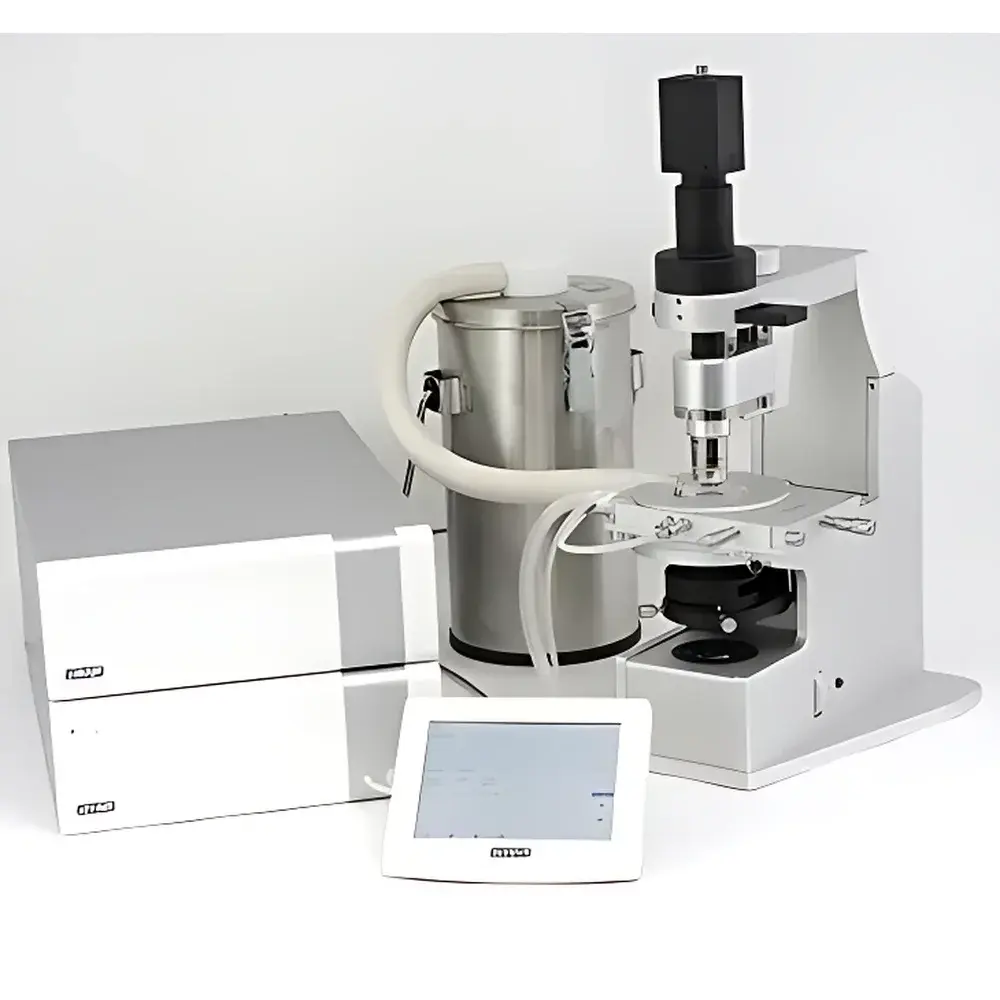
Linkam THMS600 High-Performance Heating and Cooling Stage
| Brand | Linkam |
|---|---|
| Origin | United Kingdom |
| Model | THMS600 |
| Temperature Range | –196 °C to +600 °C |
| Heating/Cooling Rate | 0.1–150 °C/min |
| Temperature Stability | <0.01 °C |
| Temperature Accuracy | ±0.1 °C (full range) |
| Sample Area Diameter | 22 mm |
| Optical Aperture Diameter | 2.0 mm |
| X/Y Translation Range | 16 mm each axis |
| Upper Window Thickness | 0.17 mm (coverslip-grade fused silica) |
| Minimum Objective Working Distance | 4.5 mm |
| Minimum Condenser Working Distance | 12.5 mm |
| Dimensions (Stage Body) | 160 × 80 × 24 mm |
Overview
The Linkam THMS600 is a precision-engineered heating and cooling stage designed for in situ thermal analysis under optical microscopy. It operates on the principle of resistive heating combined with direct cryogenic cooling—enabling continuous, bidirectional temperature control from –196 °C (using liquid nitrogen) to +600 °C. Its core architecture integrates a high-conductivity silver heating block, calibrated Pt100 resistance temperature detectors (RTDs), and a hermetically sealed sample chamber. This configuration ensures exceptional thermal uniformity across the 22 mm-diameter sample region and minimizes thermal lag during rapid ramping (up to 150 °C/min). The stage is optimized for transmitted-light and reflected-light microscopy, supporting both upright and inverted configurations. Its ultra-thin 0.17 mm fused silica top window meets standard coverslip thickness requirements, preserving optical path integrity and minimizing spherical aberration—critical for high-resolution imaging and quantitative phase analysis.
Key Features
- Wide operational temperature range: –196 °C to +600 °C, validated per ASTM E220 and ISO 17025 traceable calibration protocols
- High thermal stability: <0.01 °C drift over 30 minutes at setpoint; accuracy maintained at ±0.1 °C across full range
- Programmable multi-segment thermal profiles with real-time temperature/time curve logging
- Gas-tight environmental chamber with dual-port gas valves for inert atmosphere (N₂, Ar) or controlled humidity (with optional humidity module)
- Side-access loading mechanism enabling introduction of volatile or air-sensitive liquid samples (e.g., molten polymers, ionic liquids) without breaking chamber seal
- Integrated X/Y micrometer-driven translation stage (16 mm travel each axis) with fine-positioning capability for precise region-of-interest alignment
- Optimized optical geometry: 2.0 mm central aperture; minimum objective working distance of 4.5 mm supports high-NA dry and immersion objectives
- Direct cryogen circulation path through copper-coated silver block ensures rapid cooldown and eliminates condensation on internal optics
Sample Compatibility & Compliance
The THMS600 accommodates diverse sample formats—including thin films on silicon wafers, crystalline powders on TEM grids, polymer melts in quartz crucibles, and biological tissues mounted on standard microscope slides. Its sealed chamber complies with ISO 12185 (density measurement), ASTM D3418 (DSC calibration), and supports GLP/GMP-compliant workflows when used with audit-trail-enabled software (TMS94 v5.3+). All materials in contact with samples (silver block surface, quartz crucibles, fused silica windows) are chemically inert and non-outgassing under vacuum or inert gas purge. The stage meets CE marking requirements for electromagnetic compatibility (EMC Directive 2014/30/EU) and low-voltage safety (LVD Directive 2014/35/EU). Optional accessories include humidity control modules (for hygroscopic studies), electrical feedthroughs (for simultaneous conductivity measurements), and motorized Z-focus adapters compatible with automated stage controllers.
Software & Data Management
Control and data acquisition are performed via Linkam’s TMS94 software suite, compatible with Windows 10/11 and supporting USB 2.0 communication. The software enables full remote operation—including real-time temperature ramping, hold steps, trigger-based image capture synchronization (via TTL or software API), and export of time-stamped CSV datasets compliant with ASTM E1505 and USP . Audit trail functionality logs all user actions, parameter changes, and system events in accordance with FDA 21 CFR Part 11 requirements. Raw temperature data is sampled at 10 Hz and filtered using a moving average algorithm to suppress noise while preserving dynamic response. Integration with third-party platforms (e.g., MATLAB, Python via COM interface, or MicroManager) allows for custom scripting of multi-modal experiments combining thermal control with fluorescence lifetime imaging (FLIM), Raman spectroscopy, or digital holographic microscopy.
Applications
The THMS600 serves as a foundational tool in materials science laboratories conducting phase transition analysis (e.g., liquid crystal mesophase identification, polymer crystallization kinetics), pharmaceutical solid-state characterization (polymorph screening, hydrate/dehydrate behavior), geoscience fluid inclusion thermometry, and semiconductor thin-film processing validation. Its thermal precision and optical transparency make it ideal for correlating microstructural evolution—observed in real time—with thermodynamic parameters. Users routinely employ it in conjunction with polarized light microscopy (PLM), differential interference contrast (DIC), and confocal laser scanning microscopy (CLSM) to quantify birefringence changes, domain growth rates, and nucleation onset temperatures. In academic research, it supports reproducible method development aligned with ISO/IEC 17025 accreditation standards for testing laboratories.
FAQ
What cryogens are compatible with the THMS600?
Liquid nitrogen (LN₂) is the standard coolant; compatibility with liquid argon or specialized cryogenic mixtures requires prior consultation with Linkam Applications Engineering.
Can the THMS600 be used under vacuum?
No—the chamber is rated for positive-pressure inert gas environments only; vacuum operation may compromise seal integrity and thermal performance.
Is the 0.17 mm top window replaceable by the user?
Yes, replacement fused silica windows are available as consumables (Part No. WND-THMS600-017); installation requires torque-controlled screwdriver and cleanroom-grade handling.
Does the stage support external triggering from a camera or spectrometer?
Yes—TTL input/output ports enable hardware-synchronized acquisition at user-defined temperature thresholds or ramp intervals.
What maintenance is required to sustain calibration accuracy?
Annual recalibration against NIST-traceable reference standards is recommended; routine cleaning of the silver block surface with ethanol and lint-free wipes is sufficient between experiments.




