
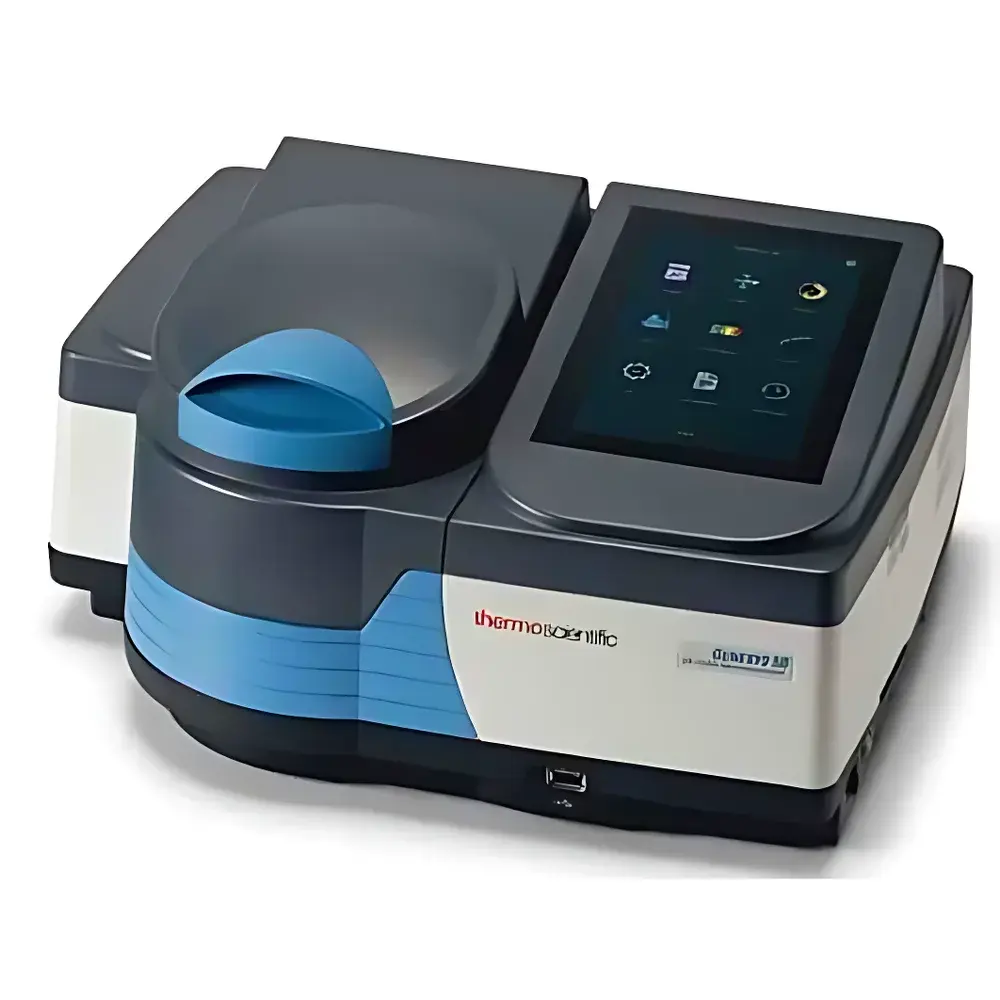
Thermo Fisher GENESYS 50 UV-Vis Spectrophotometer
| Brand | Thermo Fisher |
|---|---|
| Origin | USA |
| Distributor Type | Authorized Distributor |
| Origin Category | Imported |
| Model | GENESYS 50 |
| Instrument Architecture | Pseudo-Double-Beam |
| Detector Type | Photodiode Array (PDA) |
| Wavelength Range | 190–1100 nm |
| Automation Level | Automatic Wavelength Scanning |
| Spectral Bandwidth | 2 nm |
| Wavelength Accuracy | ±0.5 nm |
| Stray Light | <1.0% T at 198 nm (KCl), <0.05% T at 220 nm (NaI), <0.03% T at 340 nm (NaNO₂) |
Overview
The Thermo Fisher GENESYS 50 UV-Vis Spectrophotometer is a benchtop, pseudo-double-beam spectrophotometer engineered for precision, reliability, and operational efficiency in routine quantitative and qualitative analysis across academic, quality control, and industrial laboratories. Utilizing a xenon flash lamp as its broadband light source, the instrument eliminates warm-up delays—enabling immediate spectral acquisition upon activation—and ensures long-term photometric stability without lamp intensity drift. Its optical design incorporates a fixed-grating monochromator coupled with a photodiode array (PDA) detector, delivering full-spectrum acquisition in under one second with high wavelength reproducibility. The system operates across a broad spectral range of 190–1100 nm, covering deep ultraviolet through near-infrared regions, making it suitable for diverse applications including nucleic acid quantification, enzyme kinetics, colorimetric assays, and material absorbance profiling.
Key Features
- 7-inch high-resolution capacitive touchscreen interface with intuitive icon-driven navigation—designed for rapid method execution and real-time data visualization without external computing hardware.
- Xenon flash lamp technology: zero warm-up time, >10⁹ flash lifetime, and minimal thermal load on samples—ideal for temperature-sensitive or time-resolved measurements.
- Pseudo-double-beam architecture: compensates for source intensity fluctuations and detector drift via simultaneous reference and sample beam monitoring, enhancing photometric accuracy and baseline stability.
- Large, accessible sample compartment with removable, autoclavable polymer liner—facilitates rapid cleaning between corrosive or viscous samples and supports compliance with GLP cleaning validation protocols.
- Universal cuvette compatibility: accommodates standard 10 mm pathlength cells (including quartz, glass, and plastic), micro-volume adapters (down to 50 µL), and test tubes (12–16 mm diameter) without mechanical reconfiguration.
- Integrated Wi-Fi module (IEEE 802.11 b/g/n) enables secure wireless transfer of methods, spectra, and reports to networked printers or shared drives—supporting audit-ready data handling in regulated environments.
Sample Compatibility & Compliance
The GENESYS 50 is validated for use with liquid-phase samples in transmission mode across a wide range of matrices—including aqueous buffers, organic solvents, colloidal suspensions, and diluted biological extracts. Its low stray light performance (<0.03% T at 340 nm per NaNO₂) meets ASTM E275 and ISO 9001 requirements for high-absorbance measurement fidelity. The instrument’s firmware and optional VISIONlite software support 21 CFR Part 11-compliant user access controls, electronic signatures, and immutable audit trails—enabling deployment in GMP-regulated QC labs. All optical components are factory-aligned and traceably calibrated to NIST-traceable standards; wavelength accuracy (±0.5 nm) and photometric linearity (0–3.5 A) are verified per USP and EP 2.2.25 specifications.
Software & Data Management
Onboard operation is fully self-contained, but the optional VISIONlite PC software extends functionality to advanced spectral processing, kinetic modeling, multi-component quantitation, and custom report generation. VISIONlite supports method export/import in XML format, batch processing of stored spectra, and integration with LIMS via ODBC or CSV export. All data files include embedded metadata (date/time stamp, operator ID, instrument serial number, calibration status), ensuring full traceability. Raw absorbance, transmittance, and derivative spectra are stored in vendor-neutral .csv and .jdx formats—compatible with third-party chemometric tools such as MATLAB, Python (SciPy), and OriginLab.
Applications
- Quantitative analysis of biomolecules (DNA, RNA, proteins) using established extinction coefficients (e.g., A260/A280 ratios).
- Pharmaceutical assay development and release testing per USP , including dissolution profile verification and excipient interference screening.
- Environmental water quality monitoring: nitrate, phosphate, and heavy metal complex quantification via colorimetric chemistry.
- Materials science: thin-film thickness estimation from interference fringes and bandgap determination in semiconductor nanomaterials.
- Academic teaching: modular experiments covering Beer-Lambert law validation, spectral deconvolution, and pH-dependent absorbance shifts.
FAQ
Does the GENESYS 50 require routine lamp replacement?
No—the xenon flash lamp has a rated lifetime exceeding 10⁹ flashes and does not degrade gradually like tungsten-halogen or deuterium sources. Replacement is only necessary after catastrophic failure, typically beyond five years of daily use.
Can the instrument be integrated into a laboratory network for centralized data management?
Yes—via built-in Wi-Fi or optional Ethernet interface, the GENESYS 50 supports secure file transfer to shared folders, cloud storage gateways, and LIMS endpoints using standard TCP/IP protocols.
Is VISIONlite software required for GLP/GMP compliance?
VISIONlite is optional for basic operation, but mandatory for full 21 CFR Part 11 compliance—including role-based permissions, electronic signatures, and audit trail generation.
What validation documentation is supplied with the instrument?
Each unit ships with a Factory Certificate of Conformance, NIST-traceable wavelength and photometric calibration report, and IQ/OQ protocol templates aligned with ISO/IEC 17025 and ASTM E2500 guidelines.





