
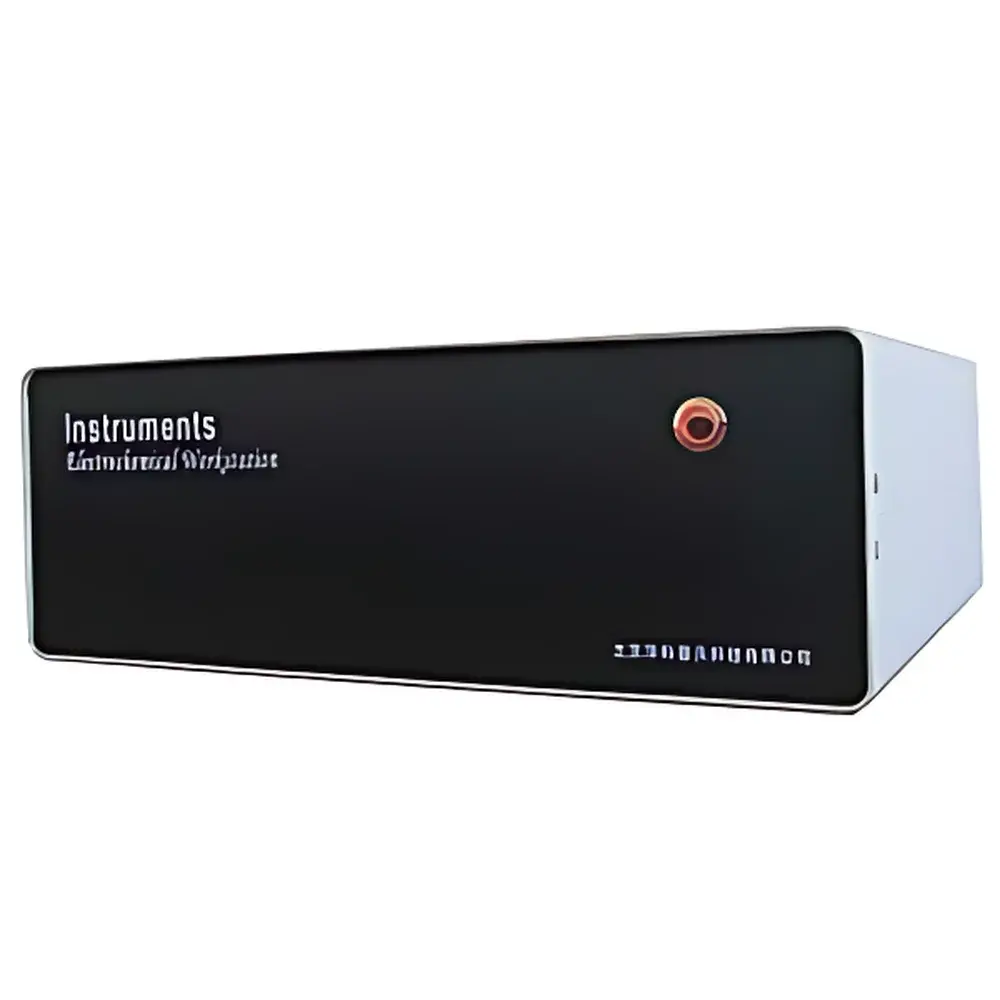
Chenhua 860D Multi-Channel Electrochemical Workstation
| Origin | Beijing, China |
|---|---|
| Manufacturer Type | Authorized Distributor |
| Country of Origin | China |
| Model | 860D |
| Price Range | USD 14,000–28,000 (FOB) |
| Instrument Type | Electrochemical Workstation |
| Channel Configuration | Multi-Channel (Up to 4 Independent Channels) |
| Current Range | ±2 A |
| Current Accuracy | ±0.2% of reading |
| Potential Accuracy | ±1 mV or ±0.01% of full scale |
| Potentiostatic Range | ±10 V |
| Impedance Frequency Range | 10 µHz to 1 MHz |
| Potential Rise Time | <1 µs |
| Compliance Voltage | ±26 V |
| Reference Electrode Input Impedance | ≥1×10¹³ Ω |
| Current Resolution | <0.01 pA |
| CV Minimum Potential Increment | 0.1 mV |
| Potential Update Rate | 10 MHz |
| Data Acquisition | 16-bit @ 1 MHz |
| Max Data Points per Experiment | 4,096,000 |
| Dimensions | 320 × 280 × 120 mm |
| Weight | 7.5 kg |
Overview
The Chenhua 860D Multi-Channel Electrochemical Workstation is a high-performance, research-grade potentiostat/galvanostat engineered for precision electrochemical characterization across academic, industrial, and regulatory laboratory environments. Built on a low-noise, high-bandwidth analog front-end architecture, it implements true four-quadrant operation with synchronized multi-channel control—enabling independent or correlated experiments on up to four electrochemical cells. Its core measurement principle relies on real-time digital feedback control of potential and current using high-stability operational amplifiers, precision DAC/ADC converters, and adaptive filtering algorithms. The system supports all fundamental electrochemical techniques—including cyclic voltammetry (CV), linear sweep voltammetry (LSV), chronoamperometry (CA), chronopotentiometry (CP), differential pulse voltammetry (DPV), square-wave voltammetry (SWV), electrochemical impedance spectroscopy (EIS), and AC voltammetry—with full compliance to ASTM E2177 (corrosion testing), ISO 16773 (coating impedance), and IEC 62321-7-2 (battery electrode analysis). Designed for reproducibility-critical applications such as battery R&D, corrosion science, sensor development, and electrocatalysis, the 860D delivers sub-picoampere current resolution and microsecond-level temporal fidelity without hardware averaging or interpolation.
Key Features
- Multi-channel architecture supporting up to four fully isolated, independently configurable potentiostat/galvanostat channels—ideal for parallel electrode screening or reference-compensated dual-cell configurations.
- Ultra-low input bias current (<50 pA) and ultra-high reference electrode input impedance (≥1×10¹³ Ω) ensure minimal loading effects on high-impedance working electrodes (e.g., coated sensors, biological interfaces).
- Dynamic iR compensation—both automatic (via current-interrupt or positive-feedback methods) and manual—enables accurate potential control in resistive electrolytes (e.g., organic solvents, solid-state electrolytes, or low-conductivity aqueous media).
- Programmable electrolyte control outputs for nitrogen purging, magnetic stirring, and electrode tapping—fully synchronized with electrochemical protocols via TTL-triggered digital I/O.
- 16-bit high-speed data acquisition at up to 1 MHz sampling rate, with user-selectable maximum dataset lengths from 128,000 to 4,096,000 points—supporting long-duration EIS sweeps or high-resolution transient capture.
- Integrated low-pass filtering (user-definable cutoff frequency and roll-off) applied in real time to both potential and current signals—reducing noise without phase distortion or post-acquisition artifacts.
- Full digital control of pulse parameters: CA/CC step durations (100 µs to 1000 s), SWV frequencies (1–100 kHz), and ACV/SHACV excitation (0.1–10 kHz), enabling rapid kinetic profiling and surface-confined redox studies.
Sample Compatibility & Compliance
The 860D accommodates standard two-, three-, and four-electrode configurations—including rotating disk electrodes (RDE), ultramicroelectrodes (UME), screen-printed electrodes (SPE), and custom microfluidic electrochemical cells. Its ±26 V compliance voltage supports high-resistance systems such as solid polymer electrolytes, ceramic separators, and thin-film battery test setups. All electrochemical measurements adhere to GLP-compliant data integrity standards: timestamped raw datasets include metadata on instrument configuration, calibration status, environmental conditions (if external sensors are connected), and operator ID. Audit trails and electronic signatures are supported when integrated with validated LIMS or ELN platforms compliant with FDA 21 CFR Part 11 requirements.
Software & Data Management
The workstation operates under Chenhua’s EC-Lab® v12.x software suite—a Windows-based platform certified for ISO/IEC 17025 laboratories. It provides intuitive experiment sequencing, real-time visualization with overlay capabilities, and batch processing for comparative analysis across multiple samples or conditions. Raw data exports are natively generated in ASCII (.txt) and HDF5 formats—ensuring compatibility with MATLAB, Python (via h5py), OriginPro, and commercial battery analytics tools. Calibration files are digitally signed and version-controlled; firmware updates include cryptographic checksum verification. Software validation documentation (IQ/OQ protocols) is available upon request for GMP-regulated environments.
Applications
- Battery material evaluation: SEI formation kinetics, Li-ion intercalation hysteresis, solid-electrolyte interface (SEI) stability, and fast-charging degradation mechanisms.
- Corrosion science: Polarization resistance mapping, localized pitting assessment, and coating delamination monitoring via low-frequency EIS.
- Electrocatalysis: Turnover frequency (TOF) quantification, Tafel slope analysis, and reaction pathway discrimination using multi-step DPV or SWV scans.
- Biosensor development: Amperometric detection limits down to sub-picomolar analyte concentrations, validated against ISO 15197 for point-of-care devices.
- Fuel cell membrane characterization: Proton conductivity profiling, catalyst layer charge-transfer resistance, and humidity-dependent impedance modeling.
FAQ
Is the 860D compatible with third-party electrodes and flow cells?
Yes—the instrument uses standard BNC and banana-jack connectors and supports custom cell geometries via user-defined electrode configuration files.
Does the system support automated calibration routines?
It includes built-in open-circuit potential (OCP) stabilization checks, current range auto-ranging, and optional NIST-traceable calibration kits for annual metrological verification.
Can EIS data be acquired under potentiostatic or galvanostatic control?
Both modes are supported; users may define DC bias conditions (potential or current) prior to superimposing sinusoidal perturbations across the full 10 µHz–1 MHz range.
What operating systems are supported?
EC-Lab® v12.x requires Windows 10 (64-bit) or Windows 11, with .NET Framework 4.8 and DirectX 12; virtualized deployments are not validated.
Is remote operation possible over LAN or USB?
Yes—TCP/IP communication enables secure remote control and monitoring via authenticated client connections; USB 2.0 provides local high-throughput data streaming.






