
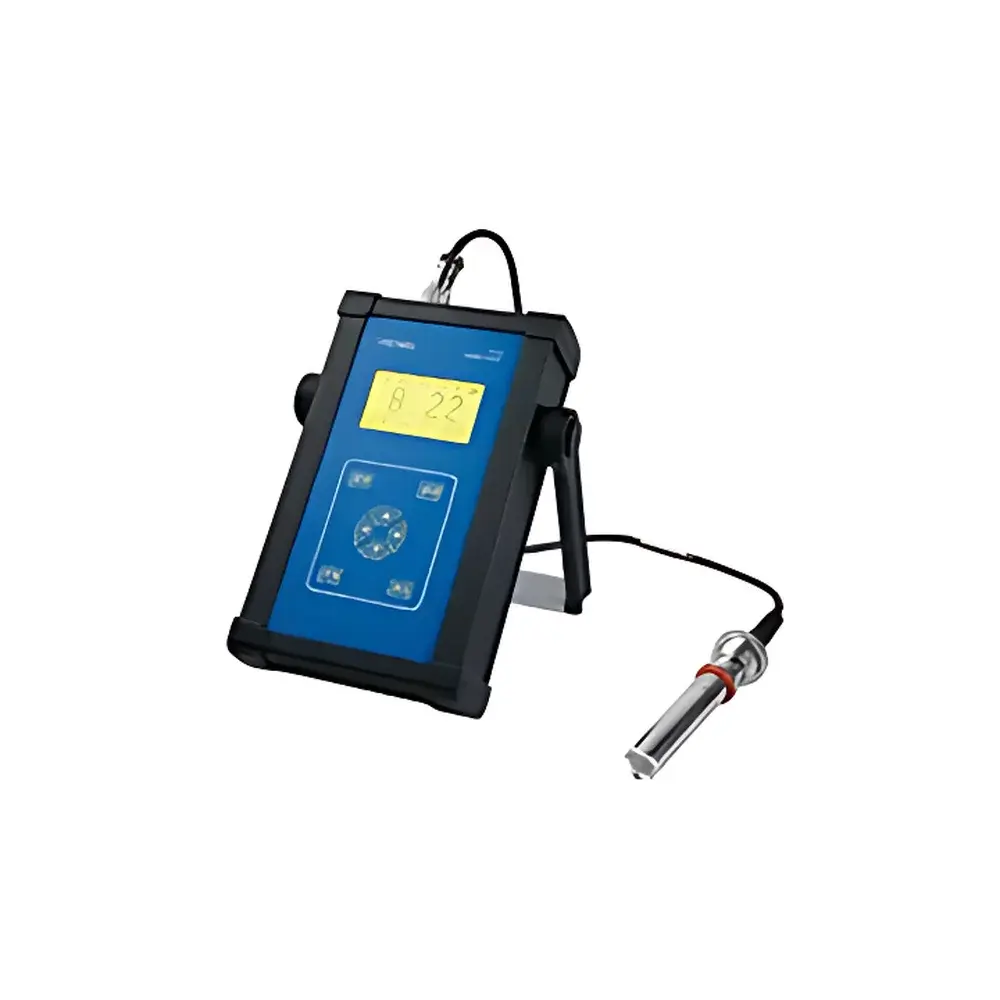
TimePower TP350 Portable Trace Dissolved Oxygen Analyzer
| Brand | TimePower |
|---|---|
| Model | TP350 |
| Origin | Beijing, China |
| Manufacturer Type | Manufacturer |
| Origin Category | Domestic (China) |
| Measurement Principle | Clark-type Membrane Electrode (Galvanic or Polarographic, Configurable) |
| Detection Range | 0.0–100 µg/L, 100–1000 µg/L, 1.00–20.00 mg/L (Auto-ranging) |
| Resolution | 0.1 µg/L (≤100 µg/L), 1.0 µg/L (100–1000 µg/L), 0.01 mg/L (1.00–20.00 mg/L) |
| Accuracy | ±1.0% FS |
| Repeatability | ≤1% |
| Response Time (T90) | <5 min at 25 °C |
| Temperature Compensation | Pt1000 sensor, 0–60.0 °C |
| Sample Temp. Range | 5–45 °C |
| Operating Ambient | 5–45 °C, ≤90% RH (non-condensing) |
| Power Supply | AC 85–265 V, 45–65 Hz |
| Power Consumption | ≤1 W |
| Display | 128 × 64 dot-matrix LCD, Chinese interface |
| Dimensions | 285 × 60 × 255 mm |
| Weight | 2.28 kg |
| IP Rating | IP65 |
| Battery Life | Up to 8 hours continuous operation (rechargeable internal battery) |
| Data Storage | Cyclic memory with >10-year data retention after power loss |
| A/D Conversion | 24-bit high-resolution ADC |
| Circuit Architecture | Surface-mount technology (SMT), integrated modular design |
| Microcontroller | Low-power, high-performance embedded MCU |
Overview
The TimePower TP350 Portable Trace Dissolved Oxygen Analyzer is a precision electrochemical instrument engineered for reliable, low-level dissolved oxygen (DO) quantification in ultra-pure water, boiler feedwater, condensate, semiconductor process water, and pharmaceutical-grade water systems. It operates on the Clark-type membrane electrode principle—utilizing a gas-permeable hydrophobic membrane (PTFE/polyethylene composite) to selectively allow molecular oxygen diffusion onto a catalytic cathode surface. In the galvanic or polarographic configuration (user-selectable via internal jumper), oxygen reduction occurs at the platinum cathode while the anode (lead or aluminum) provides the counter reaction within a sealed, electrolyte-filled chamber. The resulting diffusion-limited current is linearly proportional to the partial pressure of dissolved O2 in the sample, enabling trace-level measurement down to 0.1 µg/L with high reproducibility and minimal drift.
Key Features
- Triple-range auto-switching detection: 0.0–100 µg/L (ppb), 100–1000 µg/L, and 1.00–20.00 mg/L (ppm), optimized for both ultrapure and process water applications.
- Imported PTFE-based sensing membrane with rapid T90 response (<5 min at 25 °C) and thermal stability up to 45 °C sample temperature.
- High-fidelity 24-bit analog-to-digital conversion ensures resolution of 0.1 µg/L in the sub-100 µg/L range and maintains linearity across full scale.
- Integrated Pt1000 temperature sensor enables automatic compensation over 0–60.0 °C, conforming to ISO 5814 and ASTM D888 standard correction algorithms.
- Ruggedized industrial enclosure rated IP65 for field deployment; compact form factor (285 × 60 × 255 mm) and lightweight (2.28 kg) support handheld or flow-cell integration.
- Embedded rechargeable battery supports 8 hours of continuous measurement; low-power MCU architecture minimizes thermal noise and extends sensor stability.
- Non-volatile memory retains >10 years of logged data (time-stamped DO, temperature, calibration history) even after power interruption.
Sample Compatibility & Compliance
The TP350 is validated for use with low-conductivity aqueous matrices including deionized water (≥1 MΩ·cm), steam condensate, nuclear reactor coolant, and USP Purified Water/Water for Injection (WFI). Its galvanic cell design eliminates polarization voltage requirements, reducing interference from redox-active species commonly found in pretreated feedwater. The instrument complies with key regulatory frameworks for critical water monitoring: it supports audit-ready calibration logging per FDA 21 CFR Part 11 when paired with optional PC software (data export via RS232/USB), and its measurement uncertainty profile aligns with ISO/IEC 17025 method validation requirements for trace DO analysis. All consumables—including the replaceable membrane cap, electrolyte solution, and DO electrode assembly—are manufactured under controlled cleanroom conditions to prevent extractables contamination.
Software & Data Management
While the TP350 operates as a standalone field instrument with intuitive Chinese-language menu navigation, optional PC-based configuration and data acquisition software enables advanced functionality: multi-point calibration curve generation, GLP-compliant report generation (PDF/CSV), real-time trend plotting, and firmware updates. All stored measurements include timestamp, temperature, range selection, and operator ID fields. Data export supports CSV format compatible with LIMS integration. The system implements secure session management and user-access levels (operator, technician, administrator) to meet GMP/GLP documentation integrity requirements.
Applications
- Power generation: Real-time monitoring of boiler feedwater and turbine condensate to prevent oxidative corrosion (per ASME PTC 19.11 and EPRI guidelines).
- Semiconductor manufacturing: Ultrapure water (UPW) qualification in fab rinse loops where DO >10 µg/L may induce particle adhesion or metal leaching.
- Pharmaceutical production: On-line verification of WFI storage and distribution systems per USP and EU Annex 1.
- Research laboratories: Kinetic studies of oxygen scavenging reactions, membrane permeability testing, and bioreactor off-gas analysis support.
- Environmental monitoring: Field assessment of hypolimnetic oxygen depletion in stratified reservoirs and aquifer recharge studies.
FAQ
What is the recommended maintenance interval for the membrane and electrolyte?
Membrane replacement is advised every 3–6 months under continuous operation; electrolyte replenishment should occur during each membrane change. Frequent exposure to chlorinated or oxidizing agents may shorten service life.
Can the TP350 be used with flowing samples outside a dedicated flow cell?
Yes—though optimal accuracy requires laminar, bubble-free flow at 100–300 mL/min. For sub-50 µg/L measurements, stainless steel or rigid PFA tubing is mandatory to avoid atmospheric oxygen ingress through elastomeric lines.
Does the analyzer support two-point calibration?
Yes—zero calibration using nitrogen-saturated water (or sodium sulfite solution) and span calibration using air-saturated water at known temperature and barometric pressure.
Is temperature compensation applied automatically during measurement?
Yes—the built-in Pt1000 sensor continuously feeds temperature data to the microcontroller, applying the ISO 5814 solubility coefficient lookup table in real time.
How is data integrity ensured during power loss?
All measurement logs and calibration records are written to non-volatile FRAM memory with hardware-level write protection, guaranteeing retention for ≥10 years without backup power.




