
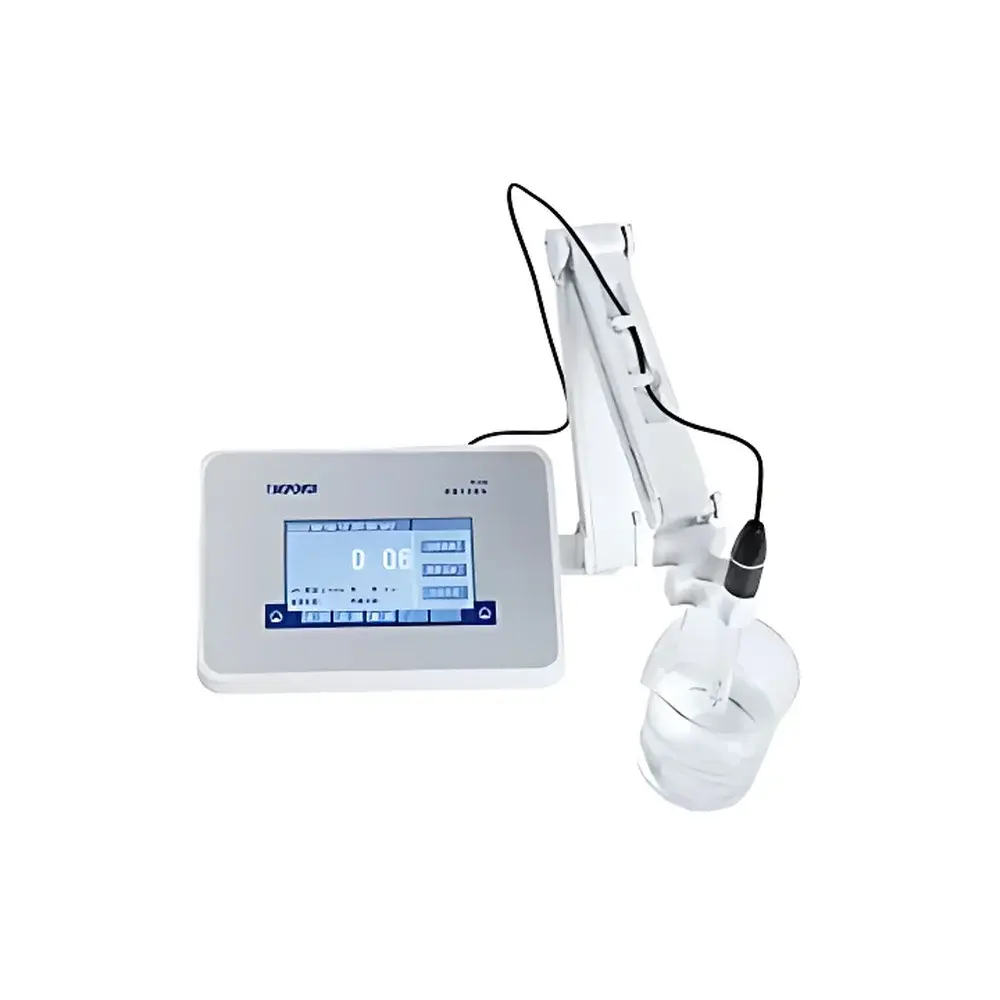
Timepower TP330 Benchtop Sodium Analyzer (Sodium Ion Meter)
| Brand | Timepower |
|---|---|
| Origin | Beijing, China |
| Manufacturer Type | Manufacturer |
| Product Category | Domestic |
| Model | TP330 |
| Instrument Type | Benchtop |
| Measurement Range | (0.00–9.36) pNa [(0.01 μg/L – 23.0 g/L] |
| Detection Limit | 12 μg/L |
| Response Time | T₉₀ < 3 min at 25 °C |
| Accuracy | ±2 μg/L or ±0.03 pNa (whichever is greater) |
| Temperature Range | 5–45 °C (operational ambient) |
| Input Impedance | ≥1 × 10¹² Ω |
| Resolution | 0.01 μg/L |
| Repeatability | ≤1% |
| Stability | ±1% F.S./4 h |
| Temperature Sensor | Pt1000 |
Overview
The Timepower TP330 Benchtop Sodium Analyzer is a high-precision potentiometric instrument engineered for reliable quantification of sodium ion activity in aqueous samples via selective ion electrode (SIE) technology. It operates on the Nernst principle—measuring the potential difference generated across a sodium-selective glass membrane relative to a stable reference electrode—and converts this voltage into pNa (–log₁₀[Na⁺]) or concentration units (μg/L or g/L). Designed for laboratory environments requiring trace-level sodium monitoring, the TP330 delivers consistent performance across critical applications including ultra-pure water analysis in power generation, pharmaceutical water systems, and steam-cycle chemistry control. Its architecture integrates a low-drift, high-input-impedance amplifier stage optimized for signals from sodium-selective electrodes, minimizing noise and polarization effects that compromise sub-ppb measurements.
Key Features
- 24-bit high-resolution analog-to-digital conversion ensures stable digitization of microvolt-level electrode potentials, supporting reproducible detection down to 12 μg/L.
- Integrated Pt1000 temperature sensor enables automatic temperature compensation across 0–60 °C, correcting for both Nernst slope variation and solution viscosity effects per ASTM D1129 and ISO 10523 guidelines.
- Benchtop form factor (200 × 200 × 85 mm; 2.1 kg) with 5.0-inch capacitive color touchscreen provides intuitive Chinese-language navigation while maintaining compatibility with ISO/IEC 17025-compliant lab workflows.
- Onboard data logging stores up to 1,000 measurement records with timestamp, temperature, and electrode status metadata; data retention exceeds 10 years after power loss.
- Low-power design (<5 W) and universal AC input (85–265 V, 45–65 Hz) ensure operational continuity in variable utility environments without external conditioning.
- Robust front-end circuitry employs surface-mount technology and monolithic PCB layout to suppress electromagnetic interference—critical when measuring high-impedance (>10¹² Ω) electrode outputs near industrial instrumentation.
Sample Compatibility & Compliance
The TP330 accepts standard sodium composite electrodes and separate temperature probes (Pt1000), supporting sample matrices ranging from deionized water (conductivity < 0.1 μS/cm) to mildly buffered process streams (pH 4–11). It complies with electrical safety standards IEC 61010-1 and EMC directive 2014/30/EU. While not certified for GMP or FDA 21 CFR Part 11 out-of-the-box, its audit-ready data storage, user-accessible calibration logs, and configurable password protection align with GLP documentation requirements for method validation and instrument qualification (IQ/OQ). Calibration verification using two-point standardization (e.g., 10 μg/L and 100 μg/L Na⁺) satisfies ISO 17025 clause 7.7 on measurement traceability.
Software & Data Management
The embedded firmware supports manual or automated two-point calibration with real-time slope calculation (mV/pNa) and offset verification. All calibration events—including date, operator ID (if enabled), standard concentrations, measured potentials, and calculated slope—are retained in non-volatile memory. Export is limited to USB-stick transfer of CSV-formatted datasets (no proprietary software required), facilitating integration into LIMS or statistical process control platforms. No cloud connectivity or remote access functionality is implemented—ensuring data sovereignty and eliminating cybersecurity exposure vectors common in networked analyzers.
Applications
- Power plant boiler feedwater and condensate monitoring per EPRI TR-102366 and ASME PTC 19.11 protocols.
- Pharmaceutical purified water (PW) and water-for-injection (WFI) system validation under USP and EU Annex 1.
- Chemical process stream sodium leakage detection in caustic soda production and ion exchange regeneration cycles.
- Environmental lab analysis of low-sodium natural waters where interferences from K⁺, H⁺, and NH₄⁺ must be minimized via proper electrode conditioning and alkalizing agents (e.g., diisopropylamine).
- Academic research in colloid stability, membrane transport kinetics, and electrochemical sensor development.
FAQ
What is the recommended calibration frequency for routine operation?
Calibration should be performed before each analytical session and repeated if ambient temperature shifts >5 °C or after electrode cleaning.
Can the TP330 measure sodium in high-conductivity samples such as seawater?
No—it is optimized for low-ionic-strength matrices (<100 μS/cm); high-salinity samples require dilution and matrix-matched standards to mitigate junction potential errors.
Is the sodium electrode included with the base unit?
Yes—the TP330 ships with a sodium composite electrode and separate Pt1000 temperature probe as standard components.
How does the instrument handle electrode drift during extended measurements?
The firmware continuously monitors baseline potential stability and alerts users if deviation exceeds ±2 mV over 15 minutes, prompting recalibration or electrode inspection.
Does the device support compliance with ASTM D4582 or ISO 9964-1?
While not pre-certified, its measurement uncertainty budget, documented calibration procedures, and traceable standards usage enable laboratories to demonstrate conformance through internal validation per those methods.
Related Products







