
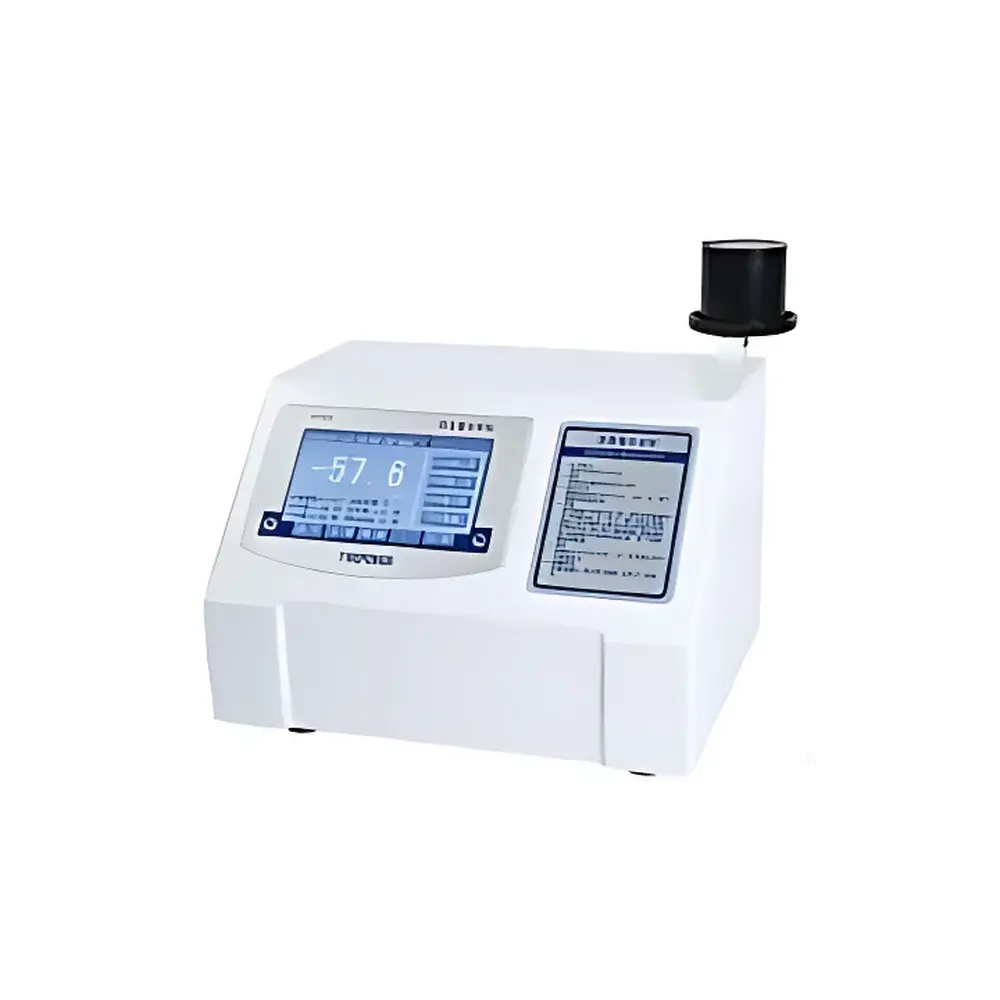
Timepower TP305 Copper Ion Analyzer for Laboratory Water Analysis
| Brand | Timepower |
|---|---|
| Model | TP305 |
| Origin | Beijing, China |
| Manufacturer Type | Direct Manufacturer |
| Origin Category | Domestic (China) |
| Measurement Principle | Photometric Colorimetry (Bicinchoninone / DBCO Method) |
| Display | 5.0-inch TFT Touchscreen (Chinese UI) |
| Power Supply | AC 85–265 V, 45–65 Hz |
| Power Consumption | ≤30 W |
| Dimensions | 260 × 200 × 180 mm |
| Weight | 3.2 kg |
| Measuring Range | 0.00–200 μg/L Cu²⁺ |
| Accuracy | ±3% F.S. |
| Resolution | 0.1 μg/L |
| Repeatability | ≤1% |
| Stability | ±1.5% F.S. / 4 h |
| Operating Temperature | 5–45 °C |
| Relative Humidity | ≤90% RH (non-condensing) |
| Data Storage | 256-cycle circular memory |
| Calibration | Blank & Multi-point Curve Calibration |
| Compliance Method | GB/T 5750.6–2023 (Equivalent to ISO 8575:2017 for copper in water) |
| Light Source | Imported monochromatic cold LED (λ = 540 nm) |
| Sample Volume | ~10 mL per test |
| Standard Reagent | Dibenzoyl-1,2-dihydroxyethylene (DBCO), certified reference material traceable to NIM (National Institute of Metrology, China) |
Overview
The Timepower TP305 Copper Ion Analyzer is a dedicated benchtop photometric instrument engineered for precise, routine quantification of dissolved copper (Cu²⁺) in low-conductivity aqueous matrices commonly encountered in power generation, pharmaceutical water systems, and environmental monitoring laboratories. It operates on the principle of visible-light absorbance spectroscopy, specifically implementing the standardized double-cyclohexanone oxalyldihydrazone (DBCO) colorimetric reaction—codified in GB/T 5750.6–2023 and aligned with ISO 8575:2017. In this method, Cu²⁺ ions form a stable, magenta-colored chelate complex with DBCO under controlled pH and temperature conditions; absorbance at 540 nm is directly proportional to copper concentration per the Lambert–Beer law. The TP305 integrates an imported narrow-band cold LED light source (540 nm), high-stability optical path design, and temperature-compensated signal processing to ensure reproducible results across variable ambient conditions (5–45 °C). Its measurement range (0.00–200 μg/L) targets critical control points in boiler feedwater, condensate, turbine steam, generator stator cooling water, and raw surface waters—where copper concentrations above 20 μg/L may accelerate corrosion in copper-alloy heat exchangers or compromise ultrapure water specifications in semiconductor rinse processes.
Key Features
- 5.0-inch capacitive touchscreen interface with intuitive Chinese-language navigation—designed for rapid operator training and minimal procedural error.
- High-integration PCB architecture using surface-mount technology (SMT) and industrial-grade microcontroller (MCU) ensures long-term reliability and low-power operation (≤30 W).
- Stabilized monochromatic LED light source (540 nm) eliminates warm-up drift and offers >50,000-hour operational lifetime—superior to tungsten-halogen or filtered lamp alternatives.
- Onboard blank calibration routine corrects for zero-point offset caused by cuvette imperfections, reagent background, and electronic baseline drift—critical for sub-5 μg/L detection fidelity.
- Automated timing protocol synchronizes reaction incubation (2–5 min), measurement acquisition, and data logging—reducing manual intervention and inter-operator variability.
- Circular buffer memory stores up to 256 measurement records with timestamp, sample ID, and calibration status—enabling retrospective QA review without external export.
- Rugged mechanical housing (260 × 200 × 180 mm, 3.2 kg) meets IEC 61010-1 safety standards for laboratory electrical equipment.
Sample Compatibility & Compliance
The TP305 is validated for use with deionized water, reverse osmosis permeate, distilled water, and low-TDS natural waters (TDS 100 μg/L), Ni²⁺ (>500 μg/L), and Co²⁺ (>200 μg/L) is mitigated via optimized DBCO reagent formulation and pH buffering (pH 9.0 ± 0.2). The analyzer complies with national standard GB/T 5750.6–2023 for drinking water quality testing and supports GLP-aligned documentation through its embedded audit trail (calibration timestamps, operator ID placeholder, and result history). While not FDA 21 CFR Part 11–certified out-of-the-box, its data integrity framework—including immutable storage and manual calibration logs—facilitates validation under GMP environments when paired with site-specific SOPs.
Software & Data Management
No proprietary PC software is required for basic operation; all functions—including method selection, calibration, measurement, and data recall—are executed locally via the touchscreen UI. Calibration curves are stored in non-volatile memory and support up to five-point linear or quadratic fitting using NIST-traceable copper standard solutions (e.g., 0, 5, 20, 50, 100 μg/L). Each stored record includes date/time stamp, user-defined sample ID, measured absorbance value, calculated concentration, and pass/fail flag relative to configurable alert thresholds. Data export is accomplished via USB flash drive (FAT32 formatted) in CSV format—compatible with LIMS platforms, Excel, and statistical process control (SPC) tools. Firmware updates are delivered via encrypted USB image files, preserving configuration integrity during revision cycles.
Applications
- Monitoring copper leaching in high-purity feedwater circuits of thermal power plants (ASTM D1066, D4582).
- Verification of copper removal efficiency in mixed-bed ion exchange polishing units for pharmaceutical water (USP , EP 2.2.42).
- Baseline assessment of copper contamination in reclaimed wastewater used for cooling tower makeup.
- Field-deployable verification of copper pipe corrosion inhibitors in district heating networks.
- Educational laboratories conducting quantitative analysis of transition metal speciation in environmental chemistry curricula.
FAQ
What is the recommended frequency for blank and calibration curve verification?
Blank calibration should be performed daily prior to sample analysis. A full multi-point calibration curve must be verified every 14 days—or immediately after reagent lot change, optical component cleaning, or instrument relocation.
Can the TP305 measure total copper, including particulate-bound fractions?
No. The TP305 measures only dissolved, filterable Cu²⁺. Total copper determination requires acid digestion (EPA Method 200.7 or ISO 11885) prior to analysis.
Is the DBCO reagent supplied with the instrument?
The TP305 is shipped with one set of copper standard solutions (0–100 μg/L); DBCO reagent kits are available as consumables (Cat. No. TP-REAG-Cu-DBCO) and require refrigerated storage (2–8 °C).
Does the instrument support English-language firmware?
The standard firmware uses Chinese UI exclusively. English localization is available upon request for OEM integration or international distribution agreements.
What maintenance procedures are required to sustain optical accuracy?
Monthly cleaning of the cuvette holder and optical window with lint-free tissue and isopropanol is recommended. Annual verification of LED output intensity and photodiode linearity is advised using factory-certified reference filters.





