
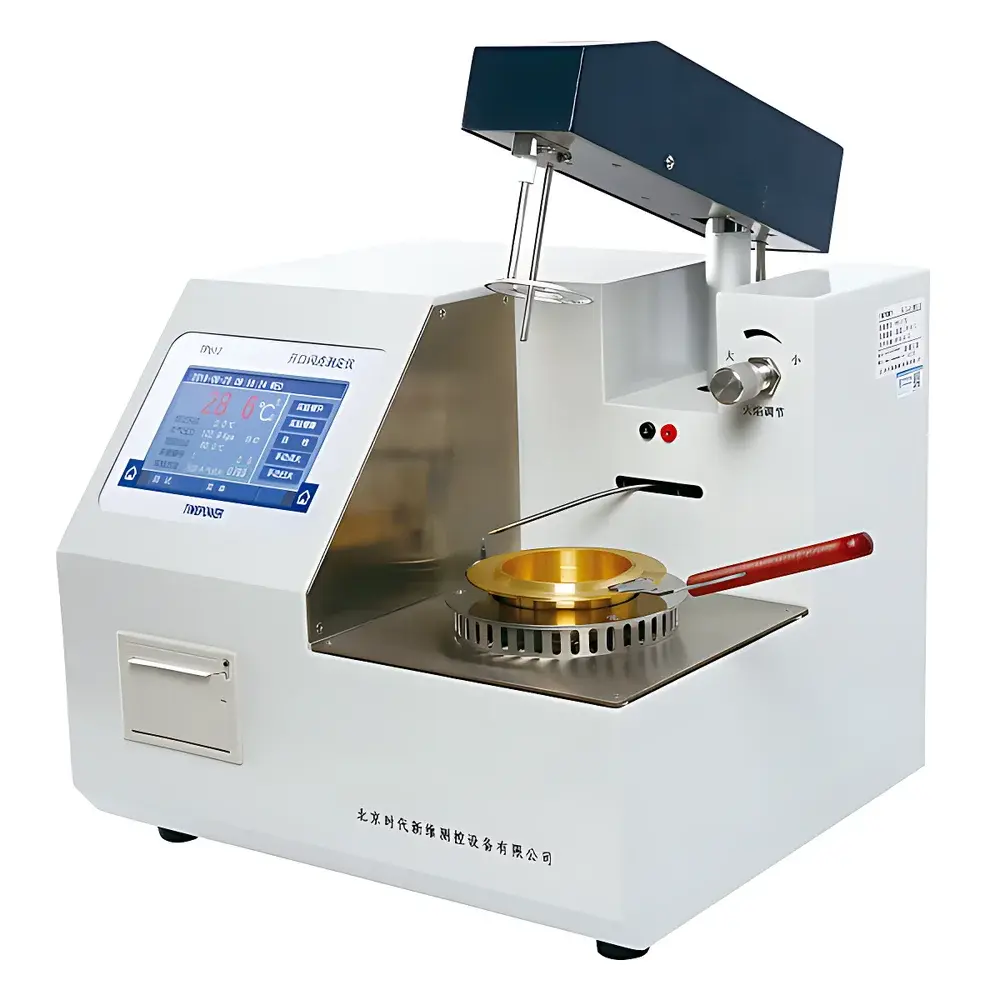
Timepower TP612 Cleveland Open Cup Flash Point Tester
| Brand | Timepower |
|---|---|
| Model | TP612 |
| Origin | Beijing, China |
| Manufacturer | Timepower Instrument Co., Ltd. |
| Detection Method | Cleveland Open Cup (COC) |
| Measurement Range | 79–370 °C |
| Accuracy | ±2 °C |
| Repeatability | ≤4 °C |
| Resolution | 0.1 °C |
| Ambient Temperature | 5–40 °C |
| Relative Humidity | ≤85% RH |
| Display | 5.0-inch touch LCD (Chinese interface) |
| Cooling Method | Integrated forced-air cooling |
| Printer | Thermal printer (36-character Chinese/English output) |
| Power Supply | AC 220 V ±10%, 50 Hz ±10% |
| Power Consumption | ≤600 W |
| Dimensions | 350 × 310 × 300 mm |
| Weight | 14.5 kg |
| Temperature Sensor | Imported Pt100 (stainless steel sheath) |
| Ignition Options | Adjustable gas flame scanning or electronic arc ignition |
| Atmospheric Pressure Compensation | Yes |
| Safety Features | Over-temperature cutoff, self-diagnostic system, automatic test arm retraction, flame detection via high-precision ionization ring |
Overview
The Timepower TP612 Cleveland Open Cup Flash Point Tester is a fully automated analytical instrument engineered for precise determination of the open-cup flash point of petroleum products in strict compliance with internationally recognized standard test methods—primarily ASTM D92 and GB/T 3536. It operates on the Cleveland Open Cup (COC) principle: a standardized brass test cup is filled with sample oil and heated at a controlled linear rate; as volatile vapors evolve and mix with ambient air above the liquid surface, an externally applied ignition source (adjustable gas flame or electronic arc) traverses the vapor space. The lowest temperature at which momentary ignition (a visible flash) occurs across the vapor surface is recorded as the flash point. This thermally driven, kinetically constrained measurement provides critical safety data for storage, transportation, handling, and classification of flammable hydrocarbon liquids—including lubricating oils, residual fuels, bitumens, and heavy distillates—across power generation, petrochemical refining, customs inspection, and R&D laboratories.
Key Features
- Fully automated workflow: integrated control of cup lifting/lowering, heating ramp regulation, ignition source actuation, flash detection, thermal shutdown, and post-test arm retraction.
- Programmable heating rate: adjustable to meet exact procedural requirements of ASTM D92 and GB/T 3536, ensuring method fidelity and inter-laboratory reproducibility.
- High-sensitivity ionization ring detector: delivers rapid, unambiguous flash event recognition with minimal false positives, even under variable ambient lighting or draft conditions.
- Dual ignition mode: user-selectable switching between propane-butane gas flame (with included regulator and cylinder adapter) and contactless electronic arc ignition—enabling operation in gas-restricted or explosion-hazard zones.
- Real-time atmospheric pressure compensation: built-in barometric sensor corrects flash point values per ASTM E1233 and ISO 3679, supporting traceable reporting under varying elevation or weather conditions.
- Robust thermal architecture: stainless-steel-shielded Pt100 sensor ensures long-term calibration stability and resistance to thermal shock or chemical exposure during repeated hot-oil testing.
- Embedded safety logic: automatic heater cutoff upon exceeding user-defined temperature limits or detecting hardware faults; audible/visual fault alerts with diagnostic code display.
Sample Compatibility & Compliance
The TP612 is validated for use with non-volatile to semi-volatile petroleum-based liquids exhibiting flash points between 79 °C and 370 °C—covering Group II/III base oils, asphalt binders, marine fuel oils (IFO 180, IFO 380), transformer oils, and industrial hydraulic fluids. It supports regulatory compliance workflows aligned with OSHA 29 CFR 1910.1200 (HCS), CLP Regulation (EC) No. 1272/2008, and GHS hazard classification criteria. While not inherently 21 CFR Part 11 compliant, its audit-ready thermal printout (with timestamp, operator ID placeholder, and result signature field) meets GLP documentation requirements for routine QC testing in ISO/IEC 17025-accredited labs. All mechanical and electrical design conforms to IEC 61010-1:2010 for laboratory equipment safety.
Software & Data Management
The TP612 operates via an embedded real-time OS with a 5.0-inch capacitive touch interface—localized in Chinese for domestic deployment. Though it lacks Ethernet/Wi-Fi connectivity or PC-hosted software, its thermal printer outputs fully traceable reports including test date/time, ambient pressure, final flash point value (°C), repeatability delta (if dual runs performed), and instrument serial number. Each printed record satisfies minimum ALCOA+ principles (Attributable, Legible, Contemporaneous, Original, Accurate) for paper-based QA systems. For digital integration, optional RS-232 output enables passive data logging to external PCs using terminal emulation software—supporting CSV export for LIMS ingestion where local validation protocols permit.
Applications
- Power sector: flash point verification of turbine oils, insulating oils, and fire-resistant hydraulic fluids per IEC 60296 and ASTM D3487.
- Petrochemical QA/QC: batch release testing of vacuum gas oils, coker feedstocks, and delayed coking residues prior to downstream processing.
- Customs & metrology institutes: conformity assessment of imported fuel blends against national mandatory standards (e.g., China’s GB 17411 for marine fuels).
- Research laboratories: thermal stability screening of bio-derived lubricants, synthetic esters, and nanofluid-enhanced heat transfer oils.
- Fire safety engineering: determination of hazard classification thresholds (e.g., UN Class 3, Packing Group II/III) per TDG and IMDG Code Annexes.
FAQ
What standards does the TP612 comply with?
It is designed and verified per ASTM D92 and GB/T 3536 for Cleveland Open Cup flash point determination.
Can the instrument operate without a gas supply?
Yes—its dual-mode ignition system supports electronic arc ignition, eliminating dependency on propane/butane cylinders.
Is atmospheric pressure correction mandatory?
While not mandatory, enabling pressure compensation improves result accuracy per ASTM E1233, especially at elevations >500 m or during barometric fluctuations.
How often should the test cup be cleaned?
The brass cup must be thoroughly cleaned and dried with solvent (e.g., xylene) after each test to prevent residue carryover and thermal lag errors.
Does the TP612 support GLP-compliant data archiving?
Its thermal printout meets core GLP documentation requirements; for full electronic audit trails, third-party RS-232 logging with time-stamped CSV export is recommended.




