
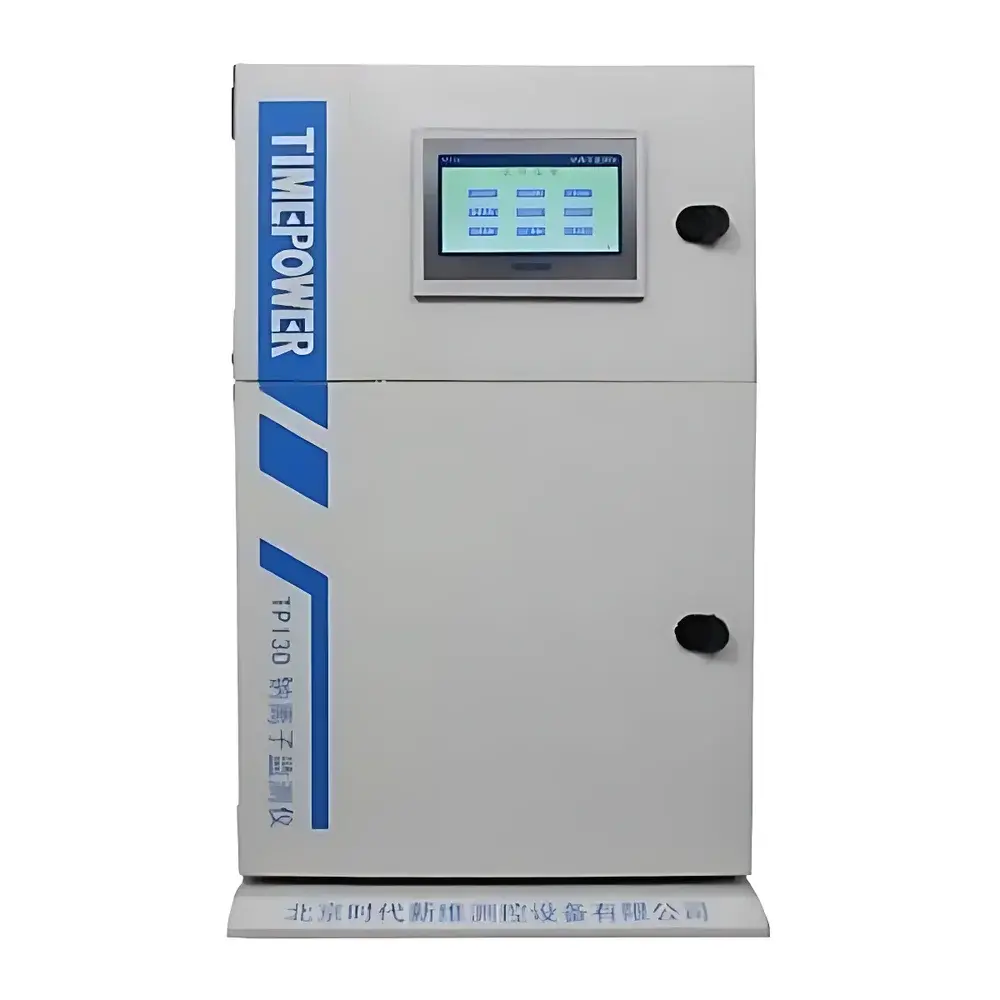
Sodium Ion Online Monitor TP-130 by TimePower
| Brand | TimePower |
|---|---|
| Origin | Beijing, China |
| Manufacturer Type | Original Equipment Manufacturer (OEM) |
| Country of Origin | China |
| Model | TP-130 |
| Pricing | Available upon Request |
Overview
The TimePower TP-130 Sodium Ion Online Monitor is a dedicated electrochemical analyser engineered for continuous, real-time measurement of sodium ion activity (pNa) in aqueous process streams. It operates on the principle of potentiometric detection using a selective sodium ion-selective electrode (ISE), coupled with integrated pH and temperature compensation to ensure thermodynamic accuracy across variable sample conditions. Unlike laboratory-based flame photometry or atomic absorption methods, the TP-130 delivers stable, low-maintenance field deployment for critical water purity assurance—particularly where trace-level sodium monitoring (< 0.1 ppb to 100 ppm) directly correlates with steam cycle integrity, boiler feedwater quality, or ultra-pure water (UPW) compliance in power generation and semiconductor-grade water systems.
Key Features
- Configurable channel architecture: supports 1–4 independent sodium measurement channels within a single enclosure, enabling cost-effective multi-point monitoring without redundant instrumentation cabinets.
- High-stability sodium ISE with solid-state membrane technology, offering long-term drift < 0.5 mV/day and calibration intervals up to 7 days under controlled operating conditions.
- Integrated triple-parameter sensing: simultaneous pNa, pH, and temperature acquisition with automatic Nernstian slope correction and temperature coefficient compensation (0–50 °C range).
- Embedded 24-bit analog-to-digital conversion with programmable gain amplification, delivering resolution of 0.01 pNa unit and repeatability ±0.02 pNa over 24-hour operation.
- Industrial-grade microcontroller platform with low-power consumption (< 8 W), conforming to IEC 61000-4 EMC immunity standards for plant-floor environments.
- Front-panel Chinese-language menu interface with intuitive navigation, contextual help prompts, and real-time status indicators for sensor health, calibration status, and alarm conditions.
- Standard 4–20 mA analog outputs per channel with HART® protocol support; configurable relay outputs (SPDT, 250 VAC/3 A) for high/low limit alarms, maintenance alerts, or interlock signaling.
- Data logging capability: internal non-volatile memory retains ≥10,000 timestamped records (pNa, pH, temp, date/time); auto-rollover overwrite policy prevents data loss during extended unattended operation.
- Robust mechanical design: IP65-rated front panel, DIN-rail or panel-mount compatible housing (144 × 144 mm cutout), and quick-release electrode holders for field servicing without tools.
Sample Compatibility & Compliance
The TP-130 is validated for use with low-conductivity water matrices typical of high-pressure boiler feedwater (conductivity < 0.3 µS/cm), condensate polishing loops, nuclear primary coolant systems, and pharmaceutical purified water (PW) distribution networks. It complies with ASTM D1129 (Standard Terminology Relating to Water), ISO 5667-3 (Water quality — Sampling — Part 3: Guidance on preservation and handling of water samples), and supports audit-ready documentation per FDA 21 CFR Part 11 when paired with optional time-stamped event logging and user-access control configuration. Electrode compatibility includes standard Ag/AgCl reference electrodes and glass-body sodium ISEs meeting IUPAC-recommended selectivity coefficients (log KNa,H ≤ –4.5; log KNa,K ≤ –3.8).
Software & Data Management
While the TP-130 operates as a standalone analyzer, its digital outputs integrate natively with SCADA, DCS, and MES platforms via Modbus RTU (RS-485) or optional Ethernet/IP. TimePower provides a Windows-based configuration utility (TP-ConfigSuite v2.1) for remote setup of calibration schedules, alarm thresholds, data export formats (CSV/Excel), and firmware updates. All calibration events, sensor diagnostics, and parameter modifications are logged with user ID, timestamp, and pre/post-change values—enabling full traceability for GLP/GMP-regulated facilities. Data retention persists through power loss due to EEPROM-backed memory with >10-year data integrity at ambient temperatures ≤ 60 °C.
Applications
- Thermal power plants: continuous monitoring of sodium breakthrough in mixed-bed demineralizers and post-polishing condensate to prevent turbine blade corrosion.
- Chemical and petrochemical refineries: verification of sodium carryover in high-purity process water used for catalyst preparation and reactor quenching.
- Pharmaceutical manufacturing: validation of sodium residuals in Water for Injection (WFI) and Purified Water (PW) distribution loops per USP .
- Municipal drinking water treatment: detection of sodium intrusion from ion exchange regeneration brine leakage or seawater intrusion in coastal groundwater sources.
- Electronics industry UPW systems: compliance verification against SEMI F63 specifications for sodium in 18.2 MΩ·cm ultrapure water.
FAQ
What is the recommended calibration frequency for the TP-130 in continuous operation?
Calibration is advised every 3–7 days depending on sample matrix stability and regulatory requirements; automated calibration verification routines can be scheduled daily.
Does the TP-130 support automatic temperature compensation?
Yes—integrated Pt1000 RTD sensor enables real-time Nernst equation correction across 0–50 °C with ±0.2 °C accuracy.
Can the instrument store historical data without external storage?
Yes—onboard flash memory retains ≥10,000 records with automatic overflow management and timestamped retrieval.
Is the TP-130 compliant with cybersecurity standards for industrial control systems?
It meets IEC 62443-3-3 Level 1 requirements for secure device configuration and supports password-protected access levels (Operator, Engineer, Administrator).
What electrode types are compatible with the TP-130?
TimePower-certified sodium ISEs (e.g., TP-ISE-Na-01) and double-junction Ag/AgCl reference electrodes with ceramic junctions for low-conductivity applications.







