
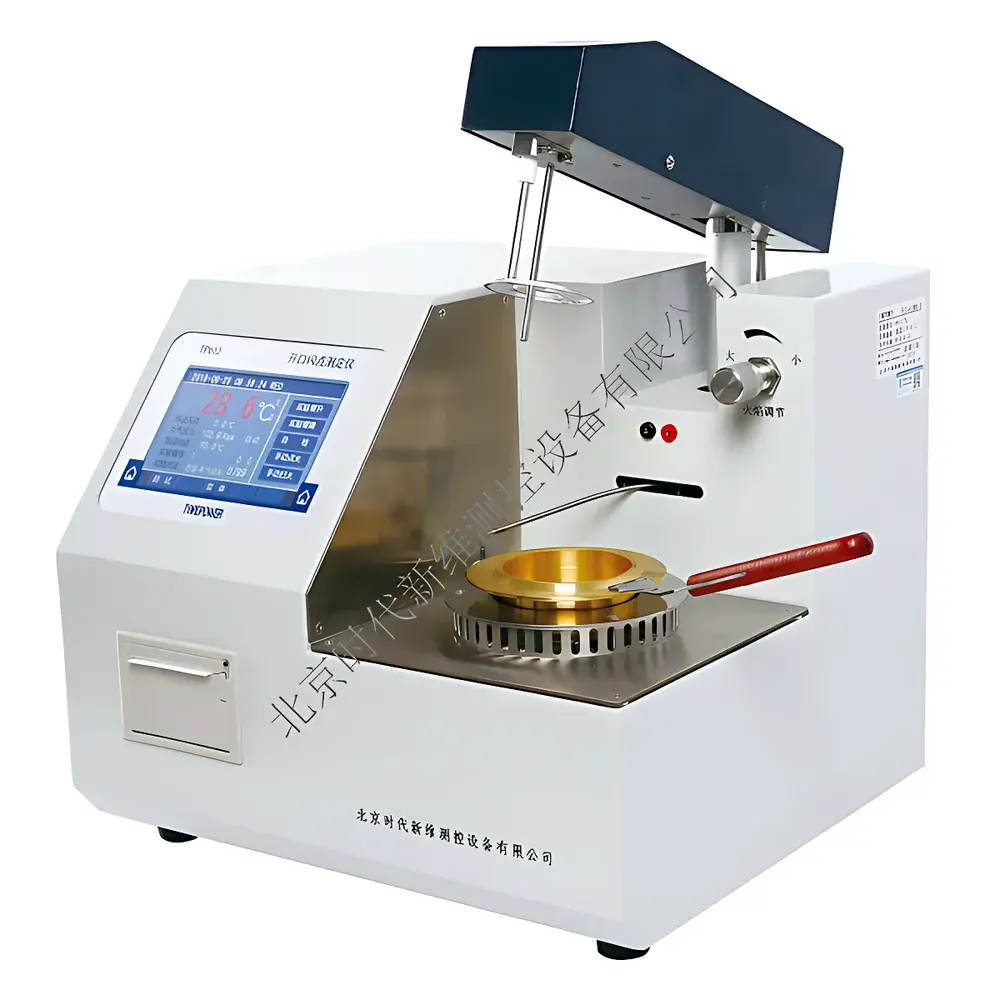
TimePower TP612 Automatic Cleveland Open-Cup Flash Point Tester
| Brand | TimePower |
|---|---|
| Origin | Beijing, China |
| Manufacturer | TimePower Instrument Co., Ltd. |
| Type | Domestic |
| Model | TP612 |
| Detection Method | Cleveland Open-Cup (COC) |
| Standards Compliance | GB/T 3536, ASTM D92 |
| Measurement Range | 79–370 °C |
| Accuracy | ±2 °C |
| Repeatability | ≤4 °C |
| Resolution | 0.1 °C |
| Temperature Sensor | Imported Pt100 (stainless steel sheath) |
| Ignition Options | Adjustable gas flame scanning or electronic arc ignition |
| Atmospheric Pressure Compensation | Yes |
| Safety Features | Over-temperature cutoff, self-diagnostic system, automatic test arm retraction |
| Cooling Method | Integrated high-efficiency air cooling |
| Display | 480×272 TFT color LCD (260K colors) |
| Printer | Thermal, 36-character Chinese/English output |
| Power Supply | AC 220 V ±10%, 50 Hz ±10% |
| Power Consumption | ≤600 W |
| Dimensions | 350 × 310 × 300 mm |
| Weight | 14.5 kg |
| Operating Environment | 5–40 °C, RH ≤85% |
Overview
The TimePower TP612 Automatic Cleveland Open-Cup Flash Point Tester is a precision-engineered instrument designed for the standardized determination of open-cup flash point and fire point of petroleum products, lubricants, biodiesel blends, and related hydrocarbon-based fluids. It operates in strict accordance with internationally recognized test protocols—primarily GB/T 3536 (China National Standard) and ASTM D92 (Standard Test Method for Flash and Fire Points by Cleveland Open Cup Tester). The instrument employs the Cleveland open-cup principle: a sample is heated at a controlled rate in a standardized brass cup; vapors above the liquid surface mix with ambient air, and the flash point is defined as the lowest temperature at which application of an ignition source results in momentary ignition (a visible flash) across the vapor layer. The fire point—the temperature at which sustained combustion occurs for at least 5 seconds—is also determinable using the same apparatus under extended heating. This method remains critical for safety classification, transportation hazard assessment (e.g., UN GHS Category 3 or 4), and refinery process control where volatility and thermal stability must be quantified under realistic atmospheric exposure conditions.
Key Features
- Fully automated operation cycle: cup positioning, temperature ramping, ignition sequence initiation, flash detection, data recording, cooling activation, and test arm retraction—all executed without manual intervention.
- Programmable heating rate compliant with ASTM D92 and GB/T 3536 specifications (typically 5–6 °C/min during final approach to flash point).
- High-sensitivity ionization ring detection system ensures reliable, low-noise flash event recognition independent of operator judgment.
- Dual-mode ignition architecture: field-selectable between propane-butane gas flame scanning (requiring external cylinder and regulator) and solid-state electronic arc ignition—enabling safe operation in environments where open flames are restricted.
- Real-time atmospheric pressure compensation algorithm improves measurement traceability by correcting flash point values to standard pressure (101.3 kPa), per ISO 3405 and ASTM D92 Annex A1.
- Integrated air-cooling module reduces post-test cooldown time significantly versus passive dissipation, supporting higher throughput in QC laboratories.
- Self-diagnostic firmware continuously monitors sensor integrity, heater function, ignition status, and mechanical actuation—logging error codes for rapid troubleshooting.
- Pt100 platinum resistance thermometer housed in corrosion-resistant stainless-steel sheath provides long-term thermal stability and NIST-traceable calibration confidence.
Sample Compatibility & Compliance
The TP612 is validated for use with transparent and opaque petroleum distillates, residual fuels, used engine oils, transformer oils, hydraulic fluids, and bio-derived fuel stocks meeting viscosity limits suitable for open-cup testing (typically < 500 cSt at 40 °C). It excludes highly volatile solvents (e.g., gasoline, acetone) due to safety constraints inherent to the Cleveland method. Regulatory compliance includes full alignment with GB/T 3536–2022, ASTM D92–22, and referenced clauses of ISO 2719. Data integrity meets GLP requirements through audit-ready thermal logging, timestamped result storage, and non-editable print output. While not inherently 21 CFR Part 11 compliant, the instrument supports integration into validated LIMS environments via RS232 serial interface (optional USB-to-serial adapter).
Software & Data Management
The embedded firmware manages all real-time thermodynamic calculations, including linear interpolation between recorded temperature points to identify flash onset. Results—including flash point, fire point (if determined), atmospheric pressure, ambient temperature, and test duration—are stored internally (up to 200 records) and output via built-in thermal printer with bilingual (English/Chinese) character support. No proprietary PC software is required for basic operation; however, optional ASCII-mode serial export enables direct ingestion into Excel, LabWare, or custom QA databases. All printed reports include instrument ID, model number, calibration date, and operator field (manually entered), satisfying internal audit documentation standards.
Applications
- Refinery quality assurance: verification of cut-point consistency in atmospheric/vacuum distillation units.
- Power generation: routine flash point monitoring of turbine oils and insulating oils per IEC 60296 and ASTM D3487.
- Marine fuel certification: compliance testing against ISO 8217 for residual and distillate marine fuels (RMG, DMA, DMZ grades).
- Regulatory submission: generation of test reports accepted by CNCA, AQSIQ, and customs laboratories for import/export clearance.
- R&D laboratories: comparative volatility screening of alternative fuel formulations under standardized thermal stress.
- Maintenance depots: on-site verification of oil degradation in industrial gearboxes and hydraulic systems.
FAQ
What standards does the TP612 fully comply with?
The instrument implements the procedural requirements and apparatus specifications of GB/T 3536 and ASTM D92, including cup geometry, thermometer placement, heating rate profile, and ignition source dimensions.
Can the TP612 be used for closed-cup flash point testing?
No—it is exclusively configured for Cleveland open-cup methodology. Closed-cup tests (e.g., ASTM D56, D3278) require fundamentally different hardware design and are not supported.
Is external gas supply mandatory?
Not mandatory—electronic arc ignition mode eliminates reliance on propane/butane cylinders, making it suitable for labs with flame restrictions or limited gas infrastructure.
How often should calibration verification be performed?
Users should verify temperature accuracy before each daily shift using certified reference standards (e.g., NIST-traceable mineral oil standards at 150 °C and 250 °C); full recalibration is recommended annually or after mechanical impact.
Does the instrument support network connectivity or remote monitoring?
The base configuration includes only RS232 serial communication. Ethernet or Wi-Fi modules are not available; integration into centralized lab networks requires third-party serial-server hardware.





