
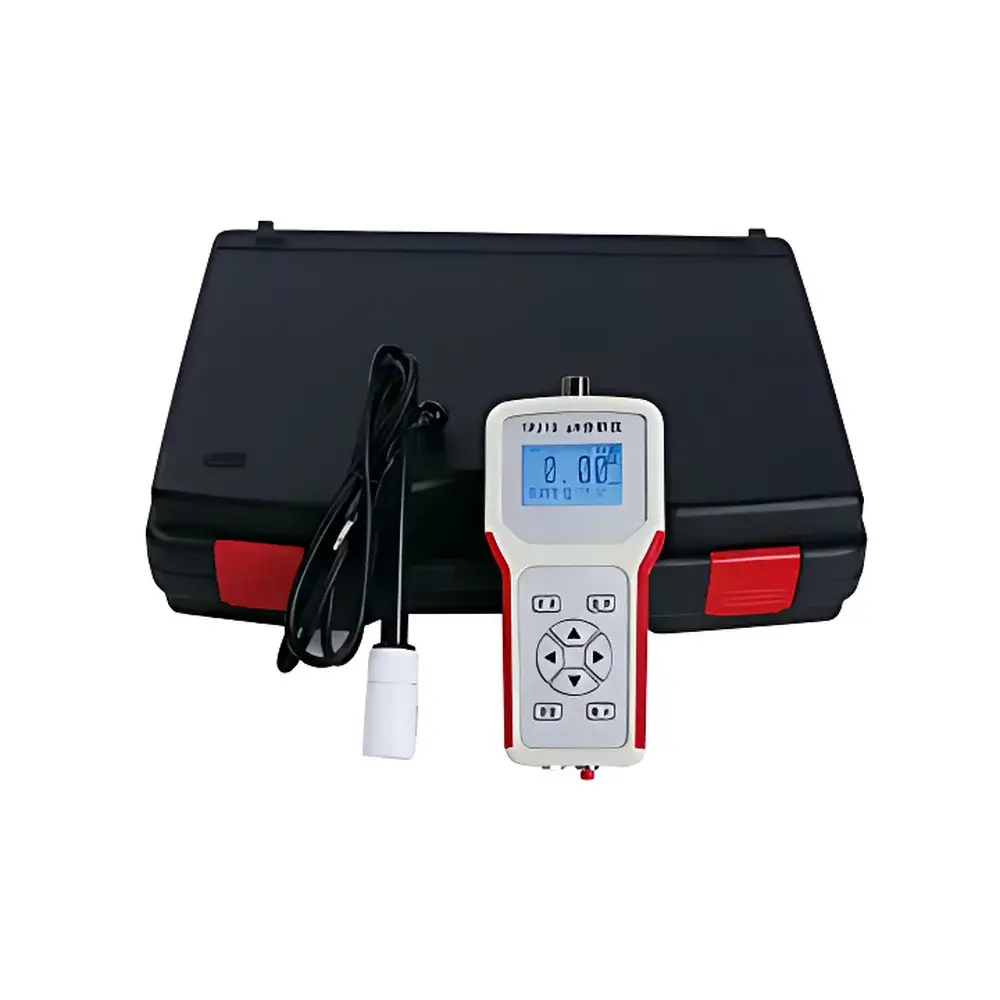
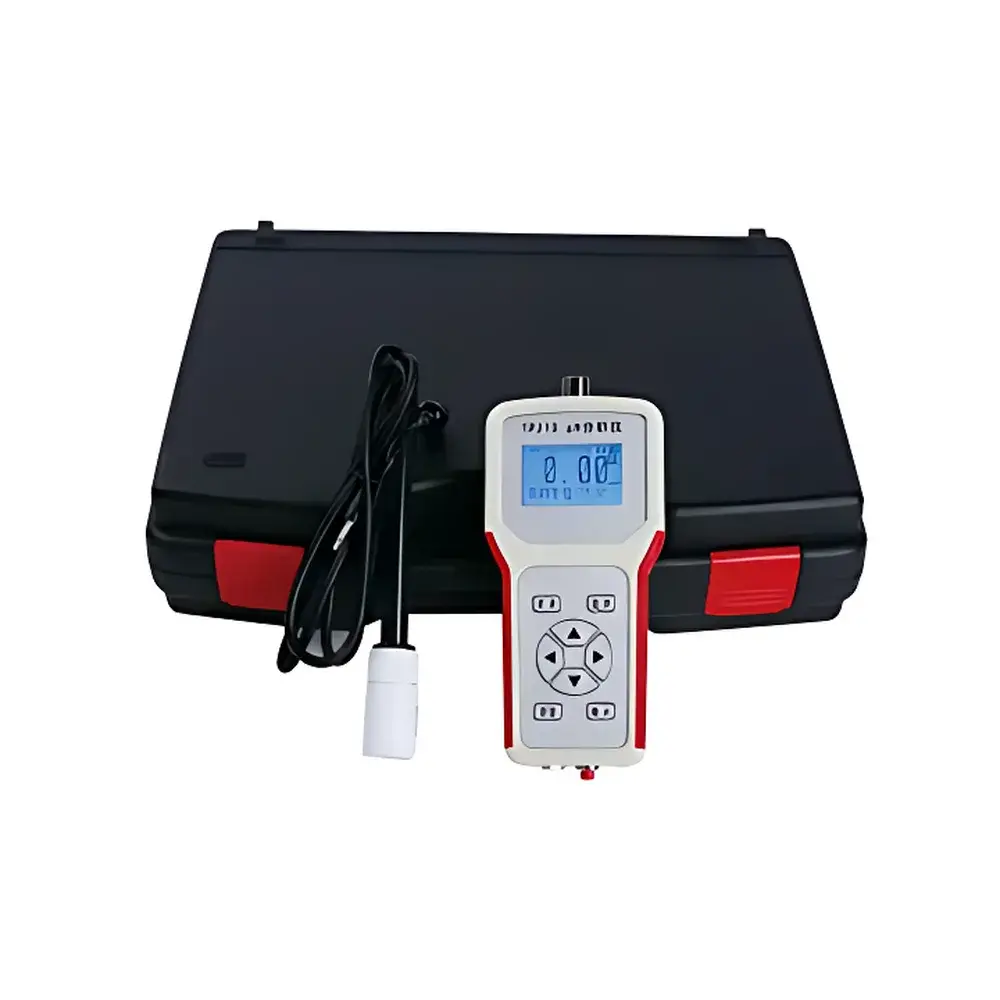
Timepower TP210 Portable Precision pH Meter
| Brand | Timepower |
|---|---|
| Model | TP210 |
| Origin | Beijing, China |
| Manufacturer | Timepower Instrument Co., Ltd. |
| Type | Domestic Portable pH Analyzer |
| Measurement Range | 0.00–14.00 pH |
| Accuracy | ±0.02 pH |
| Resolution | 0.01 pH |
| Input Impedance | ≥1×10¹² Ω |
| Repeatability | ≤1% |
| Stability | ±1% F.S./4 h |
| Response Time (T90) | <1 min at 25 °C |
| Temperature Compensation Range | 0–60 °C |
| Temperature Sensor | Pt1000 |
| Operating Temp. (Sample) | 5–60 °C |
| Ambient Temp. | 5–45 °C |
| Humidity | ≤90% RH (non-condensing) |
| Storage/Transport Temp. | −25–55 °C (electrode storage >0 °C) |
| Power Supply | AC 85–265 V, 45–65 Hz |
| Power Consumption | ≤0.5 W |
| Dimensions | 80 × 30 × 175 mm |
| Weight | 0.26 kg |
| Display | 128×64 dot-matrix LCD, Chinese interface |
| Battery Life | Up to 8 h continuous operation after full charge |
| Data Storage | Cyclic memory with auto-overflow overwrite |
| Auto-Stabilization Detection | Yes |
Overview
The Timepower TP210 Portable Precision pH Meter is a field-deployable electrochemical analyzer engineered for high-fidelity potentiometric measurement of hydrogen ion activity in aqueous solutions. It operates on the fundamental Nernst principle—measuring the electromotive force (EMF) generated across a galvanic cell composed of a pH-sensitive glass indicator electrode, a stable reference electrode (Ag/AgCl/KCl), and the sample solution. This EMF is directly proportional to the logarithm of H⁺ activity, enabling quantitative pH determination within the full operational range of 0.00–14.00 pH. Designed for rigorous use in regulated and non-regulated environments alike, the TP210 delivers laboratory-grade accuracy (±0.02 pH) and stability (±1% F.S./4 h) without requiring benchtop infrastructure. Its compact form factor (80 × 30 × 175 mm), ultra-low power draw (≤0.5 W), and 8-hour battery endurance make it suitable for extended in-situ monitoring in water treatment plants, pharmaceutical clean utilities, food processing lines, environmental field surveys, and academic research labs.
Key Features
- Triple-junction pH combination electrode architecture—optimized for low-conductivity samples (e.g., ultrapure water) and general-purpose aqueous matrices;
- 24-bit analog-to-digital conversion with input impedance ≥1×10¹² Ω ensures minimal loading error and signal integrity even in high-resistivity media;
- Integrated Pt1000 temperature sensor enables automatic temperature compensation (ATC) across 0–60 °C, supporting ISO 7888 and ASTM D1293-compliant reporting;
- Embedded microcontroller platform with advanced firmware algorithms for auto-stabilization detection (T90 < 60 s at 25 °C) and drift-compensated reading capture;
- Ruggedized PCB layout utilizing surface-mount technology (SMT) and conformal coating for long-term reliability under variable humidity (≤90% RH) and thermal cycling;
- Non-volatile cyclic memory stores up to 500 measurement records with timestamp and temperature metadata; data retained >12 months without power;
- Intuitive Chinese-language menu system with context-sensitive prompts—designed for rapid operator training and reduced procedural error in multi-shift facilities.
Sample Compatibility & Compliance
The TP210 is validated for use with liquid-phase aqueous samples exhibiting conductivity ≥20 µS/cm. It supports routine analysis of boiler feedwater, reverse osmosis permeate, municipal wastewater effluent, fermentation broths, buffer solutions, and pharmaceutical process water (PW/WFI per USP ). Electrode configurations include specialized low-ionic-strength (LIS) variants for pure water applications and standard composite electrodes for industrial wastewater and chemical process streams. While not certified for intrinsic safety or explosion-proof operation, the device complies with IEC 61010-1:2010 for electrical safety in measurement equipment and meets CE marking requirements for EMC (EN 61326-1) and RoHS directives. Calibration traceability aligns with NIST-traceable pH buffer standards (e.g., pH 4.01, 7.00, 10.01 at 25 °C).
Software & Data Management
Data export is supported via USB interface (device-mode only) for direct transfer to Windows-based workstations running Timepower’s optional PC Utility v2.1. The utility enables batch export to CSV/Excel, calibration log review (including slope/mV offset history), and compliance-ready report generation with operator ID, instrument ID, and timestamp fields. Audit trail functionality satisfies basic GLP documentation needs; however, full 21 CFR Part 11 compliance—including electronic signatures and immutable audit logs—requires integration with validated LIMS platforms. Internal firmware supports dual-point and three-point calibration with real-time slope calculation (typically 95–105% ideal Nernstian response) and diagnostic alerts for electrode aging or junction clogging.
Applications
- Continuous pH monitoring in cooling tower and boiler water treatment systems to prevent corrosion and scale formation;
- In-line verification of neutralization efficiency in chemical dosing skids for wastewater pretreatment;
- Quality control of purified water distribution loops in biopharmaceutical manufacturing (aligned with EU GMP Annex 1 and FDA guidance on PW system validation);
- Field assessment of soil leachate and surface water pH during environmental impact assessments (EIA) and remediation site characterization;
- Process analytical technology (PAT) support for fermentation pH control in academic and pilot-scale bioreactors;
- Teaching laboratories—demonstrating electrochemical principles, calibration protocols, and uncertainty propagation in potentiometric analysis.
FAQ
What calibration buffers are recommended for routine use?
NIST-traceable pH 4.01, 7.00, and 10.01 buffers at 25 °C are standard. For ultrapure water measurements, use low-ionic-strength buffers certified for conductivity <10 µS/cm.
Can the TP210 measure ORP or mV directly?
No—the instrument is dedicated to pH and temperature measurement only. It does not provide standalone redox potential (ORP) or millivolt mode.
How often should the pH electrode be cleaned and recalibrated?
Daily calibration is required for critical applications (e.g., pharmaceutical water systems). Electrode cleaning with mild detergent or 0.1 M HCl is advised after exposure to proteins, oils, or suspended solids.
Is the device suitable for outdoor field use in humid or rainy conditions?
The IP54-rated enclosure protects against dust and splashing water, but prolonged exposure to rain or condensation is not recommended. Use with protective carrying case in high-humidity field deployments.
Does the TP210 support GLP-compliant data archiving?
Basic calibration and measurement logs meet GLP documentation thresholds. Full electronic record integrity (e.g., audit trails, user authentication) requires external LIMS integration.





