
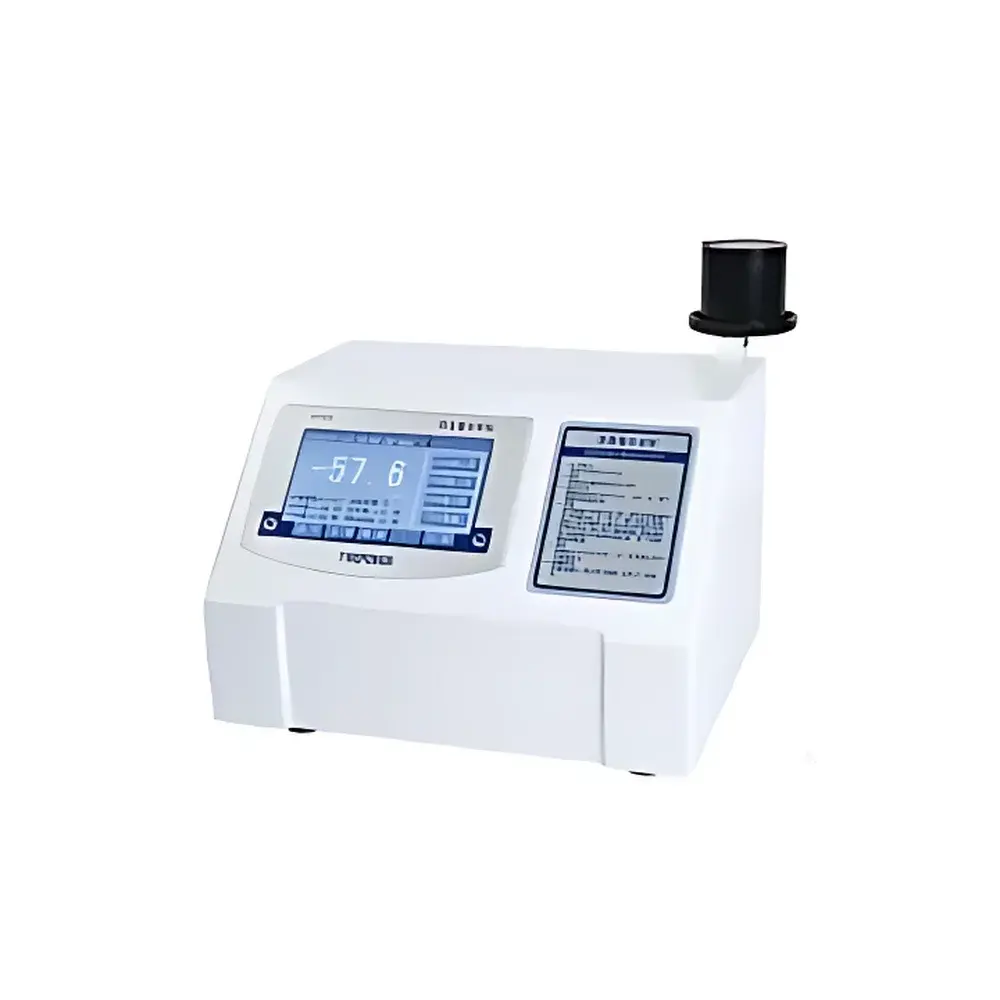
TimePower TP305 Copper Ion Analyzer
| Brand | TimePower |
|---|---|
| Model | TP305 |
| Origin | Beijing, China |
| Manufacturer | TimePower (Domestic Producer) |
| Instrument Type | Benchtop Multi-Ion Analyzer |
| Measurement Principle | Photometric Colorimetry (Bicinchoninone Oxaldihydrazone Method) |
| Detection Range | 0.00–200 µg/L (ppb) |
| Detection Limit | 2 µg/L |
| Full-Scale Accuracy | ±3% F.S. |
| Repeatability | ≤1% |
| Stability | ±1.5% F.S. / 4 h |
| Resolution | 0.1 µg/L |
| Response Time | 1 s |
| Operating Temperature | 5–45 °C |
| Relative Humidity | ≤90% RH (non-condensing) |
| Power Supply | AC 85–265 V, 45–65 Hz |
| Power Consumption | ≤30 W |
| Dimensions | 260 × 200 × 180 mm |
| Weight | 3.2 kg |
| Display | 5.0-inch capacitive color touchscreen (Chinese UI) |
Overview
The TimePower TP305 Copper Ion Analyzer is a benchtop photometric analyzer engineered for precise, trace-level quantification of dissolved copper (Cu²⁺) in ultra-pure and process water streams. It operates on the fundamental principle of photometric colorimetry, specifically implementing the internationally recognized bicinchoninone oxaldihydrazone (BCO) method—standardized in Chinese national environmental monitoring protocols and aligned with ASTM D1068 and ISO 8575 for copper determination in water. The instrument employs a stable, imported monochromatic cold-light source (center wavelength optimized at ~550 nm) to minimize thermal drift and ensure long-term signal integrity. Light absorption by the colored Cu-BCO complex is measured in accordance with the Lambert-Beer law, where absorbance is linearly proportional to copper concentration within the validated dynamic range of 0.00–200 µg/L. Designed for continuous operational reliability in power plant chemistry labs, semiconductor fab water quality control, and municipal drinking water compliance testing, the TP305 delivers high reproducibility under variable ambient conditions (5–45 °C, ≤90% RH non-condensing).
Key Features
- Benchtop architecture with integrated optical path and microprocessor-controlled fluidics—no external pumps or peristaltic tubing required.
- 5.0-inch capacitive color touchscreen interface with intuitive Chinese-language navigation and real-time graphical display of absorbance kinetics and calibration curves.
- High-stability single-chip microcontroller platform with low-power consumption (≤30 W) and advanced EMI-hardened PCB layout using surface-mount technology.
- Automated timing protocol: built-in countdown timer initiates measurement sequence precisely 60 seconds post-reagent addition, ensuring optimal complex formation kinetics.
- Dual-point drift compensation: automatic blank calibration eliminates zero-point drift from cuvette variability, electronic offset, and ambient light leakage.
- Circular data memory buffer stores up to 256 measurement records (timestamp, concentration, absorbance, calibration ID); overflow management ensures seamless archival without manual intervention.
- Compliant optical design: uses certified BCO reagent kits traceable to NIST SRM 3132a; all wetted components are chemically inert (borosilicate glass cuvettes, PTFE-sealed valves).
Sample Compatibility & Compliance
The TP305 is validated for direct analysis of low-conductivity water matrices including boiler feedwater, condensate, turbine steam condensate, generator internal cooling water, drum boiler water, and natural surface/groundwater. Sample introduction requires no pre-filtration for particulate-free streams; turbid samples must be filtered through 0.45 µm hydrophilic PVDF membranes prior to analysis. The analyzer conforms to GB/T 5750.6–2023 (Standard Methods for Examination of Drinking Water – Metals), DL/T 938–2019 (Guidelines for Chemical Supervision of Thermal Power Plants), and supports audit-ready documentation for ISO/IEC 17025-accredited laboratories. While not inherently 21 CFR Part 11 compliant, its data logging architecture allows integration with LIMS platforms supporting electronic signature and audit trail requirements.
Software & Data Management
Instrument firmware supports USB mass-storage mode for direct export of CSV-formatted measurement logs (including date/time stamp, raw absorbance, calculated concentration, operator ID, and calibration status). No proprietary software installation is required—data files are natively readable in Excel, LabArchives, or ELN systems. Calibration curves are stored internally with versioned metadata (date, standard lot number, technician ID). Firmware updates are delivered via encrypted USB key and include full change-log documentation per IEC 62304 Class B software lifecycle requirements.
Applications
- Real-time copper monitoring in high-pressure boiler cycles to prevent stress corrosion cracking (SCC) of copper-alloy condenser tubes.
- Verification of copper leaching from new piping installations in ultrapure water (UPW) distribution systems for semiconductor manufacturing.
- Compliance verification against WHO Guideline Values (2 mg/L) and EPA Secondary Maximum Contaminant Levels (SMCL) for copper in potable water.
- Process control of chelating agent dosing (e.g., EDTA) in closed-loop cooling systems to maintain sub-10 µg/L Cu thresholds.
- Field-deployable verification tool for validating ICP-MS or AAS results in environmental monitoring campaigns.
FAQ
What reagent system does the TP305 use, and is it compatible with third-party standards?
The TP305 implements the standardized bicinchoninone oxaldihydrazone (BCO) colorimetric method. It is fully compatible with certified copper standard solutions traceable to NIST SRM 3132a or equivalent national metrology institute references.
Can the instrument be operated outside the specified temperature range?
Operation below 5 °C may cause incomplete reagent dissolution and slowed complex formation kinetics; above 45 °C, BCO complex stability degrades, leading to nonlinearity and increased baseline drift. Ambient temperature control is strongly recommended.
How frequently must calibration be performed?
Daily blank calibration is mandatory. Full multi-point calibration (at least three points spanning 10–150 µg/L) is required every 14 days—or immediately after reagent lot changes, optical module servicing, or transport-induced shock.
Is the TP305 suitable for seawater or wastewater analysis?
No. High ionic strength (>500 µS/cm), suspended solids, or interfering ions (e.g., Fe³⁺ >50 µg/L, Ni²⁺ >200 µg/L) compromise accuracy. Pre-treatment (dilution, chelation masking, or solid-phase extraction) is required prior to analysis.
Does the analyzer support remote connectivity or network integration?
The TP305 does not feature Ethernet or Wi-Fi interfaces. Data exchange occurs exclusively via USB 2.0 host mode. Integration into SCADA or DCS environments requires intermediary gateway hardware running Modbus RTU-to-TCP translation.
Related Products







