
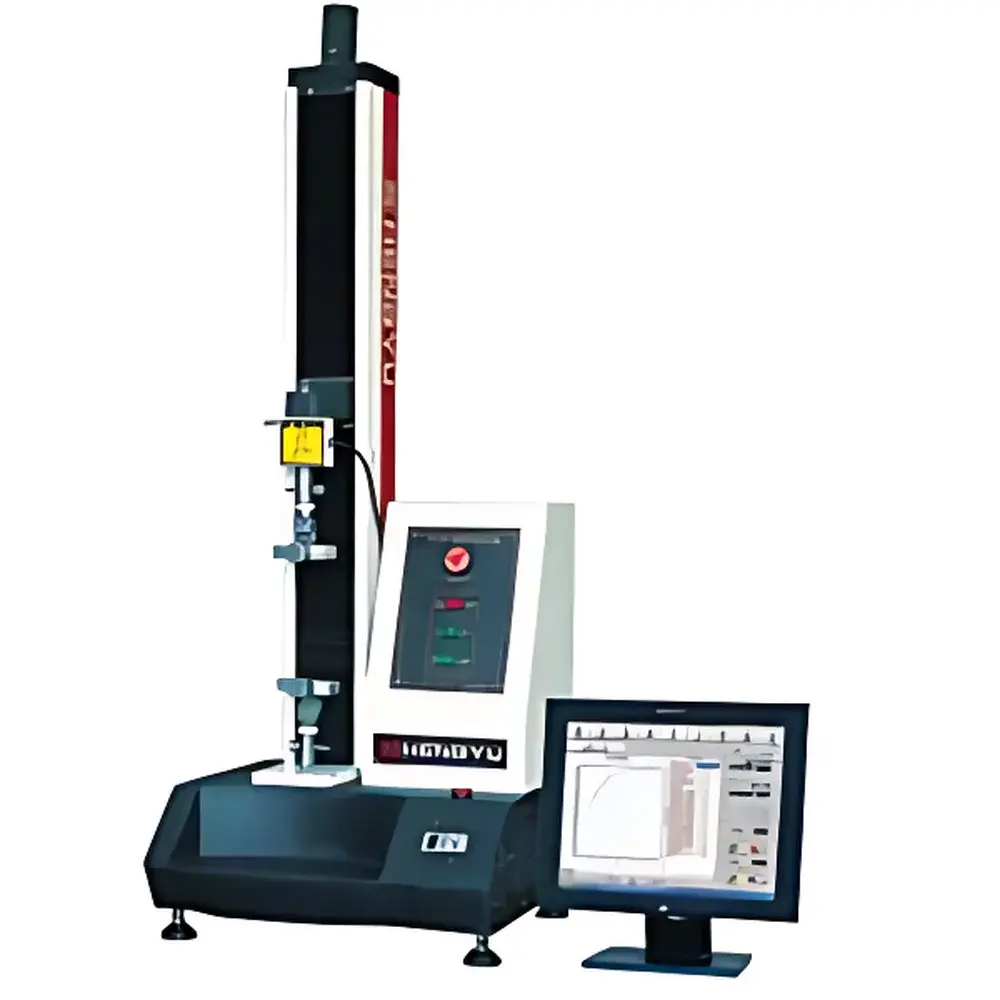
HY-939CS Computer-Controlled Servo-Electric Fabric Tensile Tester (Single-Arm Universal Materials Testing Machine)
| Origin | Tianjin, China |
|---|---|
| Manufacturer Type | Authorized Distributor |
| Origin Category | Domestic (PRC) |
| Model | HY-939CS |
| Pricing | Available Upon Request |
| Load Capacity Options | 2 / 5 / 10 / 50 / 100 / 200 kgf |
| Load Accuracy | ±0.5% of reading (within 0.4–100% of full scale) |
| Force Resolution | ±1/200,000 of maximum test load |
| Displacement Accuracy | ±0.5% of reading (within 2–100% FS) |
| Displacement Resolution | 0.005 mm |
| Large-Deformation Measurement Range | 10–800 mm |
| Large-Deformation Accuracy | ±0.5% of reading (within 2–100% FS) |
| Large-Deformation Resolution | 0.008 mm |
| Drive System | Panasonic 750 W AC servo motor + HIWIN precision ball screw + rotary encoder |
| Speed Range | 0.05–500 mm/min (optional 0.1–1000 mm/min) |
| Speed Accuracy | ±0.5% of set value |
| Test Stroke | 600 mm or 1000 mm (adjustable gauge length, fixture excluded) |
| Force Sensor Configuration | Up to four interchangeable load cells (max. 2 kN per channel) |
| Software Platform | Windows-based proprietary testing software with modular standard compliance, real-time multi-curve plotting, auto-calculation of mechanical parameters, and export to Excel, TXT, HTML |
Overview
The HY-939CS Computer-Controlled Servo-Electric Fabric Tensile Tester is a single-arm universal materials testing system engineered for high-precision mechanical characterization of textile specimens and related flexible materials. It operates on the fundamental principle of controlled uniaxial force application—measuring tensile, tear, burst, peel, seam slippage, and elongation responses under programmable displacement or load control. Its architecture integrates a closed-loop servo drive system with metrologically traceable force and displacement transduction, enabling repeatable, ISO/IEC 17025-aligned mechanical property evaluation across diverse specimen geometries and deformation regimes. Designed specifically for textile laboratories operating under GLP-compliant workflows, the HY-939CS supports both static and quasi-static mechanical testing protocols required for R&D, quality assurance, and regulatory submission.
Key Features
- Modular load cell configuration: Supports up to four calibrated sensors (maximum 2 kN each), allowing seamless switching between low-force textile tear tests and high-load fabric burst or composite laminate evaluations without recalibration.
- High-fidelity motion control: Panasonic 750 W servo motor coupled with HIWIN ground ball screw and optical encoder delivers speed stability within ±0.5% across the full range (0.05–500 mm/min), critical for strain-rate-sensitive measurements such as elastic recovery or creep behavior.
- Sub-micron displacement resolution: 0.005 mm position resolution and 0.008 mm large-deformation resolution ensure accurate tracking of initial yield, necking onset, and post-fracture elongation in knits, nonwovens, and elastomeric fabrics.
- Real-time multi-parameter acquisition: Simultaneous synchronized sampling of load, displacement, and optional extensometer or video-based strain data at up to 200 Hz enables dynamic event capture—including tear propagation initiation, seam failure modes, and viscoelastic relaxation transitions.
- Comprehensive test mode library: Preconfigured control algorithms include constant-rate extension, constant-load hold, constant-strain-rate, load cycling, and stress-relaxation protocols—each fully compliant with ASTM D5034, ISO 13934-1, GB/T 3923.1, and other referenced standards.
Sample Compatibility & Compliance
The HY-939CS accommodates standardized textile specimens per ISO, ASTM, JIS, GB/T, and FZ/T formats—including strip, grab, tongue, trapezoidal, and ball-burst configurations—as well as non-textile substrates such as polymer films, coated papers, geotextiles, leather, and thin metallic foils. Its adjustable gauge length (up to 1000 mm), interchangeable jaw systems (pneumatic, wedge, roller, and custom fixtures), and optional digital extensometry support heterogeneous material families requiring distinct gripping strategies. All firmware and software modules are structured to align with ISO/IEC 17025:2017 clause 7.7 (uncertainty of measurement), ASTM E4 (load verification), and ISO 7500-1 (static calibration). Optional third-party metrological certification includes NIST-traceable load cell calibration and documented uncertainty budgets for audit readiness.
Software & Data Management
The HY-939CS runs on a Windows-native, 64-bit software platform designed for laboratory-grade data integrity and regulatory traceability. It features dual-reporting architecture—supporting both preformatted templates aligned with ISO 105-B02, ASTM D5035, and GB/T 13773.1, and user-defined Excel-integrated report editors with formula scripting. All test sessions automatically generate timestamped audit trails containing operator ID, environmental metadata (optional via external sensor integration), calibration status flags, and raw binary data archives. Export options include CSV, Excel (.xlsx), plain text (.txt), and HTML with embedded interactive plots. The system supports 21 CFR Part 11-compliant electronic signatures when deployed with validated domain authentication and role-based access controls. Version-controlled software updates maintain backward compatibility with legacy test records and raw data files.
Applications
- Textile mechanical performance: Tensile strength and elongation (GB/T 3923, ASTM D5034/D5035), tear resistance (ASTM D2261, D5587, GB/T 3917), seam slippage (GB/T 13772, ASTM D1683), seam strength (GB/T 13773, ISO 13935), burst strength (GB/T 19976), and peel adhesion (FZ/T 80007.1).
- Elastic behavior quantification: Elongation recovery ratio (FZ/T 70006), stress relaxation, and cyclic loading/unloading hysteresis for spandex-blended knits and technical textiles.
- Nonwoven and composite evaluation: Tensile modulus, puncture resistance, and delamination threshold testing for medical gowns, filtration media, and geosynthetic reinforcements.
- Regulatory and certification testing: Full alignment with OEKO-TEX® Standard 100 mechanical requirements, GOTS Annex IV test criteria, and AATCC TM200 validation protocols.
FAQ
Does the HY-939CS comply with ISO/IEC 17025 requirements for accredited textile testing laboratories?
Yes—the system’s force measurement uncertainty, displacement linearity, and software audit trail functionality meet ISO/IEC 17025:2017 clause 7.7 and ISO 7500-1 Class 0.5 specifications. Third-party calibration reports with expanded uncertainty statements are available upon request.
Can the software generate reports compliant with FDA 21 CFR Part 11?
When configured with Windows Active Directory integration, electronic signature modules, and audit log retention policies, the HY-939CS software satisfies core Part 11 requirements including identity verification, record integrity, and change control. Validation documentation packages are provided for IQ/OQ execution.
What is the recommended maintenance interval for the servo drive and load cell subsystems?
Annual verification of load cell linearity and zero drift against certified deadweight standards is advised. Ball screw lubrication and encoder alignment checks should be performed every 6 months under continuous operation (≥40 hrs/week).
Is it possible to integrate environmental chambers or video extensometers with this system?
Yes—the HY-939CS features analog and digital I/O ports compatible with industry-standard environmental chamber controllers (e.g., ESPEC, Weiss) and high-speed stereo-DIC systems (e.g., Correlated Solutions VIC-2D) via Ethernet TCP/IP or USB 3.0 interfaces.
How does the system handle multi-specimen batch testing for QC applications?
The software supports automated sequence programming: users define specimen IDs, test methods, pass/fail thresholds, and statistical grouping rules (e.g., mean ±3σ). Results populate a centralized SQL database with configurable dashboard views for SPC charting and trend analysis.





