
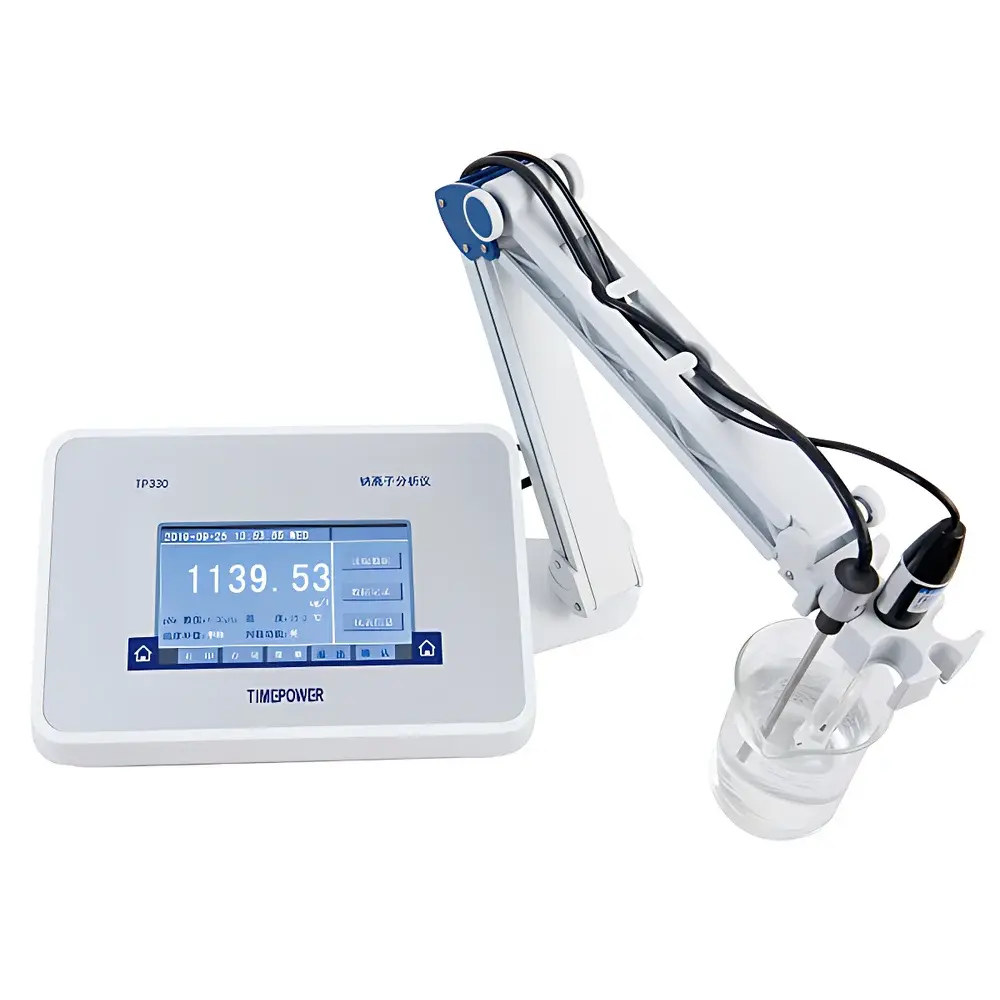
Timepower TP330 Benchtop Sodium Ion Analyzer
| Brand | Timepower |
|---|---|
| Model | TP 330 |
| Origin | Beijing, China |
| Manufacturer Type | Manufacturer |
| Category | Domestic |
| Price | Upon Request |
Overview
The Timepower TP330 Benchtop Sodium Ion Analyzer is a precision electrochemical instrument engineered for accurate, trace-level sodium ion (Na⁺) quantification in aqueous solutions. It operates on the potentiometric principle governed by the Nernst equation, where the sodium-selective electrode generates a voltage proportional to the logarithm of Na⁺ activity in the sample. At 25 °C, the theoretical electrode slope is 59.16 mV per decade change in concentration; however, real-world electrode performance deviates due to membrane composition, hydration state, and junction potential effects. The TP330 compensates for this by performing a two-point calibration using certified standard solutions—determining both the actual electrode slope and zero-point offset—to ensure metrological traceability and measurement integrity. Designed for laboratory environments requiring compliance with GB 12156–89 (“Methods for Analysis of Boiler and Cooling Water — Determination of Sodium — Static Method”), the analyzer delivers stable, reproducible results under controlled temperature conditions (5–60 °C sample range), with integrated Pt1000 temperature compensation.
Key Features
- 5.0-inch capacitive touch color LCD with intuitive Chinese-language interface and responsive menu navigation
- High-impedance input circuitry (≥1 × 10¹² Ω) optimized for low-current signal acquisition from sodium-selective electrodes
- 24-bit analog-to-digital conversion enabling high-resolution pNa measurement across the full dynamic range
- Embedded microcontroller architecture delivering low power consumption (≤5 W) and thermal stability during extended operation
- Robust PCB design utilizing surface-mount technology (SMT) and integrated shielding to minimize electromagnetic interference
- Non-volatile memory with >10-year data retention after power loss; automatic circular storage with overflow management
- Compact benchtop form factor (215 × 150 × 85 mm) and lightweight construction (1.0 kg) for space-constrained labs
Sample Compatibility & Compliance
The TP330 is validated for use with deionized water, boiler feedwater, condensate, ultrapure process water, pharmaceutical rinse solutions, and effluent streams where sub-ppb to g/L sodium concentrations must be monitored. It supports direct measurement of liquid samples without dilution in the range of 0.01 μg/L to 23.0 g/L (0.00–9.36 pNa). The instrument complies with national standard GB 12156–89 and aligns with broader quality system expectations for laboratories operating under GLP or ISO/IEC 17025 frameworks. While not pre-certified to FDA 21 CFR Part 11, its data logging architecture—including timestamped entries, user-defined ID fields, and immutable storage—facilitates audit-ready documentation when integrated into validated workflows.
Software & Data Management
The TP330 features an embedded firmware platform that manages calibration history, measurement logs, and system diagnostics locally. All data are stored with date/time stamps and user identifiers (where configured via external authentication protocols). The device does not include PC connectivity or proprietary software; however, exported data (via optional USB or RS-232 interfaces, if added per customer specification) can be imported into LIMS or Excel-based QA/QC tracking systems. Calibration records retain slope, intercept, R², and reference solution values—enabling trend analysis of electrode aging and verification of measurement uncertainty budgets over time.
Applications
- Power generation: Monitoring sodium breakthrough in steam-cycle condensate and feedwater to detect early-stage cation resin exhaustion
- Pharmaceutical manufacturing: Verifying sodium content in purified water (PW) and water-for-injection (WFI) per USP
- Microelectronics: Controlling sodium contamination in ultrapure rinse water used in wafer fabrication
- Academic research: Studying ion transport kinetics, membrane selectivity, and electrode response hysteresis in model electrolyte systems
- Environmental testing: Quantifying sodium leaching from soils, sediments, or industrial effluents in regulatory compliance studies
FAQ
What is the recommended calibration frequency for routine operation?
Calibration should be performed before each analytical session and repeated if ambient temperature shifts exceed ±2 °C or after measuring samples with large concentration gradients.
Can the TP330 measure sodium in high-ionic-strength matrices such as seawater or brine?
No—the instrument is optimized for low-conductivity samples (e.g., boiler water, PW, WFI). High TDS (>1000 µS/cm) introduces significant junction potential errors and requires matrix-matched standards and activity coefficient correction, which are outside the scope of factory calibration.
Is the sodium-selective electrode included with the base unit?
Yes—the standard configuration includes a composite sodium ion electrode, Pt1000 temperature sensor, universal electrode stand, and a set of certified Na⁺ standard solutions (e.g., 10⁻⁴ M and 10⁻⁶ M NaCl).
How does the TP330 handle temperature compensation?
It employs automatic temperature compensation (ATC) using the integrated Pt1000 sensor, applying the measured temperature to adjust the Nernst slope in real time according to the theoretical relationship dE/dT = −0.198 mV/°C per decade at 25 °C.
What maintenance is required to sustain long-term accuracy?
The glass membrane must be cleaned weekly with dilute HCl (0.1 M) followed by thorough rinsing; storage in 0.1 M NaCl solution is mandatory—never in distilled water or dry conditions. Electrode performance should be verified monthly using fresh standards.



