
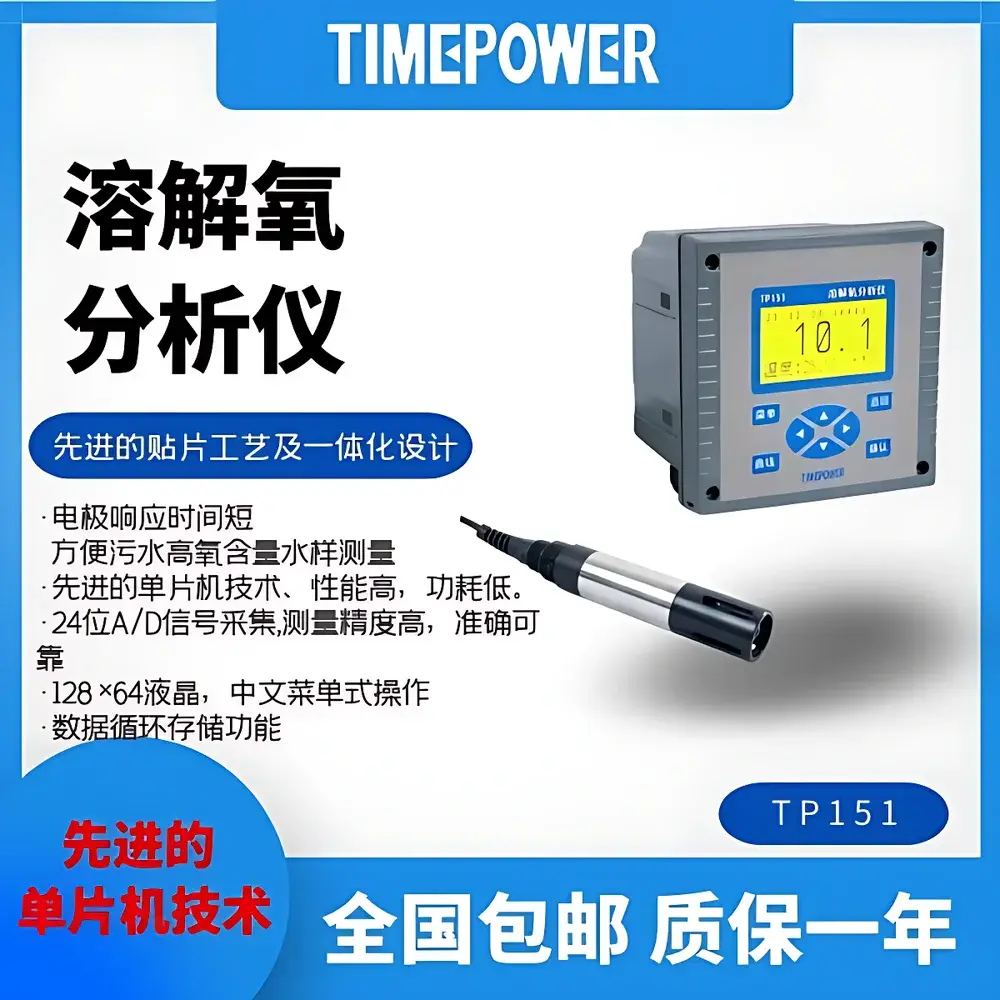
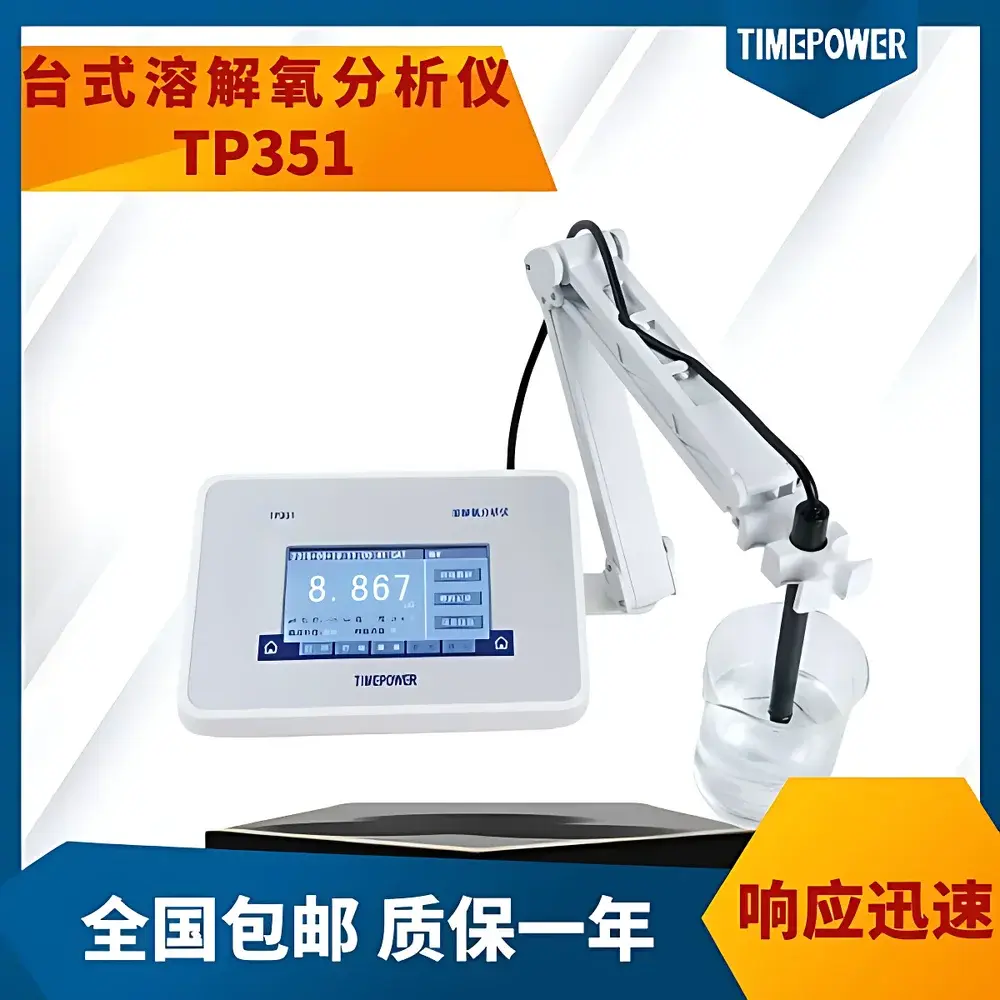
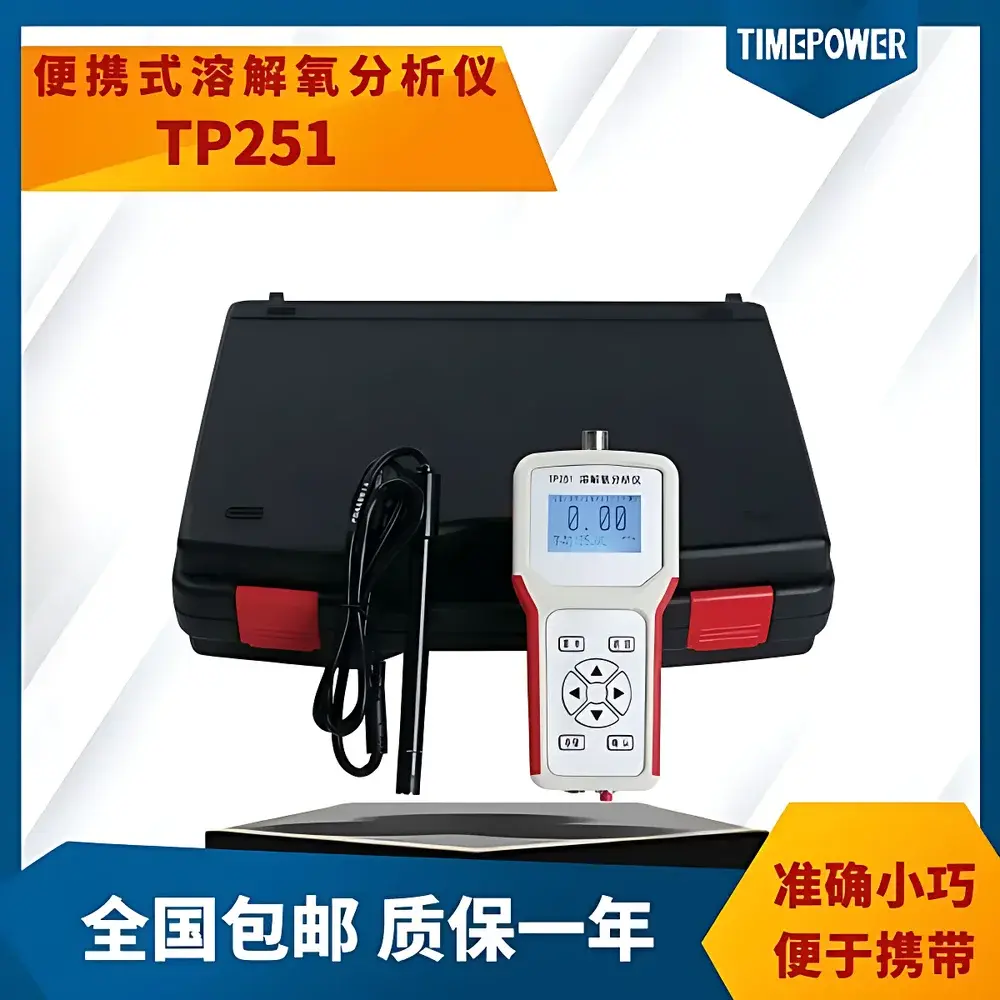
TimePower TP150/151/152/153 Online Dissolved Oxygen Analyzer
| Brand | TimePower |
|---|---|
| Origin | Beijing, China |
| Manufacturer Type | Direct Manufacturer |
| Product Category | Domestic (China-made) |
| Model | TP150 / TP151 / TP152 / TP153 |
| Instrument Type | Online Analyzer |
| Measurement Principle | Polarographic Electrochemical Probe (Clark-type membrane electrode) |
| Measurement Range | (0.0–100) µg/L, (100–1000) µg/L, (1.00–20.00) mg/L (auto-ranging) |
| Accuracy | ≤1.5% FS |
| Resolution | 0.1 µg/L (0.0–100 µg/L), 1.0 µg/L (100–1000 µg/L), 0.01 mg/L (1.00–20.00 mg/L) |
| Response Time T₉₀ | <5 min at 25 °C |
| Temperature Compensation Range | (0–60.0) °C |
| Sample Water Temperature Range | (5–45) °C |
| Ambient Operating Temperature | (0–60) °C |
| Relative Humidity | ≤90% RH (non-condensing) |
| Enclosure Rating | IP65 |
| Analog Output Options | (0–10) mA, (0–20) mA, or (4–20) mA (selectable) |
| Relay Alarm Output | 220 VAC / 3 A |
| Power Supply | AC (85–265) V, 45–65 Hz |
| Power Consumption | ≤15 W |
| Dimensions (H×W×D) | 145 mm × 120 mm × 150 mm |
| Panel Cutout | 138 mm × 138 mm |
| Weight | 0.64 kg |
Overview
The TimePower TP150/151/152/153 Online Dissolved Oxygen Analyzer is an industrial-grade electrochemical sensor system engineered for continuous, real-time monitoring of dissolved oxygen (DO) concentration in aqueous process streams and environmental water bodies. It operates on the Clark-type polarographic principle: molecular oxygen diffuses through a gas-permeable membrane—composed of polytetrafluoroethylene (PTFE) and polyethylene—into an internal electrolyte chamber containing a platinum cathode and a silver/silver chloride or lead/aluminum anode. Under a fixed polarizing voltage, oxygen reduction at the cathode generates a diffusion-limited current proportional to the partial pressure of dissolved O₂. This current is linearly converted into concentration units across three auto-switching ranges, enabling high-fidelity measurement from ultra-trace (sub-ppb) to saturation-level (20 mg/L) DO conditions—critical for wastewater treatment, aquaculture, boiler feedwater control, and bioreactor process monitoring.
Key Features
- Polarographic membrane electrode with PTFE/polyethylene composite diaphragm for stable oxygen permeability and low drift over extended operation
- Triple-range auto-ranging capability: (0.0–100) µg/L, (100–1000) µg/L, and (1.00–20.00) mg/L—ensuring optimal resolution across diverse application scenarios
- High-resolution display: 128×64 dot-matrix LCD with intuitive Chinese-language interface (field-configurable firmware supports English localization)
- Integrated temperature compensation using a Pt1000 RTD sensor, covering 0–60.0 °C with automatic correction applied per ISO 5814 and ASTM D888 standards
- Robust IP65-rated enclosure suitable for wall-mount or panel-mount installation in humid, non-explosive industrial environments
- Configurable analog outputs (0–10 mA, 0–20 mA, or 4–20 mA) compliant with standard PLC/DCS signal acquisition protocols
- Dual-stage relay alarm output (220 VAC / 3 A) for high/low DO threshold triggering and system interlock integration
Sample Compatibility & Compliance
The analyzer is validated for use in municipal and industrial wastewater, surface water, groundwater, drinking water distribution systems, and recirculating aquaculture tanks. It accommodates sample temperatures between 5 °C and 45 °C and tolerates ambient operating conditions up to 60 °C and 90% RH (non-condensing). The electrode design minimizes fouling in moderately turbid or low-conductivity media; optional cleaning accessories (e.g., ultrasonic wipers or air-pulse modules) are available for high-solids applications. While not certified to IEC 61508 or SIL2 out-of-the-box, the device meets electromagnetic compatibility (EMC) requirements per IEC 61326-1 and safety standards per IEC 61010-1. Its measurement methodology aligns with ISO 5814 (electrochemical determination of dissolved oxygen) and supports traceability under GLP-compliant QA/QC workflows when paired with documented calibration procedures.
Software & Data Management
The TP150–TP153 series features embedded firmware supporting manual zero/span calibration, slope verification, and membrane replacement logging. Though lacking built-in data storage or Ethernet connectivity, it interfaces seamlessly with SCADA, DCS, or cloud-based IIoT platforms via its analog output and relay signals. When integrated with third-party data loggers or OPC UA gateways, the system supports audit-ready records—including timestamped calibration events, alarm states, and raw current values—facilitating compliance with FDA 21 CFR Part 11 (when deployed in regulated pharmaceutical or biotech water systems) and ISO/IEC 17025 documentation requirements. Firmware updates are performed via USB port using manufacturer-provided configuration utilities.
Applications
- Activated sludge process control in municipal wastewater treatment plants—optimizing aeration energy consumption via real-time DO feedback loops
- Monitoring dissolved oxygen saturation in fish hatcheries and marine aquaculture systems to prevent hypoxia-induced mortality
- Boiler feedwater and condensate return line surveillance to mitigate oxygen-driven corrosion in power generation facilities
- Environmental monitoring of rivers, lakes, and reservoirs under national water quality assessment programs (e.g., China’s “Blue Sky & Clear Water” initiative)
- In-line DO tracking during fermentation and cell culture processes where oxygen transfer rate (OTR) directly impacts yield and metabolite profile
FAQ
What measurement principle does the TP150 series employ?
It uses the polarographic (Clark-type) electrochemical method, relying on oxygen diffusion through a selective membrane and amperometric current detection at a polarized cathode.
Is temperature compensation automatic and traceable to international standards?
Yes—integrated Pt1000 sensing enables continuous compensation across 0–60.0 °C, implemented per ISO 5814 Annex B algorithms.
Can the instrument be calibrated in the field without specialized equipment?
Yes—zero calibration uses nitrogen-purged water or sodium sulfite solution; span calibration employs air-saturated water at known temperature and barometric pressure.
Does the analyzer support regulatory compliance for pharmaceutical water systems?
When integrated into validated control architectures with proper calibration logs and change management, it meets foundational requirements for USP and EU GMP Annex 1 water monitoring.
What maintenance intervals are recommended for the membrane electrode?
Typical membrane and electrolyte replacement is required every 3–6 months under continuous operation; frequency increases in high-fouling or high-temperature applications.







