
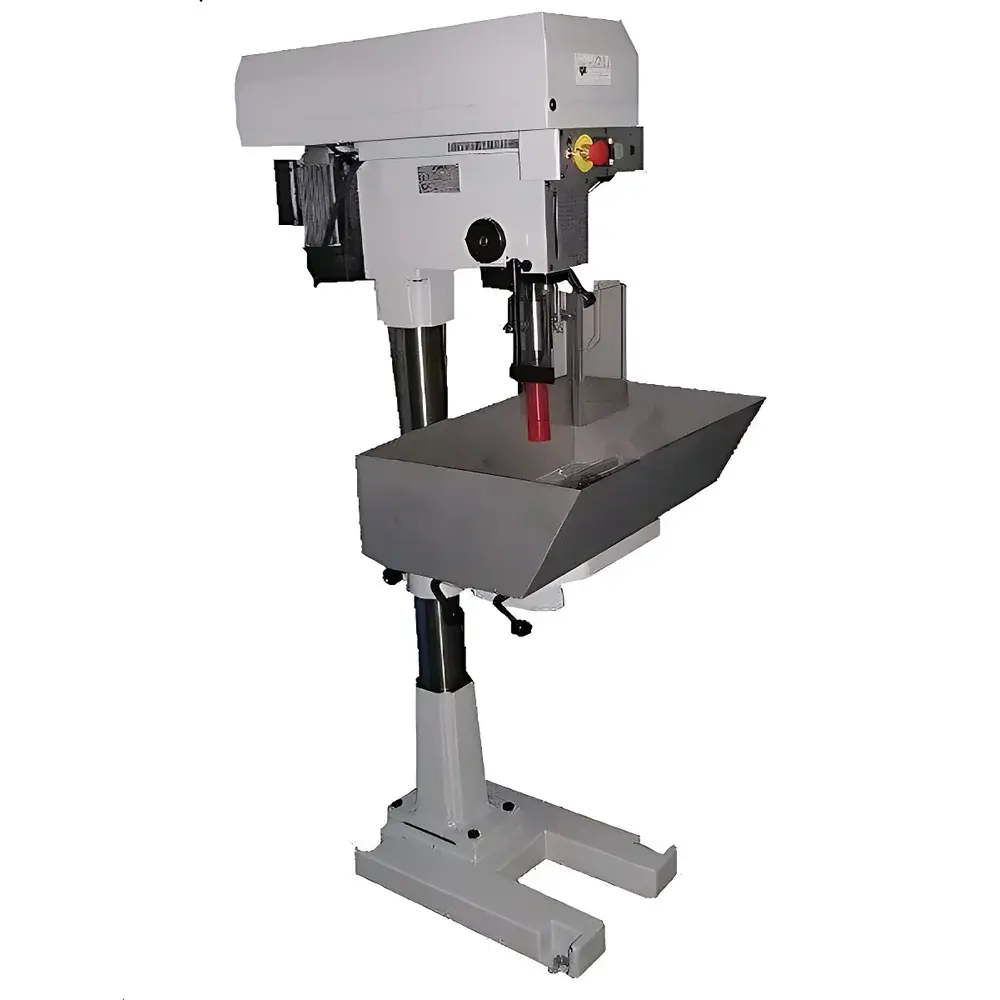
FLOXLAB SPECIMEN CORING MACHINE
| Brand | FLOXLAB |
|---|---|
| Origin | France |
| Model | SPECIMEN CORING MACHINE |
| Drill Bit Internal Diameter | 21.5–63.5 mm (0.845–2.5 in) |
| Maximum Core Depth | 125 mm (5.0 in) |
| Cooling Medium | Water or Oil |
| Motor Power | 1,500 W |
| Dimensions (W×D×H) | 500 × 500 × 1800 mm |
| Weight | 150 kg |
| Power Supply | 220 V, 50–60 Hz |
Overview
The FLOXLAB SPECIMEN CORING MACHINE is a precision-engineered laboratory-scale coring system designed for the controlled extraction of cylindrical core specimens from consolidated geological materials—including sedimentary rocks, concrete, asphalt, ceramic composites, and hardened cementitious matrices. Operating on a vertical spindle-driven rotary cutting principle, the instrument employs diamond-impregnated drill bits to achieve clean, low-damage core retrieval under consistent axial load and rotational velocity. Its mechanical architecture prioritizes dimensional stability, thermal management, and operator safety—critical requirements for producing ASTM D4543-compliant core samples used in uniaxial compressive strength testing, permeability characterization, porosity analysis, and microstructural imaging (e.g., X-ray CT or SEM sample preparation). The machine is not intended for field deployment or continuous industrial production but serves as a dedicated benchtop solution for geotechnical labs, materials research centers, and quality assurance facilities requiring traceable, repeatable specimen preparation.
Key Features
- Modular diamond-core drill head with quick-change collet system supporting internal diameters from 21.5 mm to 63.5 mm—enabling standardized core sizes per ISO 14688-1 and ASTM D2937 specifications.
- Digitally adjustable rotational speed control (0–1,200 rpm typical range, dependent on bit diameter and material hardness), allowing optimization of cutting efficiency versus core integrity.
- Dual cooling capability: integrated water mist delivery and optional oil-based lubrication path to suppress frictional heating and minimize microcracking during coring of brittle or thermally sensitive specimens.
- Rigid cast-iron base frame with vertical column guidance ensures ≤ ±0.1° angular deviation over full stroke—critical for maintaining parallel end faces required in triaxial test specimen preparation.
- Integrated depth-stop mechanism with vernier scale (0.1 mm resolution) and digital depth readout (optional upgrade) enables reproducible core length control up to 125 mm.
- Compliance-ready design: CE-marked per Machinery Directive 2006/42/EC; electrical safety certified to IEC 61000-6-2/6-4; emergency stop button and transparent polycarbonate guard meet EN ISO 13857 access protection requirements.
Sample Compatibility & Compliance
The FLOXLAB SPECIMEN CORING MACHINE accommodates a broad spectrum of quasi-brittle and heterogeneous solids with compressive strengths ranging from 5 MPa (weakly cemented sandstone) to 120 MPa (granite or high-strength concrete). Sample geometry must permit secure clamping within the vise-type specimen holder (max. 200 mm × 200 mm footprint). Core recovery rate exceeds 95% for homogeneous media when operated within recommended parameters. All core specimens produced conform to dimensional tolerances specified in ASTM D5079 (Standard Practice for Preserving and Transporting Rock Core Samples) and are suitable for downstream testing per ASTM D2938 (Direct Tensile Strength), ASTM D3967 (Splitting Tensile Strength), and ISO 13777 (Unconfined Compressive Strength of Rock). The system supports GLP-aligned documentation workflows through optional integration with lab information management systems (LIMS).
Software & Data Management
While the base configuration operates via analog controls and manual parameter setting, an optional FLOXLAB CoreLog™ digital interface module provides real-time logging of rotational speed, applied feed force (via load cell), coolant flow rate, and cumulative drilling time. Exported CSV datasets include timestamped metadata compliant with 21 CFR Part 11 audit trail requirements when paired with user-authenticated login and electronic signature modules. Firmware updates are delivered via secure HTTPS endpoint and validated using SHA-256 checksums. No cloud storage is embedded; all data reside locally unless explicitly routed through enterprise-grade network infrastructure.
Applications
- Preparation of standard-dimension rock cores for reservoir characterization in petroleum geoscience laboratories.
- Generation of representative specimens from construction materials (e.g., shotcrete, fiber-reinforced concrete) for durability and creep testing.
- Sectioning of archaeological ceramics or historical masonry for petrographic thin-section analysis.
- Extraction of intact cores from polymer-matrix composites for interlaminar shear strength evaluation (ASTM D2344).
- Supporting ISO/IEC 17025-accredited testing laboratories in maintaining documented evidence of specimen provenance and preparation consistency.
FAQ
Is the machine compatible with non-diamond drill bits?
No—only diamond-impregnated or surface-set diamond bits meeting ISO 527-2 geometry standards are approved for use. Carbide or HSS bits compromise dimensional accuracy and risk catastrophic failure.
Can it core frozen soil or ice samples?
Yes, provided the sample is pre-chilled to −10°C or lower and secured with anti-slip clamping inserts; water cooling must be disabled and replaced with chilled ethanol-based coolant to prevent thermal shock.
What maintenance intervals are recommended?
Lubrication of linear guide rails every 200 operating hours; spindle bearing inspection every 1,000 hours; calibration of depth-stop mechanism prior to each batch of critical-specimen production.
Does FLOXLAB provide method validation support?
Yes—application engineers supply SOP templates aligned with ISO/IEC 17025 clause 7.2.2, including uncertainty budgeting for core diameter and length measurements.
Is remote diagnostics available?
Only via optional CoreLog™ module with Ethernet port; requires customer-provided firewall-configured VLAN and TLS 1.2+ encrypted tunneling.



