
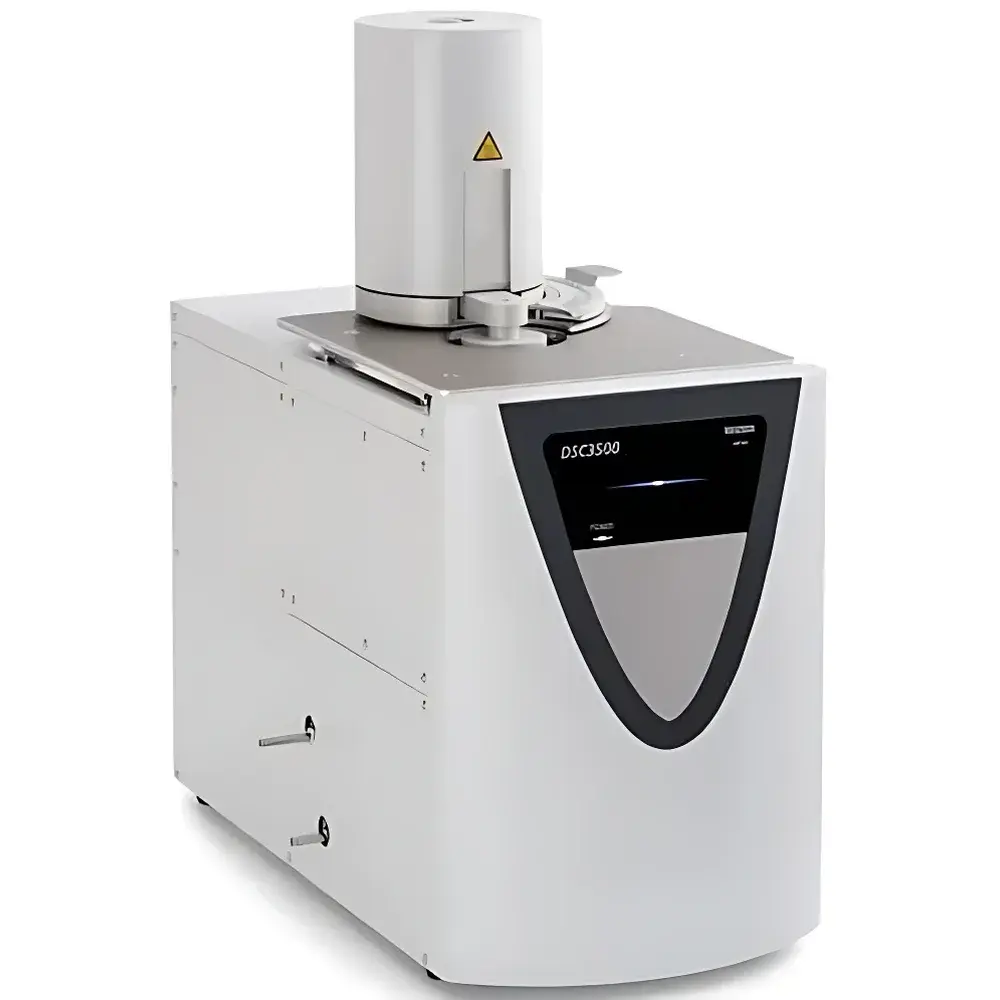
Netzsch DSC 3500 Sirius Differential Scanning Calorimeter
| Brand | Netzsch |
|---|---|
| Origin | Germany |
| Model | DSC 3500 Sirius |
| Temperature Range | −170 °C to 600 °C |
| Temperature Accuracy | ±0.1 K |
| Heating/Cooling Rate | 0.001–100 K/min (temperature-dependent) |
| Sensor Type | Heat-Flow |
| Calorimetric Range | ±650 mW |
| Enthalpy Accuracy | ±1% (vs. certified metals) |
| Atmosphere Options | Oxidizing or inert (static/dynamic) |
| ASC Capacity | Up to 20 sample/reference positions (optional) |
Overview
The Netzsch DSC 3500 Sirius is a high-performance, heat-flow-type differential scanning calorimeter engineered for precision thermal characterization across demanding research and industrial quality control environments. Operating on the fundamental principle of measuring differential heat flow between a sample and an inert reference as both are subjected to identical, precisely controlled temperature programs, the DSC 3500 Sirius delivers quantitative data on endothermic and exothermic transitions—including glass transitions (Tg), melting (Tm), crystallization (Tc), curing reactions, oxidative induction time (OIT), and specific heat capacity (Cp). Its extended operational range from −170 °C to 600 °C—enabled by a robust silver-furnace heating unit and integrated sensor architecture—ensures exceptional thermal stability, long-term calibration retention, and sub-millikelvin temperature resolution. Designed and manufactured in Selb, Germany, the instrument complies with core metrological requirements aligned with ISO 11357, ASTM E794, ASTM E1356, and USP , supporting GLP/GMP-compliant workflows where traceability and reproducibility are critical.
Key Features
- High-stability silver furnace with integrated heat-flow sensor, delivering superior baseline flatness and long service life
- Ultra-broad dynamic heating/cooling rate range (0.001–100 K/min), enabling kinetic analysis and rapid screening without hardware switching
- Proteus® software platform with intuitive MS Windows® interface, supporting fully automated measurement sequences, multi-step temperature programs, and real-time data visualization
- Advanced peak evaluation suite: automatic onset, peak, inflection, and endset detection; customizable baseline selection (linear, polynomial, BeFlat®); partial integration for overlapping transitions
- Comprehensive thermal transition analysis: Tg determination with step-height and midpoint methods; crystallinity calculation via enthalpy ratio against 100% crystalline standard; Cp measurement using sapphire calibration
- Tau-R correction module (optional): compensates for instrument time constant and thermal resistance effects to sharpen peak resolution and improve quantitative accuracy
- Temperature-modulated DSC (TM-DSC) capability (optional): deconvolutes total heat flow into reversible (thermodynamic) and irreversible (kinetic) components for complex polymer and pharmaceutical systems
- Full compliance with FDA 21 CFR Part 11 requirements when configured with audit trail, electronic signatures, and user access controls
Sample Compatibility & Compliance
The DSC 3500 Sirius accommodates a wide variety of sample forms—including powders, granules, films, fibers, gels, and small metallic pieces—using standardized aluminum, gold-plated aluminum, or high-pressure stainless-steel crucibles. Optional high-vacuum and reactive gas modules support measurements under O2, N2, Ar, He, or synthetic air, with mass flow controllers ensuring precise atmosphere management. The optional Automatic Sample Changer (ASC) supports unattended operation for up to 20 samples and references, significantly enhancing throughput in routine QC labs. All hardware and software components meet CE marking requirements and adhere to IEC 61010-1 safety standards. Instrument qualification documentation (DQ/IQ/OQ/PQ protocols) is available to support regulatory submissions in pharmaceutical, medical device, and food packaging applications.
Software & Data Management
Proteus® software serves as the unified control, acquisition, and analysis environment for the DSC 3500 Sirius. It operates natively on Windows® 10/11 platforms and supports both online (instrument-connected) and offline (post-acquisition) modes. Core functionalities include method templating, batch processing, spectral overlay, derivative thermograms (dH/dT), and export to CSV, ASCII, or proprietary .NETZ formats. Data integrity is ensured through configurable audit trails, version-controlled method storage, and encrypted raw data files. For enterprise integration, Proteus® offers OPC UA connectivity and API hooks for LIMS and MES systems. Software validation packages—including IQ/OQ documentation and test scripts—are provided to facilitate 21 CFR Part 11 compliance in regulated industries.
Applications
- Polymers & Composites: Crystallinity quantification, Tg mapping, crosslink density assessment, filler dispersion effects, aging studies
- Pharmaceuticals: Polymorph screening, amorphous content determination, excipient compatibility, stability-indicating assays
- Food Science: Fat crystallization kinetics, starch gelatinization, moisture migration effects, shelf-life prediction
- Electronics & Packaging: Thermal stability of adhesives, solder reflow profiling, barrier film performance, delamination onset
- Inorganics & Ceramics: Phase transformation temperatures, decomposition enthalpies, sintering behavior, catalyst thermal stability
- Personal Care & Cosmetics: Emulsion stability, wax melting profiles, surfactant phase behavior, rheological solid–liquid transitions
FAQ
What types of calibration standards are recommended for routine verification?
Certified indium, zinc, tin, and lead standards are used for temperature calibration; high-purity sapphire is employed for specific heat capacity calibration. Netzsch provides traceable calibration kits compliant with ISO/IEC 17025-accredited reference materials.
Is the DSC 3500 Sirius compatible with hyphenated techniques such as TGA-DSC or DSC-FTIR?
While the DSC 3500 Sirius is a standalone system, it features standardized gas outlet ports and electrical interfaces that enable integration with Netzsch’s STA 449 F3 or FTIR spectrometers via optional coupling modules—subject to mechanical and software configuration.
Can Proteus® software generate GMP-compliant reports with electronic signatures?
Yes—when deployed with user role management, audit trail logging, and digital signature modules enabled, Proteus® supports full 21 CFR Part 11 compliance for regulated reporting.
What maintenance intervals are recommended for the silver furnace and sensor assembly?
Under normal operating conditions (≤500 °C, inert atmosphere), no routine sensor replacement is required. Furnace cleaning is advised every 6–12 months depending on sample volatility and crucible usage; full calibration verification is recommended semiannually.
Does the ASC support different crucible types and sizes automatically?
The ASC accepts standard 5 mm and 7 mm diameter crucibles. Manual crucible type definition per position is required in the method setup; auto-detection is not supported.
Related Products



