
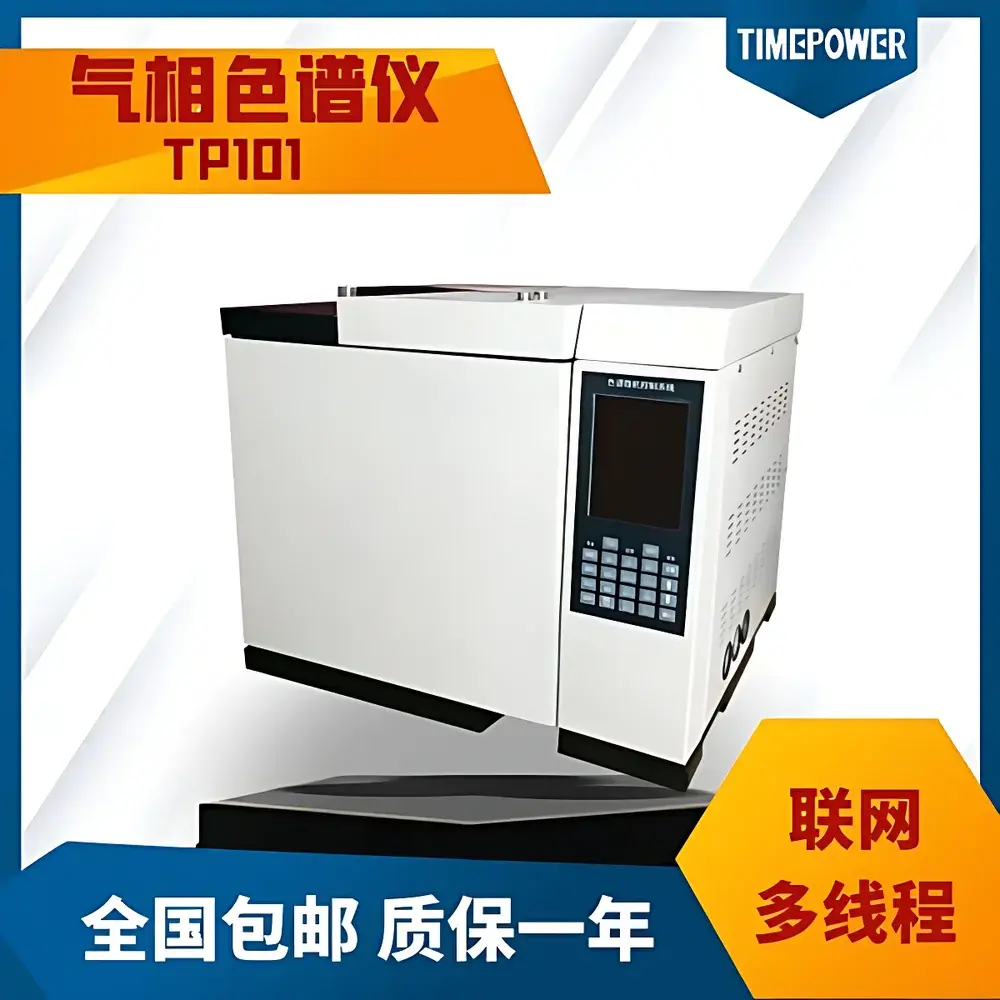
TIMEPOWER TP-101 Laboratory Gas Chromatograph
| Brand | TIMEPOWER |
|---|---|
| Model | TP-101 |
| Origin | Beijing, China |
| Manufacturer Type | Direct Manufacturer |
| Instrument Type | Laboratory Gas Chromatograph |
| Application Field | Petrochemical Industry-Specific |
| Oven Temperature Range | Ambient to 200 °C (Column Oven), up to 300 °C (Detector & Methanizer) |
| Temperature Control Accuracy | ≤ ±0.3 °C |
| Temperature Stability (Baseline Drift) | TCD ≤ 0.2 mV/30 min |
| Baseline Noise | TCD ≤ 0.1 mV |
| Sensitivity | TCD ≥ 1000 mV·mL/mg (benzene) |
| Carrier Gas Flow Range & Control | 0–1200 mL/min (N₂ or other compatible gases) |
| Methanizer Temperature | 380 °C |
| Detection Limits (ppm) | CH₄ 0.1 |
| Warm-up Time to Operational Stability | < 90 min |
| Display Resolution | 0.1 °C |
| Dimensions (W×D×H) | 620 × 445 × 485 mm |
| Weight | 31.8 kg |
| Power Supply | AC 220 V ±10%, 50 Hz |
Overview
The TIMEPOWER TP-101 is a dedicated laboratory-scale gas chromatograph engineered for high-reproducibility quantitative and qualitative analysis of permanent gases and light hydrocarbons in petrochemical, refinery, and industrial process environments. It operates on the fundamental principle of partition chromatography: analytes are vaporized in a heated inlet, carried through a capillary or packed column by an inert carrier gas (typically nitrogen or helium), and separated based on differential partitioning between the mobile phase (gas) and stationary phase (coated or adsorbed on column wall or packing material). Separated components elute at characteristic retention times and are detected using dual-detector capability—thermally conductive detection (TCD) for universal, non-destructive measurement and flame ionization detection (FID) for selective, high-sensitivity hydrocarbon quantification. The system integrates precise oven temperature programming, digitally stabilized detector electronics, and robust pneumatic control—enabling compliance with ASTM D1945, ISO 6974, and USP residual solvent testing protocols when configured with appropriate columns and calibration standards.
Key Features
- Modular dual-detector architecture supporting simultaneous or sequential TCD and FID operation with independent temperature zoning
- Microprocessor-controlled column oven with programmable ramp rates (0.1–40 °C/min), isothermal hold, and multi-step temperature gradients
- High-stability pneumatic system featuring mass flow-controlled carrier gas delivery (0–1200 mL/min) with real-time digital feedback and pressure monitoring
- Dedicated methanizer furnace (up to 380 °C) for catalytic conversion of CO and CO₂ to methane prior to FID detection—enabling sub-ppm quantification per ASTM D1945 Annex A2
- Low-noise, low-drift detector electronics: TCD baseline noise ≤ 0.1 mV; FID detection limit ≤ 5×10⁻¹² g/s (n-hexane), meeting GLP-grade performance criteria
- Integrated thermal management ensuring column oven uniformity ±0.3 °C across full operating range (ambient to 200 °C)
- Front-panel LCD interface with 0.1 °C temperature resolution and configurable alarm thresholds for overtemperature, low flow, or detector fault conditions
Sample Compatibility & Compliance
The TP-101 accommodates gaseous, liquid, and dissolved samples introduced via split/splitless injectors, gas-tight syringes, or automated valve loops. It is routinely deployed for analysis of refinery gas streams (C₁–C₅ hydrocarbons), syngas composition (H₂, CO, CO₂, CH₄), transformer oil dissolved gas analysis (DGA), and environmental air monitoring (VOCs, BTEX). Column selection—including PLOT Al₂O₃/KCl, Hayesep D, and fused silica capillaries—supports method development aligned with ISO 6974-2 (natural gas), ASTM D1945 (refinery gas), and EPA Method 18 (fugitive emissions). All temperature zones meet IEC 61000-6-3 EMC requirements; electrical safety complies with GB 4793.1 (equivalent to IEC 61010-1). System validation documentation supports IQ/OQ protocols under GMP and GLP frameworks.
Software & Data Management
The TP-101 interfaces with TIMEPOWER ChromaSuite™ PC software (Windows 10/11 compatible) for instrument control, sequence scheduling, peak integration, calibration curve generation (linear, quadratic, or multi-point), and report export in PDF, CSV, or XML formats. Audit trail functionality records all parameter changes, run logs, and user actions—fully compliant with FDA 21 CFR Part 11 requirements when enabled with electronic signatures and role-based access control. Raw data files retain native acquisition metadata (retention time, detector response, temperature setpoints, flow rates) for retrospective reprocessing. Optional LIMS connectivity via ASTM E1394 or HL7 messaging enables seamless integration into enterprise laboratory informatics environments.
Applications
- Petrochemical QA/QC: Hydrocarbon group-type analysis (PIONA), gasoline oxygenate determination (MTBE, ETBE), and sulfur compound profiling (e.g., mercaptans, sulfides)
- Power generation: Dissolved gas analysis (DGA) in insulating oils per IEC 60599 and IEEE C57.104
- Environmental monitoring: Quantification of ambient VOCs, landfill gas composition, and stack emissions per EPA Method 18 and TO-17
- Pharmaceutical manufacturing: Residual solvent testing in APIs and excipients per USP and ICH Q3C(R8)
- Forensic toxicology: Blood alcohol and volatile substance screening in clinical and judicial laboratories
- Research & development: Catalyst evaluation, reaction kinetics studies, and polymer degradation product identification
FAQ
What carrier gases are supported, and how is flow accuracy ensured?
Nitrogen, helium, hydrogen, and argon are compatible. Flow is regulated via a digitally controlled mass flow controller (MFC) with NIST-traceable calibration, delivering ±1% full-scale accuracy across 0–1200 mL/min.
Can the TP-101 be validated for GMP-regulated environments?
Yes—when paired with ChromaSuite™ audit trail mode, electronic signatures, and documented IQ/OQ protocols, it satisfies FDA 21 CFR Part 11 and EU Annex 11 requirements for computerized system validation.
Is method transfer possible from other GC platforms?
Method parameters (oven program, injection volume, detector settings) are exportable/importable in standard .mth format; column dimensions and phase chemistry determine retention time reproducibility across instruments.
What maintenance intervals are recommended for routine operation?
Detector cleaning every 3 months; inlet liner replacement every 100 injections; column trimming every 6 months or after exposure to dirty matrices; annual full system performance verification using certified test mixtures.
Does the system support unattended overnight operation?
Yes—sequence scheduling, auto-shutdown, and thermal safety interlocks enable extended unattended runs with email/SMS alerting for abnormal events (e.g., flame-out, pressure loss, temperature deviation).




