
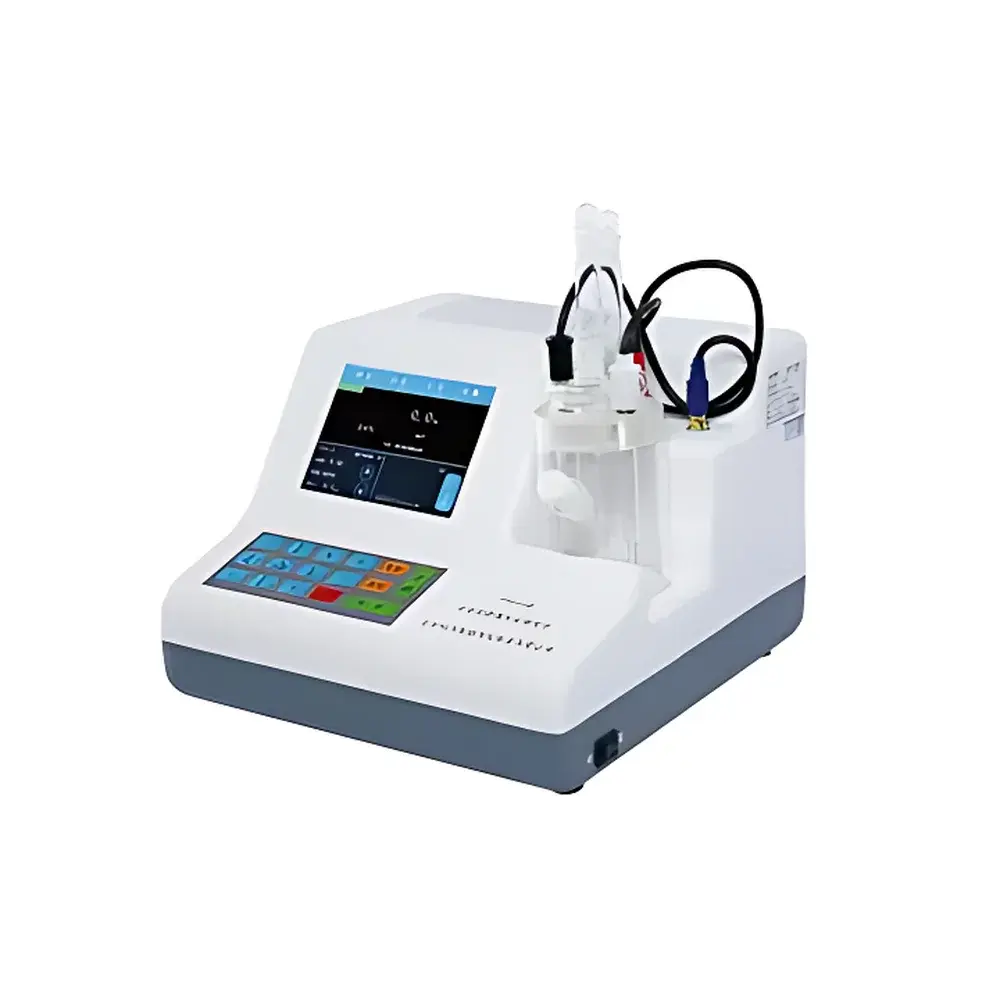
Timepower TP653 Coulometric Karl Fischer Moisture Titrator
| Brand | Timepower |
|---|---|
| Origin | Beijing, China |
| Manufacturer Type | Direct Manufacturer |
| Country of Origin | China |
| Model | TP653 |
| Pricing | Upon Request |
| Principle | Coulometric Karl Fischer Titration |
| Measurement Range | 3 µg – 100 mg H₂O |
| Resolution | 0.1 µg |
| Accuracy | ±20% at 3 µg, ±10% at 10 µg, ±5% at 100 µg, ±0.5% above 100 µg (excluding sampling error) |
| Electrolysis Current Control | 0–400 mA, auto-regulated |
| Display | 5.6-inch color TFT-LCD touchscreen |
| Operating Temperature | 20–30 °C |
| Relative Humidity | ≤85% RH |
| Power Supply | AC 220 V ±10%, 50 Hz ±10% |
| Max. Power Consumption | ≤40 W |
| Dimensions (W×D×H) | 300 × 290 × 200 mm |
| Weight | 3.7 kg |
| Sample Introduction | Manual syringe injection (0.5 µL / 50 µL / 1 mL), compatible with analytical balance input |
| Data Interface | RS-232 for balance & PC connectivity |
| Printer | Integrated thermal mini-printer |
| Compliance | GB/T 7600, GB/T 6283, SH/T 0246, SH/T 0255 |
| Sample Forms | Liquids, solids, gases |
| Electrolyte System | Iodine-generating coulometric cell with pyridine-free reagent option (SO₂, methanol, iodine precursor) |
Overview
The Timepower TP653 Coulometric Karl Fischer Moisture Titrator is an analytically rigorous, benchtop instrument engineered for trace-level water quantification in industrial and laboratory environments. It operates on the fundamental electrochemical principle of coulometric Karl Fischer titration—where iodine is generated *in situ* via controlled electrolysis at the anode, reacting stoichiometrically with water according to the Faraday law (1 mole I₂ ≡ 1 mole H₂O). This method eliminates volumetric reagent delivery errors and enables high-precision determination of water content down to 3 µg, making it especially suitable for low-moisture matrices such as lithium battery electrolytes, pharmaceutical excipients, transformer oils, and high-purity solvents. Unlike volumetric KF systems, the TP653 measures water content directly through charge integration (coulombs), ensuring intrinsic calibration stability and minimal drift over extended operation.
Key Features
- 32-bit embedded microprocessor core with real-time operating system for deterministic control loop execution and stable current regulation.
- Auto-regulated electrolysis current (0–400 mA) ensures optimal iodine generation kinetics across wide moisture concentration ranges—from ultra-trace (ppm) to mid-range (0.1%) levels.
- Integrated 5.6-inch color LCD touchscreen with physical membrane keys provides dual-mode operability, enhanced durability, and glove-compatible interaction in regulated lab settings.
- Real-time dynamic electrolysis curve visualization allows immediate assessment of reagent activity, endpoint detection fidelity, and cell conditioning status.
- Twelve pre-programmable analysis methods—including custom blank subtraction, drift compensation, and multi-step titration protocols—with six user-accessible slots for rapid method recall.
- Automated reagent dispensing and waste evacuation reduce operator exposure to hazardous KF reagents (e.g., SO₂, methanol-based electrolytes) and improve workflow reproducibility.
- Sealed, hydrophobic electrolytic cell design minimizes atmospheric moisture ingress, shortens equilibration time (<60 s after reagent fill), and extends usable electrolyte life by up to 40% versus conventional open-cell configurations.
- Full RS-232 connectivity supports direct integration with analytical balances (auto-sampling weight import) and LIMS or ELN platforms for audit-compliant data capture.
Sample Compatibility & Compliance
The TP653 accommodates diverse sample physical states—liquids (e.g., ethanol, acetone, lubricating oils), solids (e.g., polymers, APIs, desiccants), and gases (via gas-tight sampling loops)—without hardware modification. Its coulometric architecture avoids solvent compatibility limitations inherent in volumetric systems, enabling robust analysis of aggressive media including strong acids, amines, and halogenated solvents. The instrument complies with national standard methodologies GB/T 7600 (for insulating oils), GB/T 6283 (general chemical products), SH/T 0246 (light petroleum fractions), and SH/T 0255 (additive-containing lubricants). While not pre-certified to ISO 12937 or ASTM D6304, its operational parameters and validation framework align with GLP and GMP documentation requirements—including full audit trail support when paired with compliant PC software.
Software & Data Management
Data acquisition and reporting are managed via Timepower’s proprietary firmware, supporting timestamped result logging with operator ID, method ID, sample ID, ambient temperature/humidity metadata, and raw coulombic integral values. All measurements include automatic drift correction (based on pre-titration baseline monitoring) and optional blank subtraction. Export formats include CSV and plain-text reports, compatible with third-party statistical process control (SPC) tools. When connected to a validated computer system, the TP653 satisfies FDA 21 CFR Part 11 requirements for electronic records—provided appropriate access controls, electronic signatures, and audit trail configuration are implemented at the host level. Thermal printer output includes full method parameters, calculated water mass (µg), concentration (% w/w or ppm), relative standard deviation (RSD) if replicate runs are performed, and system status flags.
Applications
The TP653 delivers metrologically sound moisture data across regulated and process-critical domains: In power generation, it verifies moisture limits in turbine oils (ASTM D974-equivalent compliance) and SF₆ gas systems; in petrochemical QA/QC, it validates dryness specifications for ethylene oxide, MTBE, and jet fuel per IP 386; in pharmaceutical manufacturing, it supports ICH Q5C stability studies and excipient release testing under USP ; in electronics, it quantifies residual H₂O in Li-ion battery cathode slurries and packaging films; and in food-grade solvent production, it confirms compliance with FCC moisture thresholds for ethanol and glycerin. Its sub-10-µg repeatability makes it suitable for reference material certification and inter-laboratory comparison exercises.
FAQ
What safety precautions apply when handling the electrolyte?
KF electrolytes contain methanol and sulfur dioxide—both toxic and volatile. All reagent handling must occur in a certified fume hood with appropriate PPE (nitrile gloves, splash goggles). Never pipette by mouth; use positive-displacement syringes only.
How often should the electrolyte be replaced?
Replace when cumulative titration approaches 90% of the manufacturer-specified reagent capacity or when background drift exceeds 2 µg/min over a 5-minute interval—indicating oxidative degradation or moisture saturation.
Can the TP653 analyze viscous or particulate-laden samples?
Yes—solid samples may be dissolved in KF-compatible solvents (e.g., chloroform, formamide) prior to injection; suspended particles require filtration (0.45 µm PTFE) to prevent electrode fouling.
Is method validation support available?
Timepower provides IQ/OQ documentation templates and linearity, precision, LOD/LOQ verification protocols aligned with ICH Q2(R2) guidelines—intended for customer-executed qualification under qualified personnel supervision.
Does the instrument support GLP-compliant electronic signatures?
The device itself does not generate electronic signatures; however, its RS-232 output enables integration with validated LIMS or ELN platforms that implement 21 CFR Part 11-compliant signature workflows.




