
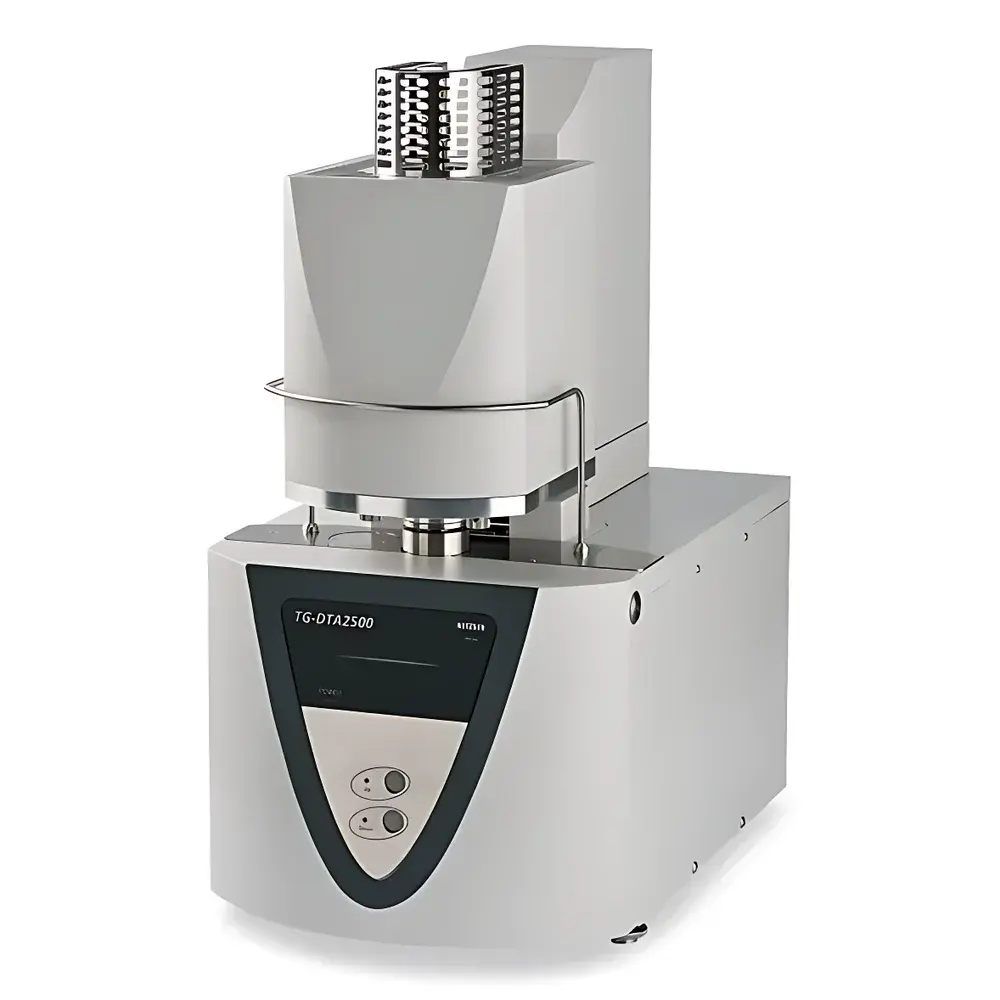
Netzsch STA 2500 Regulus Simultaneous Thermal Analyzer
| Brand | Netzsch |
|---|---|
| Origin | Germany |
| Model | STA 2500 Regulus |
| Temperature Range | RT to 1100°C (low-temperature furnace) / RT to 1600°C (high-temperature furnace) |
| Heating Rate | 0.001–100 °C/min (RT–1100°C) |
| Temperature Stability | ±0.1 °C |
| Maximum Sample Mass | 1 g |
| Thermogravimetric Resolution | 0.03 µg |
| Temperature Accuracy | ±0.3 K |
| Atmosphere Options | Inert, oxidizing, reducing, vacuum (dynamic or static) |
| Vacuum Tightness | ≤10⁻⁴ mbar (≤10⁻² Pa) |
| Gas Control | Integrated mass flow controllers (MFCs) with software-defined flow programming |
Overview
The Netzsch STA 2500 Regulus is a high-precision simultaneous thermal analyzer engineered for rigorous thermogravimetric analysis (TGA) and differential scanning calorimetry (DSC) or differential thermal analysis (DTA) in a single, vertically oriented measurement configuration. Based on the principle of dual-sensor differential measurement—where mass change is detected via a self-compensating microbalance and thermal effects are captured using symmetrically arranged thermocouples—the instrument delivers exceptional reproducibility and baseline stability across wide temperature domains. Its top-loading architecture ensures optimal gas flow dynamics, minimizes buoyancy artifacts and convection-induced noise, and enables seamless coupling with evolved gas analysis (EGA) systems such as FTIR, QMS, or GC-MS. Designed for laboratories requiring trace-level mass resolution and high-fidelity thermal event detection, the STA 2500 Regulus supports both routine QC workflows and advanced materials research under ISO 11357, ASTM E1131, ASTM E1641, and USP thermal characterization protocols.
Key Features
- Top-loading design with natural gas convection path—reduces cold condensation on the balance and extends sensor lifetime
- Self-compensating differential microbalance system—eliminates buoyancy drift and provides true mass stability independent of furnace temperature ramping
- Dual interchangeable furnace modules: low-temperature (RT–1100°C) and high-temperature (RT–1600°C) configurations, both optimized for rapid thermal equilibration and uniform axial temperature gradients
- Integrated mass flow controllers (MFCs) enabling precise, software-controlled gas switching and dynamic flow modulation during multi-step experiments
- Vacuum-compatible construction with leak rate ≤10⁻⁴ mbar—supports inert, oxidative, reductive, and static/vacuum atmospheres per ASTM D3850 and ISO 11358
- Thermogravimetric resolution of 0.03 µg and temperature stability of ±0.1 °C over full operational range
Sample Compatibility & Compliance
The STA 2500 Regulus accommodates standard crucibles in Al₂O₃, Pt, Al, and quartz—available in multiple geometries (e.g., flat-bottom, concave, lid-equipped) and capacities up to 1 g sample mass. The modular insert platform ensures mechanical compatibility across all crucible types, including large-volume variants. All thermal data comply with GLP/GMP documentation requirements when used with Proteus® software configured for audit-trail mode (21 CFR Part 11 compliant). Instrument validation adheres to IQ/OQ protocols aligned with ISO/IEC 17025 and ASTM E967 standards. Routine calibration includes certified reference materials (e.g., Ni, In, Zn, Al₂O₃) for temperature, enthalpy, and mass accuracy verification.
Software & Data Management
Data acquisition and post-processing are executed via Proteus®—a Windows-based, modular software suite developed exclusively for Netzsch thermal analyzers. Proteus supports real-time synchronization of TGA and DTA/DSC signals, automated peak detection (onset, peak, endset), derivative calculation (DTG, d²m/dt²), and quantitative kinetic modeling (e.g., Friedman, Ozawa-Flynn-Wall, ASTM E698). Advanced modules include Peak Separation (for overlapping decomposition steps) and Kinetics Neo (for model-free and model-fitting activation energy analysis). Raw data export is available in ASCII, CSV, and universal .tdf formats; reports are customizable and support embedded metadata (operator ID, instrument serial, calibration date, atmosphere log). Offline analysis is fully functional on any Windows PC with Proteus installed.
Applications
- Decomposition kinetics and thermal stability assessment of polymers, composites, and pharmaceutical excipients
- Oxidative induction time (OIT) and oxidation onset temperature determination per ASTM D3895 and ISO 11357-6
- Residue quantification in catalysts, ceramics, and battery electrode materials
- Hydration/dehydration behavior in hydrates, MOFs, and clays
- Reaction enthalpy and phase transition characterization (glass transitions, crystallization, melting) under controlled atmospheres
- Evolved gas analysis (EGA) workflows—correlating mass loss events with real-time FTIR/QMS spectral fingerprints for mechanistic insight into pyrolysis pathways
FAQ
What furnace options are available for the STA 2500 Regulus?
Two plug-and-play furnace modules are supported: a low-temperature unit (RT–1100°C) and a high-temperature unit (RT–1600°C), each optimized for thermal homogeneity and rapid cooldown.
Can the instrument operate under reducing atmospheres such as H₂ or CO?
Yes—the gas handling system supports fully programmable reducing gas mixtures, with integrated safety interlocks and leak-check routines prior to high-temperature operation.
Is Proteus® software validated for regulated environments (e.g., pharmaceutical QA)?
When deployed with electronic signature, audit trail, and user access control enabled, Proteus meets 21 CFR Part 11 requirements for data integrity in GxP settings.
How is buoyancy correction handled during high-rate heating?
The self-compensating differential balance architecture inherently rejects convective and buoyancy artifacts—no post-acquisition correction algorithms are required for accurate mass tracking at up to 100 °C/min.
What EGA interfaces are certified for use with the STA 2500 Regulus?
Factory-integrated interfaces exist for Bruker Tensor series FTIR, Pfeiffer Omnistar QMS, and Agilent 5977B GC-MS systems—including heated transfer lines, pressure regulation, and synchronized trigger logic.



