
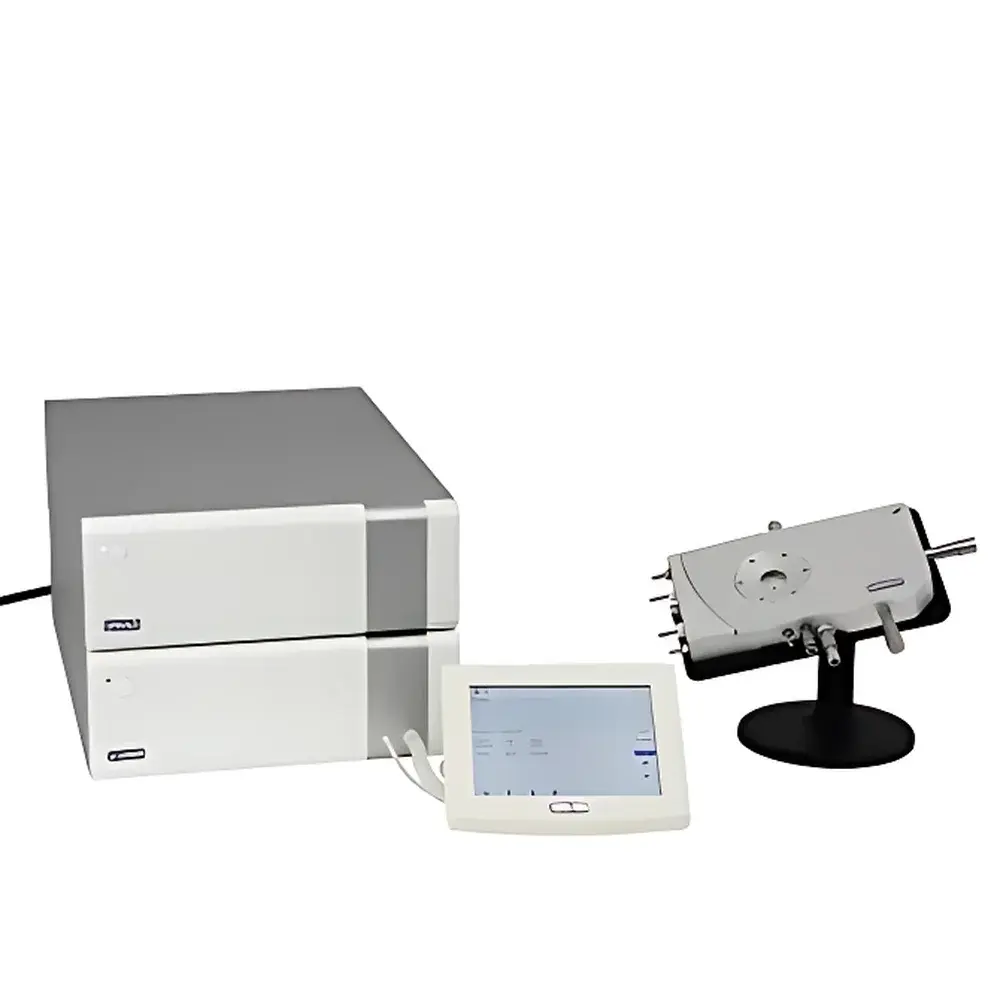
Linkam LTSE420 Liquid Crystal Stage with Integrated Electrodes and Environmental Chamber
| Brand | Linkam |
|---|---|
| Origin | United Kingdom |
| Model | LTSE420 |
| Temperature Range | Ambient to +420 °C (with optional cryo-cooling: down to −196 °C) |
| Temperature Stability | <0.01 °C |
| Temperature Resolution | 0.01 °C |
| Electrode Configuration | Standard dual-electrode |
| Optical Aperture | Ø2.4 mm |
| Sample XY Translation | 15 × 15 mm |
| Stage Surface Area | 53.5 × 43 mm |
| Compatible Sample Holders | Standard 76 × 26 mm microscope slides or Ø16 mm coverslips |
| Heating Rate | 0.1–50 °C/min |
| Minimum Objective Working Distance | 6.0 mm |
| Minimum Condenser Working Distance | 13.2 mm |
| Stage Dimensions | 160 × 80 × 24 mm |
Overview
The Linkam LTSE420 is a precision-engineered liquid crystal stage designed explicitly for in-situ optical characterization of anisotropic soft matter under controlled thermal, electrical, and environmental conditions. Built upon Linkam’s proven Peltier- and resistive-heating platform architecture, the LTSE420 integrates a hermetically sealed sample chamber with embedded parallel-plate electrodes—enabling simultaneous temperature ramping, electric field application, and real-time polarized optical microscopy (POM). Its core measurement principle relies on thermally induced phase transitions (e.g., isotropic–nematic–smectic) and electric-field-driven reorientation of mesogenic molecules, observed via birefringence changes under crossed polarizers. The stage is optimized for integration with upright and inverted research-grade microscopes, supporting high-magnification objectives with minimal working distance constraints. Unlike generic heating stages, the LTSE420’s electrode geometry, thermal uniformity across the 53.5 × 43 mm active area, and sub-0.01 °C temperature stability meet the stringent requirements of quantitative liquid crystal physics, electro-optic response analysis, and materials qualification per ISO 10993-12 and ASTM D3350 protocols.
Key Features
- Integrated dual-electrode system fabricated directly into the stage substrate, enabling direct voltage application (DC or AC up to 1 kHz) across standard conductive glass LC cells without external wiring clutter.
- Hermetically sealed environmental chamber with vacuum-rated O-ring sealing and dual gas inlet/outlet ports—compatible with nitrogen purging, low-humidity (<5% RH) operation, or controlled partial-pressure atmospheres.
- High-fidelity temperature control using a PID-regulated resistive heater and integrated Pt100 sensor, delivering ±0.01 °C setpoint accuracy and <0.01 °C short-term stability over 30-minute dwell periods.
- Optimized optical path: Ø2.4 mm central aperture aligned with stage center, preserving Köhler illumination integrity and minimizing thermal lensing effects at high magnifications.
- Motorized or manual XY translation (15 × 15 mm range) with micrometer-adjustable locking, facilitating precise positioning of capillary-filled LC cells (typical thickness: 5 µm) or sandwich-type devices.
- Modular mounting interface compatible with standard polarizing microscope nosepieces and rotating stage adapters—enabling full 360° azimuthal rotation during texture evolution studies.
Sample Compatibility & Compliance
The LTSE420 accommodates standard LC sample formats: commercially available conductive ITO-glass cells (Ø16 mm or 76 × 26 mm slide format), custom capillaries (filled via capillary action to ~5 µm effective gap), and polymer-stabilized or nanoparticle-doped composite films. Its sealed chamber supports GLP-compliant documentation of ambient parameters (pressure, gas composition, dew point) when paired with external sensors and data loggers. The stage conforms to CE marking requirements for laboratory electrical equipment (2014/30/EU EMC Directive and 2014/35/EU LVD Directive) and is routinely deployed in environments adhering to ISO/IEC 17025-accredited testing workflows. No modifications are required for use in Class 1000 cleanrooms; surface finishes meet ISO 14644-1 particle emission thresholds.
Software & Data Management
Control is executed via Linkam’s TC124 temperature controller and optional TMS94 software suite (Windows-based), which supports multi-segment temperature ramps, synchronized analog voltage output (±10 V, 16-bit resolution) for electrode biasing, and TTL-triggered image capture integration with common camera SDKs (e.g., Thorlabs DCx, Hamamatsu ORCA). All temperature and voltage profiles are timestamped and stored in CSV/ASCII format with millisecond resolution. Audit trails—including user ID, parameter changes, and system error logs—are retained locally and exportable for FDA 21 CFR Part 11 compliance when deployed with validated electronic signature modules. Raw thermal/electrical metadata can be imported into MATLAB, Python (via PyLinkam), or OriginLab for derivative analysis (e.g., clearing point determination, dielectric relaxation time constants).
Applications
- Dynamic texture analysis of nematic, cholesteric, and ferroelectric LC phases during heating/cooling cycles.
- Electric-field-induced Freedericksz transition threshold measurement and response time quantification (τon/τoff).
- In-situ polymerization of reactive mesogens under UV irradiation within thermally stabilized inert atmospheres.
- Thermotropic behavior assessment of lyotropic systems (e.g., surfactant-water mesophases) under controlled humidity gradients.
- Reliability testing of LC-based optical shutters, tunable lenses, and spatial light modulators across extended thermal excursions.
- Correlative studies combining POM with Raman spectroscopy or fluorescence lifetime imaging (FLIM), leveraging the stage’s compatibility with side-illumination ports and confocal alignment.
FAQ
Can the LTSE420 be used with immersion objectives?
Yes—its 6.0 mm minimum objective working distance and low-profile design support 40× and 60× water- or glycerol-immersion objectives when combined with thin-bottomed LC cells.
Is vacuum operation supported out of the box?
The chamber is vacuum-rated to 10−2 mbar using the standard O-ring seal; optional vacuum feedthroughs for electrical leads are available as accessories.
Does the stage support bidirectional current flow for electrochemical LC studies?
No—the integrated electrodes are configured for passive voltage bias only; for true 4-wire impedance measurements, external potentiostat integration via BNC breakout is recommended.
What calibration documentation is supplied?
Each unit ships with a UKAS-traceable temperature calibration certificate (at 25 °C, 100 °C, 200 °C, and 400 °C) and mechanical alignment report verifying aperture concentricity and XY orthogonality.
Can third-party software trigger temperature ramps via serial command?
Yes—the TC124 controller supports ASCII-based RS232/USB-VCP commands (e.g., “SET TEMP 120.0”, “START RAMP”) fully documented in the Linkam Developer Manual v4.2.



