
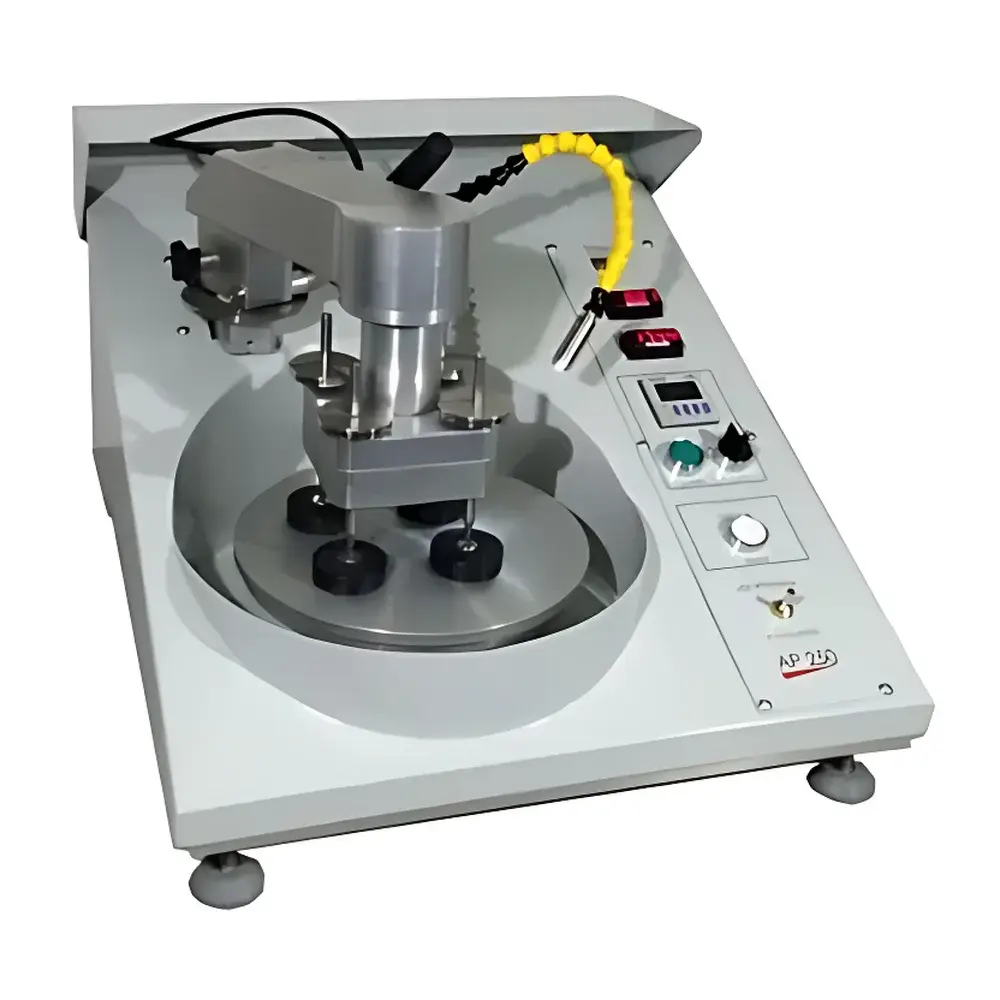
FLOXLAB AP 250 Automatic Polishing System
| Brand | FLOXLAB |
|---|---|
| Origin | France |
| Model | AP 250 |
| Speed Range | 10–600 rpm |
| Sample Dimensions | 30×45 mm, 60×45 mm (1×1.5 in, 1×3 in) |
| Polishing Plate Diameter | 250 mm |
| Dimensions (W×D×H) | 526×589×380 mm |
| Weight | 50 kg |
| Power Supply | 220 V, 50/60 Hz |
Overview
The FLOXLAB AP 250 Automatic Polishing System is a precision-engineered laboratory instrument designed for standardized, reproducible preparation of petrographic thin sections and rock specimens in petroleum geoscience laboratories. Built upon a robust electromechanical architecture, the AP 250 employs controlled rotational polishing using concentric plate motion to achieve uniform surface planarity and optimal optical clarity—critical prerequisites for quantitative petrographic analysis under transmitted light microscopy and subsequent digital image-based mineralogical quantification. Unlike manual or semi-automated systems, the AP 250 integrates programmable speed modulation and fixed-time cycle logic to eliminate operator-induced variability across sequential polishing stages—from coarse grinding through intermediate diamond lapping to final colloidal silica or aluminum oxide suspension finishing. Its dual-stage sample holder accommodates up to four standard-sized thin sections simultaneously, enabling batch processing without cross-contamination or positional drift.
Key Features
- Four-position specimen carrier with independent clamping force adjustment ensures consistent pressure distribution across all samples during simultaneous polishing.
- Digitally regulated DC motor delivers precise speed control from 10 to 600 rpm in 1-rpm increments, supporting ASTM D5777-compliant polishing protocols for siliceous and carbonate-rich reservoir rocks.
- 250 mm diameter cast-iron polishing plate with integrated coolant channeling minimizes thermal distortion and extends abrasive disc service life.
- Programmable timer with memory for up to 12 user-defined polishing sequences—including pre-set routines for epoxy-impregnated sandstones, shales, and dolomitic carbonates.
- Ergonomic height-adjustable base and front-accessible fluid reservoir simplify maintenance and reduce operator fatigue during extended workflow sessions.
- CE-marked electrical system compliant with IEC 61000-6-2 (EMC immunity) and IEC 61000-6-4 (EMC emissions) standards for integration into ISO/IEC 17025-accredited testing environments.
Sample Compatibility & Compliance
The AP 250 accepts standard petrographic specimen formats including 30×45 mm and 60×45 mm thin sections—compatible with industry-standard glass slides, epoxy-mounted cores, and polished blocks used in routine reservoir characterization. It supports both water-based and non-aqueous polishing media, including 9 µm to 0.02 µm diamond suspensions and pH-stabilized colloidal silica dispersions. All mechanical and electrical components conform to EN 60204-1 for safety of machinery and are validated for use in laboratories operating under GLP (Good Laboratory Practice) frameworks per OECD Series on Principles of Good Laboratory Practice. The system’s repeatable material removal rate (MRR) profile enables traceable correlation between polishing parameters and resulting surface roughness (Ra < 0.05 µm post-final step), satisfying requirements for ASTM D3418 and ISO 1127 for geological sample preparation.
Software & Data Management
While the AP 250 operates via intuitive front-panel controls, optional RS-485 serial interface enables integration with centralized laboratory information management systems (LIMS). Logged operational data—including actual speed, elapsed time per stage, total runtime, and motor load feedback—is timestamped and exportable as CSV for audit trails. When deployed in regulated environments (e.g., upstream QA/QC labs serving API RP 14C or ISO 14224 compliance programs), the system supports manual logbook entry synchronization and can be configured to generate PDF-formatted polishing reports aligned with 21 CFR Part 11 electronic record requirements when paired with validated third-party software.
Applications
- Preparation of thin sections for optical petrography and cathodoluminescence (CL) imaging in clastic and carbonate reservoir evaluation.
- Standardized polishing of drill core plugs prior to mercury intrusion porosimetry (MIP) and nitrogen BET surface area analysis.
- Surface conditioning of shale samples for focused ion beam–scanning electron microscopy (FIB-SEM) tomography workflows.
- Routine quality assurance of polished surfaces in ISO 17025-certified petroleum testing laboratories performing API RP 40 or ASTM D388 assessments.
- Method development for automated polishing of unconventional reservoir analogs containing brittle minerals (e.g., quartz, feldspar) and ductile phases (e.g., clay, bitumen).
FAQ
What types of rock matrices are compatible with the AP 250?
The system is validated for siliciclastic, carbonate, evaporite, and low-metamorphic-grade metamorphic rocks. High-quartz sandstones and anhydrite require diamond grit sequencing; organic-rich shales benefit from low-speed, high-pressure final polishing.
Can the AP 250 be integrated into an existing LIMS platform?
Yes—via optional RS-485 interface and Modbus RTU protocol support. Integration requires configuration by qualified laboratory IT personnel and validation per site-specific SOPs.
Is the polishing plate interchangeable with other FLOXLAB models?
No—the 250 mm plate is mechanically and thermally optimized for the AP 250’s torque profile and cooling architecture. Cross-model interchangeability is not supported.
Does the system include calibration documentation for ISO/IEC 17025 accreditation?
A factory calibration certificate covering rotational speed accuracy (±0.5% of setpoint) and timer deviation (±0.1 s over 60 min) is supplied with each unit. On-site verification tools and procedures are provided in the technical manual.
What maintenance intervals are recommended for daily operation?
Daily: cleaning of coolant channels and inspection of clamp integrity. Quarterly: motor brush inspection and bearing lubrication. Annual: full torque calibration and electrical safety test per EN 61000-4-8.





