
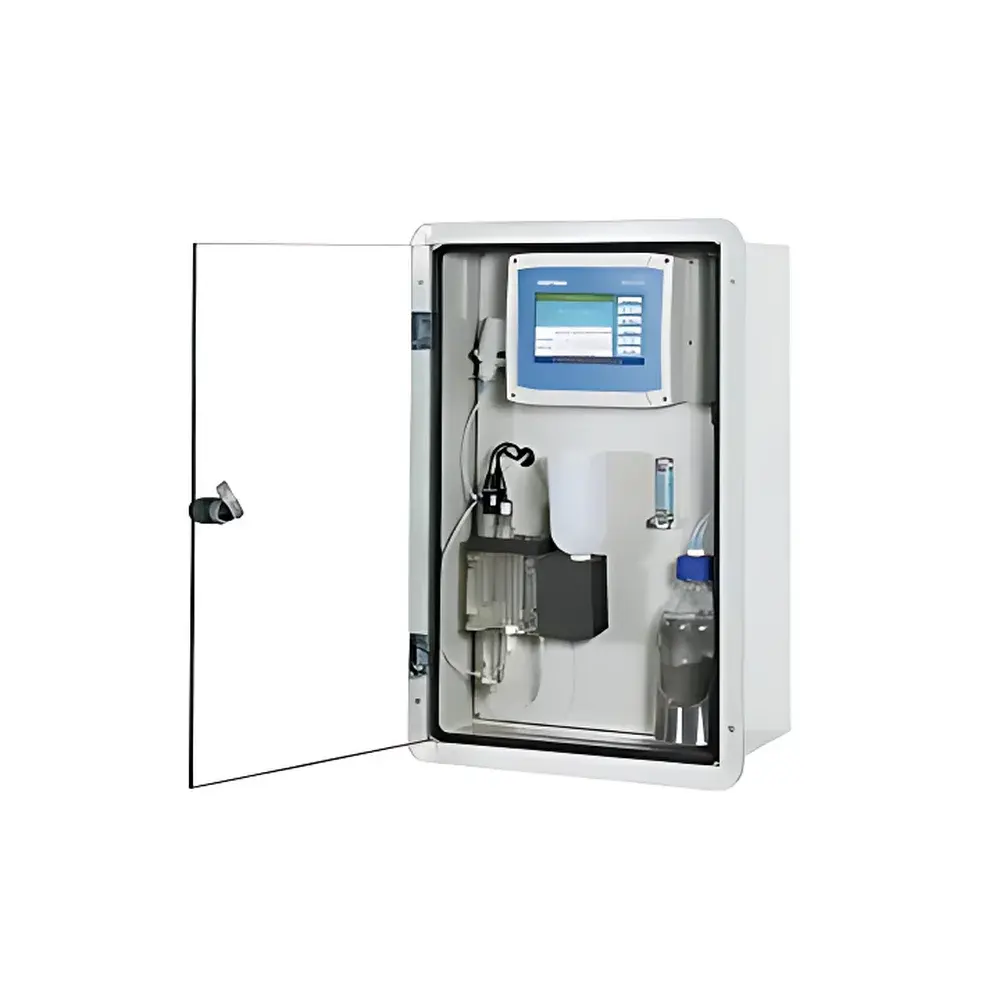
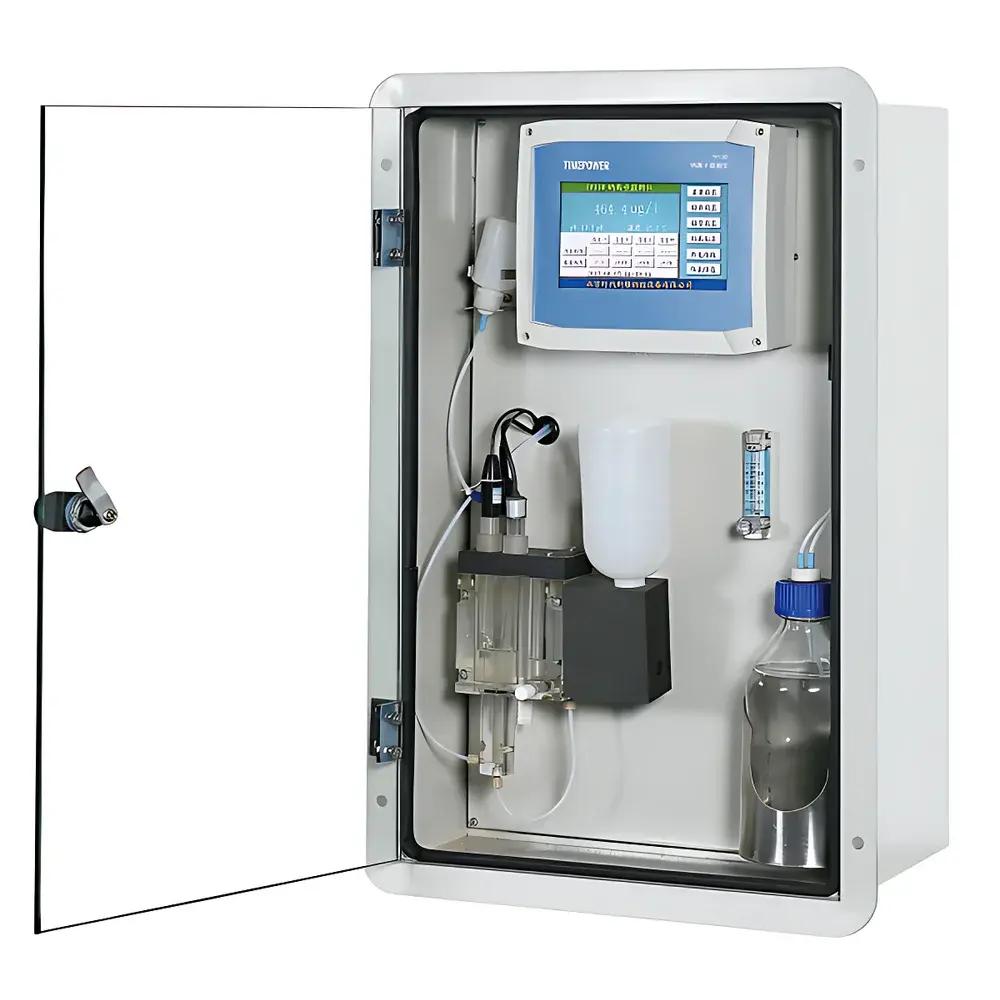
Timepower TP130 Online Sodium Ion Monitor
| Brand | Timepower |
|---|---|
| Model | TP130 |
| Origin | Beijing, China |
| Manufacturer | Timepower Instrument Co., Ltd. |
| Category | Online Electrochemical Analyzer for Sodium Ion (Na⁺) |
| Measurement Principle | Potentiometric Detection via Sodium-Selective Electrode (Nernstian Response) |
| Display | 7.0-inch Color TFT Touchscreen (Chinese UI) |
| Measurement Range | pNa 0.00–9.36 (equivalent to 0.01 µg/L – 23.0 g/L Na⁺) |
| Accuracy | ±0.03 pNa or ±3 µg/L (whichever is greater) |
| Repeatability | ≤±1% F.S. |
| Drift | <±0.02 pNa/24 h or <±0.5 µg/L/24 h |
| Temperature Compensation Range | 0–60 °C |
| Calibration Method | Two-point calibration (using standard Na⁺ solutions) |
| Response Time | <2 min |
| Sample Flow Rate | 10–40 L/h |
| Sample Temperature | 0–60 °C |
| Sample Particulate Limit | <5 µm, no colloidal content |
| Ambient Operating Conditions | 5–45 °C, ≤90% RH (non-condensing) |
| Reagent Consumption | ~1.5 L/month (diisopropylamine, DIPA) |
| Output Signals | Isolated 0–20 mA / 4–20 mA / 0–10 mA (≤750 Ω) |
| Alarm Outputs | Independent relay outputs per channel (flow failure, high/low limit) |
| Power Supply | AC 85–265 V, 45–65 Hz |
| Power Consumption | ≤100 W |
| Dimensions (W×H×D) | 460 × 720 × 280 mm |
| Panel Cutout | 670 × 410 mm |
| Weight | 22 kg |
| Data Storage | Cyclic non-volatile memory |
| Channel Configurability | 1–4 independent measurement channels |
| A/D Resolution | 24-bit |
| Microcontroller Architecture | Low-power, high-integrity single-chip system |
Overview
The Timepower TP130 Online Sodium Ion Monitor is a dedicated potentiometric analyzer engineered for continuous, real-time measurement of sodium ion activity (expressed as pNa) in aqueous process streams. It operates on the Nernst equation principle: at 25 °C, an ideal sodium-selective electrode exhibits a theoretical slope of 59.16 mV per decade change in Na⁺ activity. In practice, electrode performance deviates due to membrane composition, hydration state, and interference from H⁺ and other alkali ions—necessitating rigorous two-point calibration using traceable Na⁺ standards. The TP130 integrates a sodium-selective composite electrode, pH-sensing element, and PT1000 temperature probe into a single measurement loop, enabling simultaneous pNa, pH, and temperature acquisition with automatic thermal compensation. Designed for industrial environments where steam purity and boiler water chemistry are mission-critical—particularly in fossil-fueled power plants—the instrument meets functional requirements aligned with ASTM D4582 (Standard Practice for Measuring Sodium in High-Purity Water) and supports compliance frameworks referenced in ASME PTC 19.11 and IAPWS TR-10. Its architecture prioritizes long-term stability over short-term peak performance, with drift specifications validated under continuous 24-hour operation.
Key Features
- Configurable 1–4 channel architecture: Enables scalable deployment across multiple sampling points without redundant hardware investment.
- 24-bit high-resolution analog-to-digital conversion: Ensures sub-microgram-per-liter resolution in low-concentration regimes (<10 µg/L), critical for supercritical boiler feedwater monitoring.
- Integrated triple-sensor probe interface: Simultaneous acquisition of pNa, pH, and temperature eliminates inter-channel timing errors and simplifies calibration synchronization.
- Non-volatile cyclic data storage: Logs timestamped measurements, calibration events, and alarm states; retains full history for >10 years without battery backup.
- Industrial-grade touchscreen HMI: 7.0-inch resistive TFT display with Chinese-language menu navigation, engineered for glove-compatible operation in control rooms and field enclosures.
- Flexible analog output configuration: User-selectable 0–20 mA, 4–20 mA, or 0–10 mA isolated current loops compliant with IEC 61000-6-2/4 EMC standards.
- Robust mechanical design: Front-panel cutout mounting (670 × 410 mm), IP54-rated enclosure, and shock-absorbing internal layout suitable for turbine hall or chemical dosing skid integration.
Sample Compatibility & Compliance
The TP130 accepts liquid samples within a flow range of 10–40 L/h and temperature band of 0–60 °C. To ensure electrochemical integrity, inlet water must contain no suspended solids exceeding 5 µm and must be free of colloidal silica or organic fouling agents—conditions routinely verified upstream by cartridge filtration and UV oxidation in high-purity water systems. The instrument complies with electromagnetic compatibility directives (EN 61326-1), safety standards (IEC 61010-1), and supports audit-ready operation under GLP/GMP-aligned workflows. While not FDA 21 CFR Part 11-certified out-of-the-box, its event-logged calibration records, user-accessible audit trail, and password-protected parameter modification provide foundational traceability for regulated pharmaceutical or biotech applications.
Software & Data Management
Data handling is implemented via embedded firmware—not external PC software—ensuring deterministic response and immunity to OS-level vulnerabilities. All measurements are time-stamped using an onboard RTC synchronized during power-up. Calibration logs include date/time, standard concentrations used, calculated electrode slope (mV/decade), and zero offset—stored alongside raw sensor mV outputs. Alarms (e.g., flow loss, pNa excursion, electrode timeout) trigger relay closures and persist in memory until acknowledged. Export is limited to manual USB dump of CSV-formatted archives; no cloud connectivity or remote telemetry is included, preserving network isolation required in critical infrastructure SCADA environments.
Applications
- Power generation: Continuous monitoring of condensate, feedwater, and steam cycle sodium to detect early-stage tube leakage or resin breakthrough in mixed-bed demineralizers.
- Chemical manufacturing: Control of sodium carryover in caustic soda production and catalyst recovery loops where Na⁺ impurity affects product grade.
- Pharmaceutical water systems: Verification of sodium limits in Purified Water (PW) and Water for Injection (WFI) per USP and EP 2.2.48.
- Municipal water treatment: Detection of sodium intrusion in desalinated seawater or brackish groundwater blending operations.
- Fertilizer production: Monitoring of ammonium-based process streams where Na⁺ competes with NH₄⁺ in ion-exchange regeneration cycles.
FAQ
What calibration standards are required for routine operation?
Two certified Na⁺ standard solutions—typically 0.1 µg/L and 10 µg/L—are recommended for daily verification; higher concentrations (e.g., 100 µg/L) may be used for span checks in high-range applications.
Is diisopropylamine (DIPA) mandatory for low-level sodium measurement?
Yes. DIPA suppresses H⁺ interference below pH 10.5, extending effective pNa detection down to 0.01 µg/L; omission results in significant positive bias above 50 °C.
Can the TP130 operate unattended for extended periods?
Yes. With stable sample conditioning, quarterly electrode replacement, and monthly DIPA replenishment, mean time between interventions exceeds 90 days in typical utility service.
Does the instrument support MODBUS RTU or TCP/IP communication?
No. The TP130 provides only analog current outputs and dry-contact relays; third-party PLC integration requires external signal converters.
How is electrode drift compensated during long-term deployment?
Drift is managed through scheduled two-point recalibration and by monitoring the electrode’s measured slope value—deviations >5% from initial calibration trigger maintenance alerts.




