
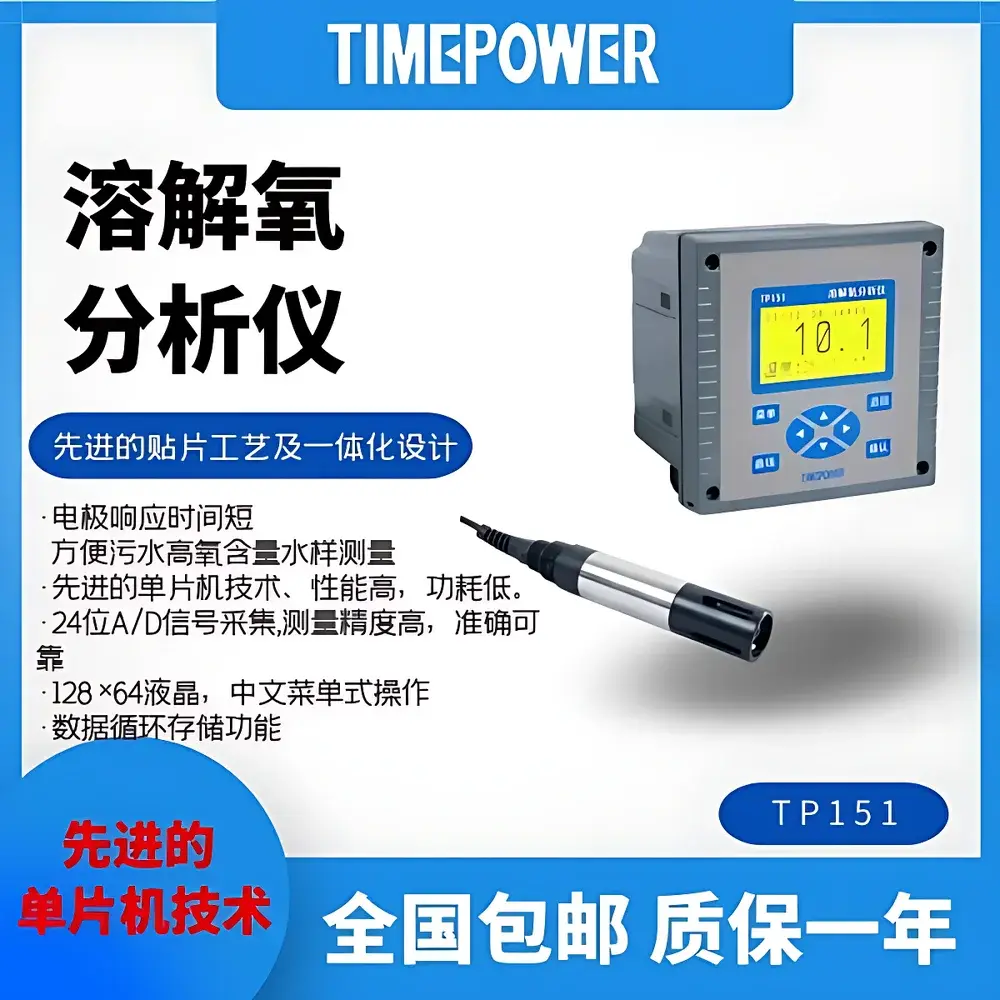
TimePower TP150 Online Dissolved Oxygen Analyzer
| Brand | TimePower |
|---|---|
| Origin | Beijing, China |
| Manufacturer Type | Manufacturer |
| Product Category | Domestic |
| Model | TP/150 |
| Instrument Type | Online |
| Measurement Principle | Electrochemical Galvanic Cell Probe |
| Measurement Range | 0.00–80.00 mg/L |
| Accuracy | ±0.2 mg/L |
| Repeatability | 0.05% |
| Detection Limit | ±2 ppb (at 0 µg/L baseline) |
Overview
The TimePower TP150 Online Dissolved Oxygen Analyzer is an industrial-grade, continuous-monitoring instrument engineered for high-stability electrochemical measurement of dissolved oxygen (DO) in aqueous environments. It operates on the galvanic cell principle — a self-powered, zero-current electrochemical transduction method where oxygen diffusion through a selective gas-permeable membrane drives a spontaneous redox reaction between cathode and anode materials, generating a current linearly proportional to DO concentration. Unlike polarographic sensors requiring external polarization voltage, the galvanic design ensures rapid response, low maintenance, and inherent stability over extended deployment periods — especially critical in wastewater treatment plants, drinking water distribution systems, aquaculture facilities, and bioreactor process control. The TP150 is specifically optimized for sub-ppm (µg/L) level detection, with a verified lower detection limit of ±2 ppb at zero-oxygen baseline, making it suitable for ultra-low DO applications such as deaerator outlet monitoring, pharmaceutical water systems (PW/WFI), and anaerobic digestion control.
Key Features
- Galvanic cell sensor architecture with integrated temperature compensation (Pt1000 RTD) and pressure correction algorithm for field-deployed accuracy.
- 24-bit A/D signal acquisition circuitry ensuring high-resolution analog-to-digital conversion and minimal quantization error across the full 0.00–80.00 mg/L range.
- Microcontroller-based embedded system with low-power consumption (<3 W typical), enabling stable operation in unconditioned outdoor enclosures or panel-mounted installations.
- Onboard non-volatile memory storing up to 3,000 timestamped measurement records with circular buffer management; data retention exceeds 10 years after power loss.
- Configurable 4–20 mA analog output with HART® protocol support (optional), plus two user-programmable relay outputs for alarm or control actuation (e.g., air blower activation, chemical dosing initiation).
- Intuitive Chinese-language menu interface with dual-line LCD display, soft-key navigation, and context-sensitive help prompts — designed for operator efficiency in multi-shift industrial settings.
Sample Compatibility & Compliance
The TP150 is validated for continuous immersion in potable water, surface water, activated sludge effluent, seawater (with optional fouling-resistant membrane), and purified water streams meeting USP and EP 2.2.48 specifications. Its galvanic probe exhibits minimal drift in variable pH (5.0–9.0) and conductivity (50 µS/cm–20 mS/cm) conditions. The analyzer complies with IEC 61000-6-2 (immunity) and IEC 61000-6-4 (emission) standards for industrial environments. While not certified to SIL or ATEX, its robust IP66-rated housing and intrinsically safe signal conditioning make it suitable for Zone 2 classified areas when installed per local electrical codes. Data logging functionality supports GLP-compliant audit trails when paired with TimePower’s optional PC-based configuration software.
Software & Data Management
Configuration and calibration are performed via front-panel interface or optional Windows-based PC utility (TP-Config v3.2), which provides firmware update capability, calibration history export (CSV), and real-time trend visualization. All calibration events — including zero-point (sodium sulfite solution) and span-point (air-saturated water or Winkler titration reference) — are time-stamped and stored with operator ID fields. The system supports 21 CFR Part 11–compliant electronic signatures when deployed with networked authentication servers. Raw data export includes measurement value, temperature, pressure, sensor status flags (e.g., membrane integrity, electrolyte depletion warning), and diagnostic logs — facilitating integration into SCADA, DCS, or LIMS platforms via Modbus RTU or ASCII serial protocols.
Applications
- Real-time DO monitoring in municipal wastewater treatment: aeration basin control, nitrification/denitrification optimization, and final effluent compliance reporting per EPA Method 360.1.
- Process water quality assurance in food & beverage production lines, particularly post-sterilization cooling water and CIP rinse validation.
- Environmental monitoring networks: river and reservoir DO profiling stations, where long-term sensor stability reduces site visit frequency and maintenance costs.
- Pharmaceutical purified water (PW) and water-for-injection (WFI) distribution loops, supporting FDA guidance on microbial growth prevention through continuous low-level DO surveillance.
- Industrial boiler feedwater deaeration verification, ensuring oxygen scavenger dosing efficiency and minimizing corrosion risk in high-pressure steam systems.
FAQ
What calibration standards are required for routine maintenance?
Zero calibration uses freshly prepared sodium sulfite solution (0.00 mg/L); span calibration employs air-saturated water at ambient temperature and barometric pressure, or a certified Winkler titration standard.
Can the TP150 be used in seawater or high-salinity environments?
Yes — with the optional hydrophobic PTFE membrane and stainless-steel 316L sensor body, the unit maintains accuracy in salinities up to 45 ppt; however, regular mechanical cleaning is recommended to prevent biofouling.
Does the analyzer support automatic temperature compensation?
Yes — integrated Pt1000 RTD provides continuous temperature measurement, and the firmware applies ISO 5814:2012-derived solubility correction curves to raw current signals.
How often does the sensor membrane require replacement?
Under normal freshwater operation, membrane and electrolyte replacement is recommended every 6–12 months; frequency increases under abrasive or high-fouling conditions.
Is remote firmware update supported?
Firmware updates must be performed locally via USB or RS-232 connection using TP-Config software; no over-the-air (OTA) capability is included in this model.
Related Products







