
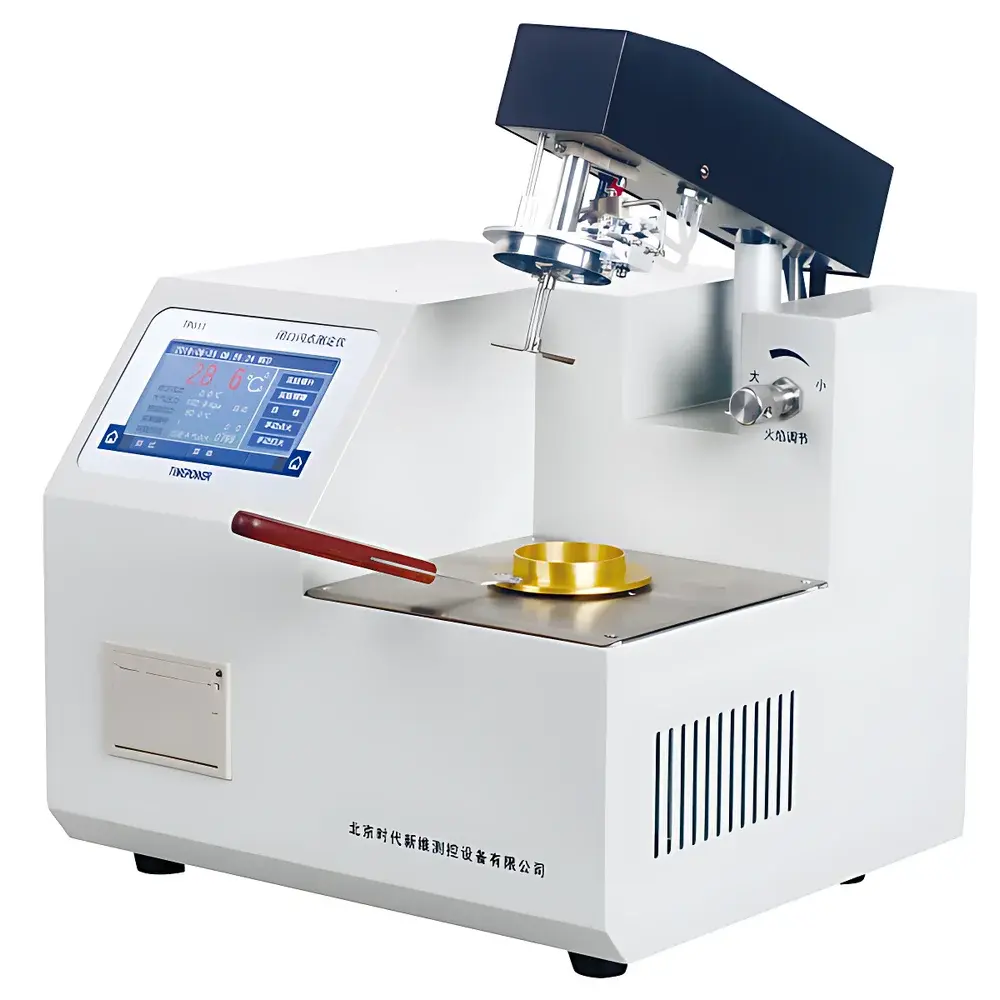
Timepower TP611 Automated Closed-Cup Flash Point Tester
| Brand | Timepower |
|---|---|
| Origin | Beijing, China |
| Manufacturer Type | Manufacturer |
| Country of Origin | Domestic (China) |
| Model | TP611 |
| Detection Method | Closed-Cup Method |
| Measurement Range | 40–370 °C |
| Accuracy | ±1 °C for flash point <110 °C |
| Repeatability | ≤2 °C |
| Resolution | 0.1 °C |
| Ambient Temperature | 5–40 °C |
| Relative Humidity | ≤85% |
| Display | 260k-color TFT LCD (480×272) |
| Cooling Method | Integrated Forced-Air Cooling |
| Printer | Thermal, 36-character Chinese/English output |
| Power Supply | AC 220 V ±10%, 50 Hz ±10% |
| Power Consumption | ≤500 W |
| Dimensions | 350 × 310 × 300 mm |
| Weight | 13.5 kg |
| Atmospheric Pressure Compensation | Yes |
| Ignition Options | Gas flame scanning or electronic spark ignition (user-selectable) |
Overview
The Timepower TP611 Automated Closed-Cup Flash Point Tester is a precision-engineered instrument designed in strict compliance with internationally recognized standard test methods—including ASTM D93 (Standard Test Method for Flash Point by Pensky-Martens Closed Cup Tester) and GB/T 261 (Chinese national standard equivalent to ISO 2719). It operates on the fundamental principle of closed-cup flash point determination: a representative sample is heated under controlled conditions within a sealed test cup; vapors accumulate above the liquid surface until, upon exposure to an externally applied ignition source, a momentary flash occurs across the vapor-air mixture. The lowest temperature at which this flash is observed—under defined heating rate, stirring speed, and ignition timing—is recorded as the flash point. This thermodynamic parameter serves as a critical safety indicator for flammability classification, transportation hazard assessment, and quality control in petroleum refining, lubricant formulation, and fuel blending operations.
Key Features
- Fully automated workflow: integrated control of cup lifting, temperature ramping, stirrer activation, ignition sequence, flash detection, data logging, thermal shutdown, and post-test cooling.
- Dual ignition mode selection: users may configure the system for either gas-fueled flame scanning (using liquefied petroleum gas via included regulator and hose assembly) or solid-state electronic spark ignition—enhancing operational flexibility and eliminating dependency on external gas supply where prohibited.
- Real-time atmospheric pressure compensation: built-in barometric sensor enables automatic correction of flash point values per ASTM D93 Annex A1, ensuring metrological traceability across varying elevation and weather conditions.
- High-resolution thermal management: PID-controlled heating system maintains programmable ramp rates (e.g., 1–2 °C/min per ASTM D93 Procedure A), with over-temperature cutoff protection activated at user-defined thresholds.
- Self-diagnostic firmware: continuous hardware status monitoring alerts operators to anomalies in stirrer motor function, cup positioning, flame detection circuitry, or thermal sensor integrity prior to test initiation.
- Industrial-grade human-machine interface: 260,000-color TFT display (480 × 272 pixels) provides intuitive navigation, real-time temperature curves, pass/fail status indicators, and multilingual on-screen prompts (English/Chinese).
Sample Compatibility & Compliance
The TP611 is validated for use with a broad spectrum of petroleum-derived liquids—including diesel fuel, kerosene, base oils, transformer oils, hydraulic fluids, and solvent naphthas—as specified in ASTM D93 Scope. It excludes highly volatile materials (e.g., gasoline, ethanol blends) requiring open-cup or Tagliabue methods (ASTM D56/D3828). All mechanical and electronic subsystems conform to IEC 61010-1:2010 safety requirements for electrical equipment used in measurement, control, and laboratory applications. Instrument design supports GLP-compliant operation through audit-ready event logging (time-stamped ignition attempts, temperature excursions, operator ID entry) and optional integration with LIMS via RS232 serial interface.
Software & Data Management
Data acquisition and reporting are handled locally via embedded firmware with non-volatile memory storage for up to 200 test records. Each record includes sample ID, ambient pressure, start/end times, ramp rate, detected flash temperature, and operator confirmation signature. Thermal printer output generates permanent hardcopy reports compliant with internal QA documentation requirements—featuring bilingual (English/Chinese) labeling, numeric precision to 0.1 °C, and automatic unit annotation. While no proprietary PC software is bundled, ASCII-formatted export via serial port enables compatibility with third-party statistical process control (SPC) platforms and enterprise-level data archiving systems adhering to 21 CFR Part 11 principles when paired with appropriate validation protocols.
Applications
- Refinery QC laboratories verifying flash point conformity of distillate fractions against ASTM D975 (diesel fuel) or ASTM D3699 (kerosene) specifications.
- Power generation facilities performing routine testing of insulating oils per IEEE C57.106 and IEC 60296 standards.
- Chemical distributors conducting hazard classification per UN GHS and CLP Regulation Annex VI, supporting SDS authoring and transport documentation.
- R&D labs evaluating thermal stability of bio-based lubricants or synthetic esters during formulation development.
- Third-party inspection agencies executing contract testing under ISO/IEC 17025-accredited procedures.
FAQ
What standards does the TP611 comply with?
The instrument is engineered to meet ASTM D93 (Method A and B), GB/T 261, and ISO 2719 requirements for closed-cup flash point determination.
Is external gas supply mandatory?
No—users may select electronic spark ignition mode, eliminating need for LPG cylinder; gas mode remains available for cross-method verification or regulatory alignment.
How is atmospheric pressure accounted for during testing?
An integrated digital barometer continuously measures ambient pressure and applies real-time correction algorithms per ASTM D93 Annex A1.
Can test data be exported to a laboratory information management system (LIMS)?
Yes—via RS232 serial interface using ASCII protocol; integration requires site-specific configuration and validation per organizational IT policies.
What maintenance is required between tests?
The test cup must be thoroughly cleaned and dried after each analysis to prevent residue carryover; periodic calibration verification using certified reference materials (e.g., NIST SRM 2721) is recommended annually or per internal SOP.






