
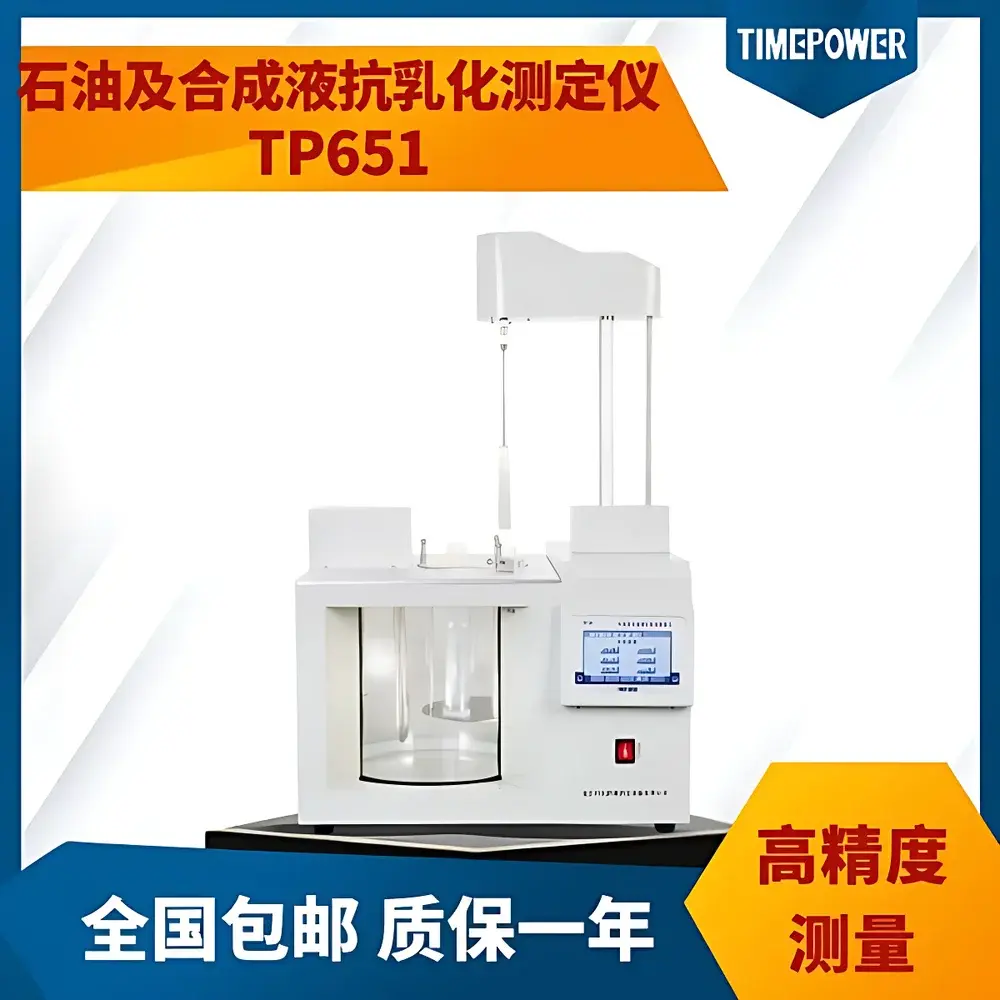
Timepower TP-651 Petroleum Demulsibility Tester
| Brand | Timepower |
|---|---|
| Model | TP-651 |
| Origin | Beijing, China |
| Manufacturer Type | Direct Manufacturer |
| Regional Classification | Domestic (China) |
| Pricing | Upon Request |
Overview
The Timepower TP-651 Petroleum Demulsibility Tester is a precision-engineered laboratory instrument designed to quantitatively evaluate the demulsification behavior of petroleum products and synthetic lubricants when mixed with water under standardized thermal and mechanical conditions. Unlike moisture analyzers—which rely on coulometric Karl Fischer titration—the TP-651 operates on a fundamentally distinct physical principle: it measures the time required for an oil–water emulsion to separate into discrete, visually distinguishable layers (oil, emulsion, and water) following controlled agitation and static settling at elevated temperature (typically 54 °C or 82 °C per ASTM D1401 and ISO 6614). This separation kinetics assessment provides critical insight into the formulation stability, additive performance (e.g., demulsifiers), and service-life predictability of turbine oils, hydraulic fluids, and transformer oils in real-world operating environments where water ingress is unavoidable.
Key Features
- Compliant dual-temperature capability: Precise thermostatic control at 54 °C and 82 °C, aligned with ASTM D1401, ISO 6614, and GB/T 7305 test protocols.
- Integrated mechanical agitator with calibrated impeller geometry and fixed rotational speed (1500 ± 15 rpm), ensuring reproducible emulsion generation across test cycles.
- Dual independent test chambers: Enables parallel evaluation of two samples under identical thermal and agitation conditions—improving throughput without compromising inter-test consistency.
- High-resolution digital timer with automatic start/stop triggers based on user-defined phase separation thresholds (e.g., ≤3 mL emulsion layer volume).
- Corrosion-resistant stainless-steel bath housing and borosilicate glass test cylinders (100 mL capacity, graduated to 1 mL increments) for long-term chemical compatibility with hydrocarbon-based samples and cleaning solvents.
- Front-panel LED interface with real-time temperature display, agitation status indicator, and elapsed time tracking—designed for GLP-compliant manual data recording.
Sample Compatibility & Compliance
The TP-651 is validated for use with mineral-based and synthetic base oils, including but not limited to turbine oils (ISO L-TGA, L-TGB), hydraulic fluids (ISO L-HM, L-HV), and insulating oils (IEC 60296). It accommodates sample viscosities up to 100 mm²/s at 40 °C and water concentrations ranging from trace (<50 ppm) to bulk-phase addition (typically 40 mL oil + 40 mL distilled water per test). All operational procedures adhere strictly to internationally recognized standards: ASTM D1401 (Standard Test Method for Determining the Separability of Oil and Water by Heating), ISO 6614 (Petroleum Products — Determination of Demulsibility), and Chinese national standard GB/T 7305. The instrument’s mechanical architecture and thermal calibration protocol support audit readiness for laboratories operating under ISO/IEC 17025, GMP, or internal quality management systems requiring documented equipment qualification.
Software & Data Management
The TP-651 is a standalone benchtop instrument with no embedded firmware or proprietary software. All measurements are recorded manually by trained analysts using standardized lab notebooks or LIMS-integrated electronic worksheets. This design intentionally avoids digital data handling to eliminate validation burdens associated with computerized system compliance (e.g., FDA 21 CFR Part 11, Annex 11). However, the instrument’s repeatable mechanical timing and stable thermal environment ensure high inter-operator reproducibility (RSD < 3% for replicate runs on reference oils), facilitating robust statistical analysis when integrated into larger QC workflows. Calibration verification is performed quarterly using NIST-traceable thermometer probes and stopwatch metrology standards.
Applications
- Quality control release testing of new lubricant batches prior to distribution.
- Evaluation of demulsifier additive efficacy during R&D formulation development.
- Condition monitoring of in-service turbine and hydraulic oils to assess degradation-induced surfactant accumulation or additive depletion.
- Root-cause analysis of field failures linked to emulsion-related issues (e.g., bearing corrosion, valve sticking, reduced heat transfer efficiency).
- Regulatory conformance documentation for OEM specifications (e.g., GEK 32568, Siemens TLV 9013).
FAQ
Does the TP-651 perform Karl Fischer moisture analysis?
No. The instrument described in the provided text mistakenly conflates demulsibility testing with coulometric moisture determination. The TP-651 measures physical phase separation—not water content—and does not utilize iodine electrolysis or Karl Fischer reagents.
What is the minimum sample volume required per test?
Each test requires 40 mL of conditioned oil and 40 mL of ASTM D1193 Type IV distilled water, totaling 80 mL per chamber.
Is third-party calibration certification available?
Yes. Timepower provides optional factory calibration reports traceable to CNAS-accredited metrology labs, including temperature uniformity mapping and timer accuracy verification.
Can the TP-651 be used for biodiesel or bio-lubricants?
It may be applied subject to method validation per ASTM D7462; however, non-petroleum esters often exhibit divergent interfacial tension behavior, necessitating extended settling observation windows beyond standard 30/60-minute endpoints.





