
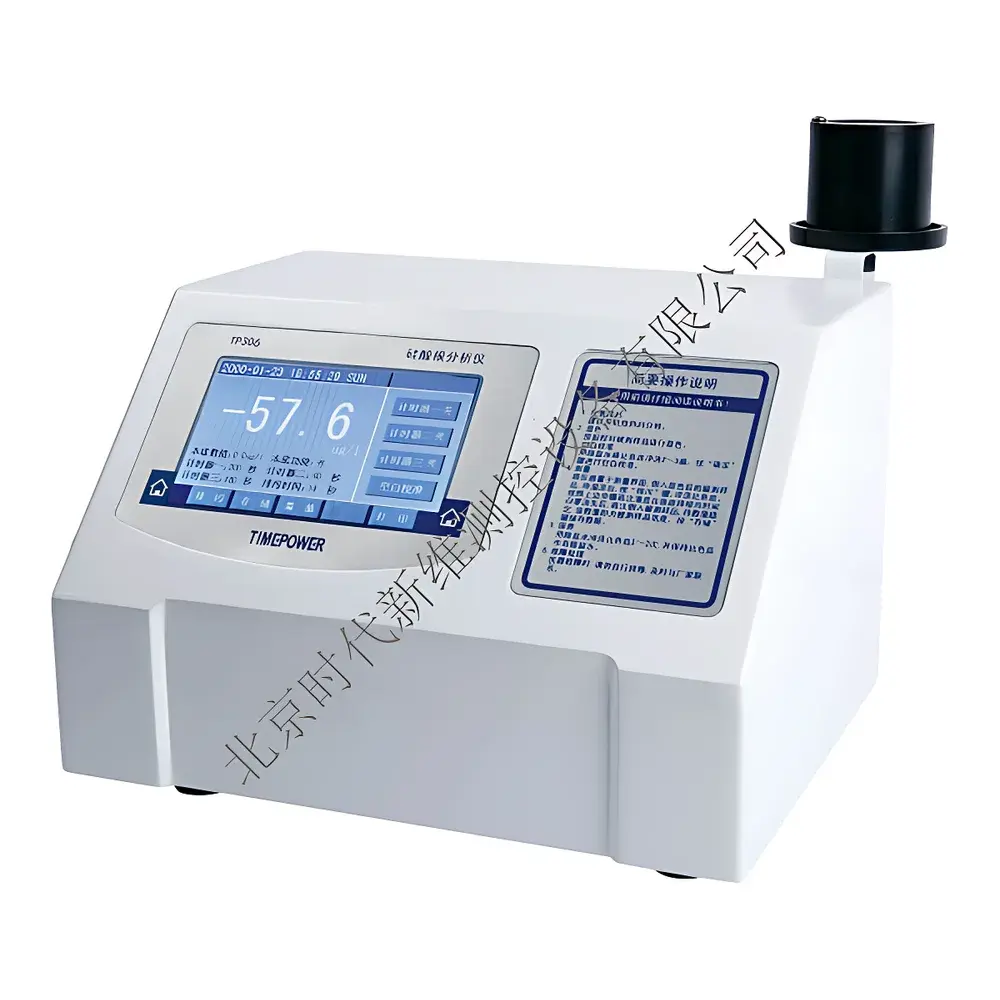
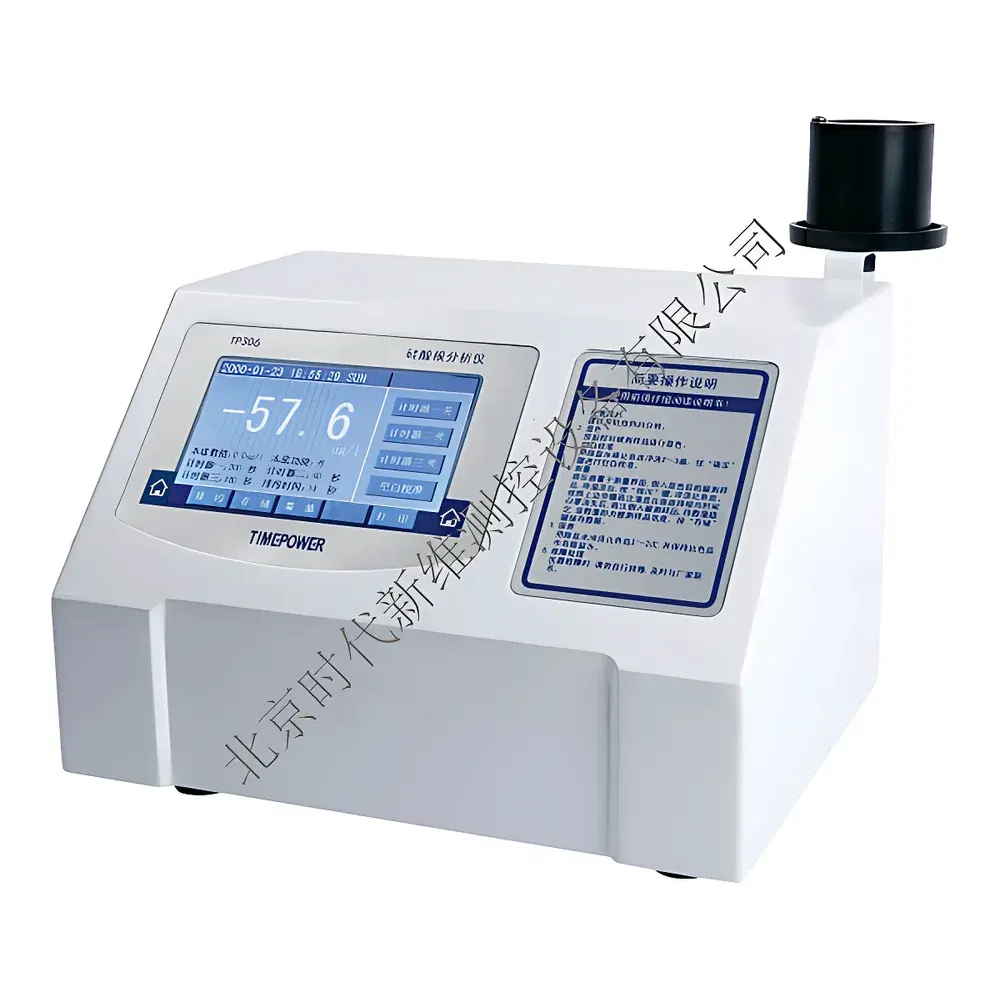
Timepower TP306 Laboratory Silica Analyzer
| Brand | Timepower |
|---|---|
| Model | TP306 |
| Origin | Beijing, China |
| Manufacturer | Timepower (Producer) |
| Type | Benchtop Laboratory Analyzer |
| Measurement Principle | Colorimetric Photometry (Molybdenum Blue Method) |
| Range | 0.0–200.0 μg/L or 0.0–2000 μg/L |
| Accuracy | ±2% F.S. |
| Resolution | 0.1 μg/L |
| Repeatability | ≤1% |
| Stability | ±1% F.S./4h |
| Display | 5.0-inch TFT color touchscreen (Chinese UI) |
| Power Supply | AC 85–265 V, 45–65 Hz |
| Power Consumption | ≤30 W |
| Dimensions | 260 × 200 × 180 mm |
| Weight | 3.2 kg |
| Environmental Operating Conditions | 5–45 °C, ≤90% RH (non-condensing) |
Overview
The Timepower TP306 Laboratory Silica Analyzer is a benchtop photometric instrument engineered for precise quantification of dissolved silica (as SiO₂) and soluble silicates in ultra-pure water streams. It operates on the standardized molybdenum blue colorimetric method—compliant with ASTM D859 and ISO 10523—where soluble silicate reacts with ammonium molybdate under controlled acidic conditions (pH 1.1–1.3) to form a yellow heteropoly acid complex. This intermediate is subsequently reduced by 1-amino-2-naphthol-4-sulfonic acid (1-2-4 acid) to yield the intensely colored silicon molybdenum blue species. Absorbance is measured at ~815 nm using a stable, imported monochromatic cold-light source. Quantification follows the Lambert-Beer law, establishing a linear relationship between absorbance and silica concentration within defined calibration ranges (0.0–200.0 μg/L and 0.0–2000 μg/L). Designed for high-reliability operation in regulated environments, the TP306 delivers trace-level silica detection essential for boiler feedwater, condensate, and ultrapure process water monitoring in power generation, semiconductor fabrication, pharmaceutical manufacturing, and fine chemical synthesis.
Key Features
- Integrated hardware architecture featuring surface-mount technology (SMT) PCBs and single-chip microcontroller design for enhanced signal integrity and long-term operational stability.
- High-stability monochromatic cold-light source with extended service life (>10,000 h), low thermal drift, and minimal power consumption.
- Digital background compensation algorithm to correct for optical path interference and baseline offset—critical for sub-5 μg/L silica measurements.
- Automated timing control with audible/visual prompts for reaction incubation steps, ensuring consistent color development kinetics across analyses.
- Zero-point calibration function using blank reagent to eliminate electronic and photometric zero drift; performed daily per recommended QA protocol.
- Circular data storage buffer retaining up to 256 measurement records with automatic overwrite management; accessible via on-device touchscreen interface.
Sample Compatibility & Compliance
The TP306 is validated for analysis of deionized water, condensate, demineralized steam cycle water, and process water from high-purity industrial systems. Sample matrix compatibility includes waters with total dissolved solids (TDS) < 10 mg/L and conductivity < 0.2 μS/cm. The analyzer conforms to core elements of GLP and GMP-aligned laboratory practices, supporting audit-ready documentation through timestamped calibration logs and measurement history. While not inherently 21 CFR Part 11 compliant out-of-the-box, its firmware architecture permits integration into validated LIMS environments when paired with external electronic signature and audit trail modules. All reagents—including ammonium molybdate and 1-2-4 acid—are required to meet ACS-grade or higher purity specifications and must be stored in certified polyethylene containers to prevent leaching-induced contamination.
Software & Data Management
The TP306 features an embedded 5.0-inch resistive touchscreen running a real-time operating system (RTOS) with localized Chinese-language UI. Navigation supports intuitive menu-driven calibration, measurement, and data review workflows. Calibration curves are stored internally with user-defined naming and date stamps. Measurement records include sample ID, time/date stamp, range selection, absorbance value, calculated concentration, and operator ID (manually entered). Data export is supported via USB flash drive (FAT32 formatted); CSV-formatted files contain raw absorbance, concentration, and metadata fields compatible with Excel, LabArchives, or Empower. Firmware updates are delivered via encrypted USB packages with version-controlled checksum verification.
Applications
- Power plant chemistry control: continuous monitoring of silica in boiler feedwater, turbine condensate, and once-through HRSG cycles to prevent silica deposition on superheater tubes.
- Semiconductor fab UPW systems: verification of silica removal efficiency downstream of mixed-bed ion exchange and EDI units prior to point-of-use filtration.
- Pharmaceutical water-for-injection (WFI) and purified water (PW) systems: routine testing per USP and EP 2.2.44 specifications for silica as a non-volatile residue indicator.
- Chemical and fiber production: quality assurance of process water used in polymerization, dyeing, and catalyst preparation where silica-induced fouling compromises batch consistency.
- Research laboratories: method development and validation studies for silica speciation, including hydrolyzable vs. colloidal silica fractionation protocols.
FAQ
What is the recommended frequency for blank calibration?
Daily blank calibration is mandatory to maintain accuracy below 5 μg/L; this compensates for optical aging and electronic baseline shift.
Can the TP306 measure colloidal silica?
No—the method quantifies only dissolved (reactive) silica; colloidal or particulate silica requires acid digestion pretreatment prior to analysis.
Is the instrument suitable for field use?
It is designed exclusively for laboratory environments; no IP rating or battery operation is provided.
What reagent purity is required for trace-level accuracy?
All reagents must be ACS-grade or higher, prepared in Type I ultrapure water (resistivity ≥18.2 MΩ·cm, TOC < 5 ppb) generated by a mixed-bed + UV oxidation system.
How is linearity verified across both measurement ranges?
Linearity is confirmed using NIST-traceable silica standard solutions (e.g., SRM 1643e) at five concentration points per range during initial qualification and semiannual verification.
Related Products







