
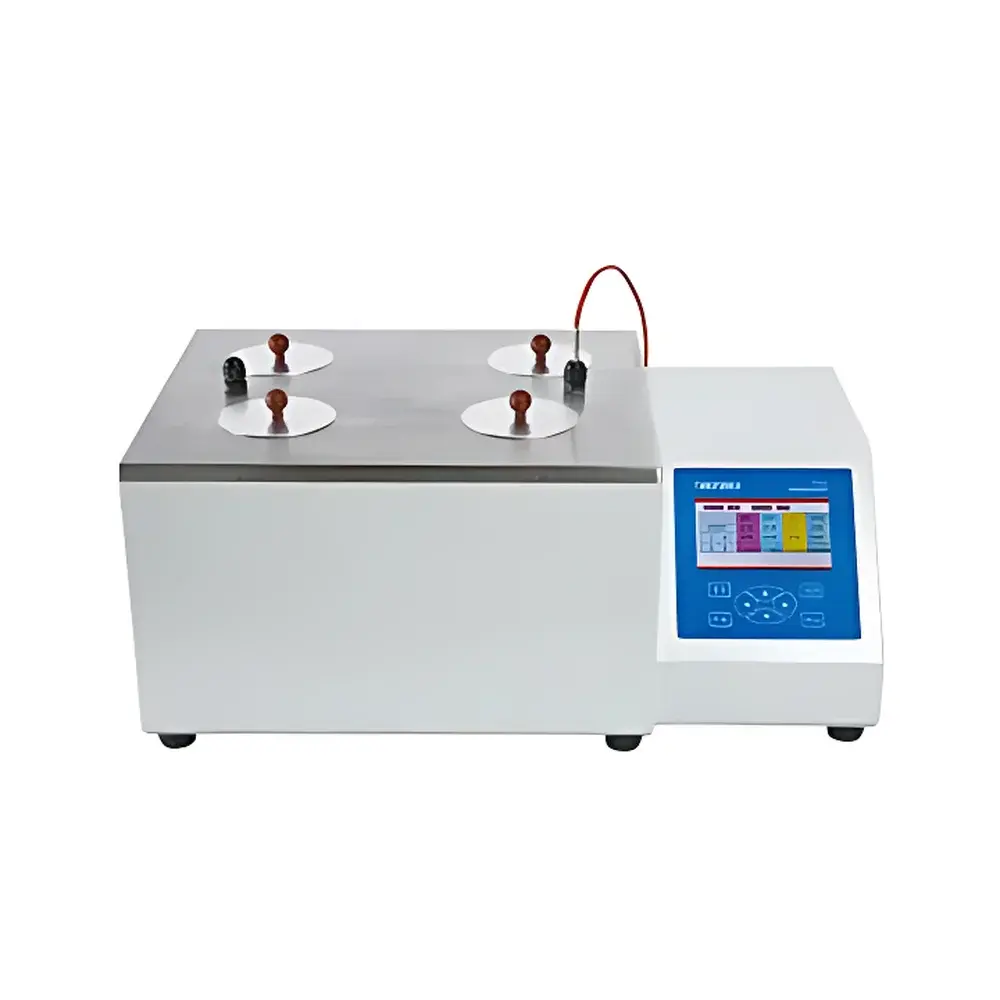
Timepower TP633 Liquid-Phase Rust Corrosion Tester
| Brand | Timepower |
|---|---|
| Origin | Beijing, China |
| Manufacturer Type | Direct Manufacturer |
| Country of Origin | Domestic (China) |
| Model | TP633 |
| Pricing | Available Upon Request |
| Display | 480×272 Color LCD |
| Temperature Control Range | Ambient to 100°C |
| Temperature Accuracy | ±1°C |
| Temperature Resolution | 0.1°C |
| Test Capacity | 4 Independent Stations |
| Stirring Speed | 1000 ± 25 rpm |
| Heating Method | Immersion Heater Tube |
| Temperature Sensor | Pt100 Platinum Resistance Thermometer |
| Power Supply | AC 220 V ±10%, 50 Hz ±10% |
| Max. Power Consumption | ≤1500 W |
| Heater Power | ≤1200 W |
| Stirring Motor Power | ≤100 W |
| Dimensions (W×D×H) | 530 × 300 × 200 mm |
| Net Weight | 9.5 kg |
| Operating Environment | 5–40°C, RH ≤85% |
| Sample Volume | 300 mL oil + 30 mL water/synthetic seawater |
| Test Duration | Adjustable (typically 24 h) |
| Compliance | GB/T 11143–2008 |
Overview
The Timepower TP633 Liquid-Phase Rust Corrosion Tester is an engineered laboratory instrument designed to quantitatively assess the rust-inhibiting performance of petroleum-based lubricants—including turbine oils, hydraulic fluids, circulating oils, and inhibited mineral oils—when exposed to water or synthetic seawater under controlled thermal and mechanical agitation. It operates in strict accordance with the Chinese national standard GB/T 11143–2008, which aligns methodologically with ASTM D665 (Standard Test Method for Rust-Preventing Characteristics of Inhibited Mineral Oil in the Presence of Water) and ISO 7120:2018 (Petroleum products — Determination of rust-inhibiting properties of lubricating oils). The test principle relies on simulating real-world conditions where ferrous components (e.g., steel shafts, bearings, or gear surfaces) contact oil-water emulsions at elevated temperature (60°C), inducing electrochemical corrosion if rust inhibitors are ineffective. Four independent test stations allow parallel evaluation of multiple samples or formulation variants, significantly improving throughput while maintaining inter-test comparability.
Key Features
- Four-channel independent test configuration with individual temperature and timing control per station—enabling comparative studies without cross-contamination or thermal lag.
- Precision temperature regulation via Pt100 platinum resistance sensor and microprocessor-based PID feedback loop, achieving ±1°C stability over the full operating range (ambient to 100°C) with 0.1°C resolution.
- Stable, low-vibration stirring system using imported permanent-magnet DC motors, delivering consistent 1000 ± 25 rpm rotation across all stations—critical for uniform oil/water dispersion and reproducible oxygen mass transfer.
- High-resolution 480×272 color LCD interface with intuitive Chinese menu navigation, real-time display of bath temperature, elapsed time, and system status—designed for ease of use in QC labs with mixed operator experience levels.
- Robust thermal architecture featuring immersion-type heating elements and optimized insulation, ensuring rapid heat-up (<30 min to 60°C) and minimal power fluctuation (<±5% under load).
- Integrated safety logic: automatic power cutoff upon low-bath-level detection, overtemperature lockout, and phase-failure protection compliant with IEC 61000-4-5 surge immunity requirements.
Sample Compatibility & Compliance
The TP633 accommodates standard ASTM/GB-compliant test specimens: cylindrical mild steel rods (12.7 mm diameter × 76 mm length), pre-polished and solvent-cleaned per GB/T 11143–2008 Section 6.2. It supports both distilled water and synthetic seawater (as defined in Annex A of ASTM D665) as corrosive media. The instrument’s design meets essential electrical safety standards (GB 4793.1–2018 / IEC 61010-1) and environmental operating specifications (IEC 60068-2-1/2 for cold/heat testing). While not certified for GLP or FDA 21 CFR Part 11 out-of-the-box, its deterministic control logic, non-volatile parameter storage, and timestamped test logs support audit-ready documentation when integrated into validated lab workflows.
Software & Data Management
The TP633 employs embedded firmware with no external PC dependency. All test parameters—including setpoint temperature, duration, start time, and station activation—are stored in non-volatile memory with battery-backed real-time clock (RTC). Each test cycle generates a timestamped log file containing initiation time, actual bath temperature profile (recorded every 60 s), and final status flag (pass/fail based on visual inspection criteria per GB/T 11143–2008 Section 9). Data export is manual via USB flash drive (optional accessory), supporting CSV-formatted records compatible with LIMS systems. For regulated environments, users may implement supplementary electronic record controls (e.g., PDF report generation with digital signatures) using third-party lab software aligned with ALCOA+ principles.
Applications
- Quality control of rust-inhibited turbine oils in power generation facilities, verifying compliance prior to turbine commissioning or oil replenishment.
- R&D screening of additive packages for hydraulic and circulating lubricants, enabling structure–performance correlation between inhibitor chemistry and corrosion suppression efficacy.
- Contractual verification testing per purchase specifications requiring GB/T 11143–2008 or ASTM D665 conformance—common in petrochemical procurement and third-party inspection services.
- Evaluation of used oil degradation: progressive loss of rust inhibition correlates with oxidation byproducts and depletion of amine/phosphate additives.
- Academic research on aqueous corrosion mechanisms in oil–water interfaces, including studies on micelle formation, interfacial tension, and inhibitor adsorption kinetics on Fe surfaces.
FAQ
What standards does the TP633 comply with?
It is fully aligned with GB/T 11143–2008 and technically equivalent to ASTM D665 and ISO 7120:2018 in test methodology, specimen geometry, and pass/fail evaluation criteria.
Can the instrument run tests longer than 24 hours?
Yes—its programmable timer supports durations from 1 minute up to 99 hours, accommodating extended aging protocols or low-corrosivity formulations requiring longer exposure.
Is the steel test rod included, and how is it prepared?
Each unit ships with four standardized test rods and associated handling tools (tongs, burnishing cloth). Rods must be cleaned with petroleum ether or isooctane immediately before use and never touched with bare hands to avoid fingerprint-induced localized corrosion.
Does the system require water or oil as the heating medium?
Water is standard; however, thermal oil with kinematic viscosity 28.8–35.2 mm²/s at 40°C may be substituted for higher-temperature tests (>80°C), provided bath level remains 3–4 cm below the rim to prevent overflow during expansion.
How is temperature uniformity verified across the four stations?
Each station features an independent Pt100 sensor positioned adjacent to the test vessel; factory calibration ensures inter-station deviation ≤0.3°C at 60°C under steady-state conditions. Users may perform periodic verification using traceable NIST-calibrated thermometers.





