
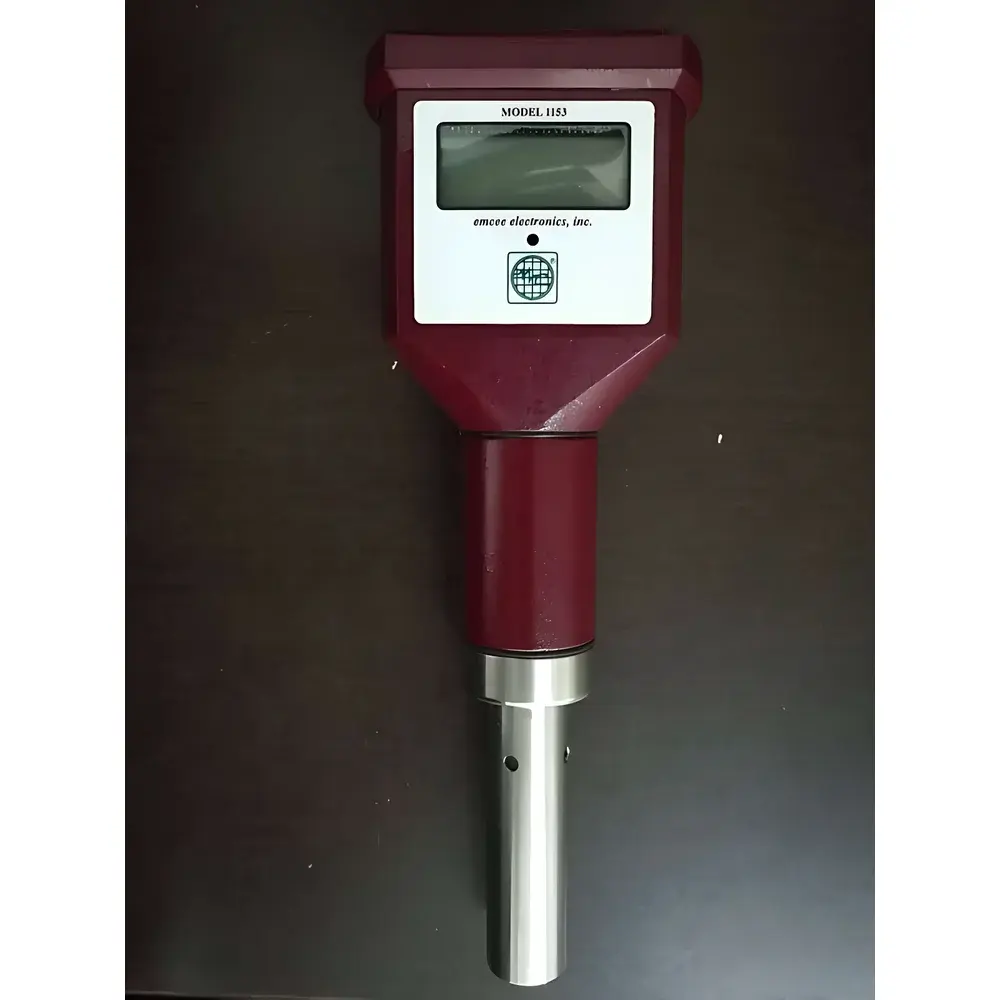
EMCEE 1153 Digital Conductivity Meter for Fuel Oil and Hydrocarbon Liquids
| Brand | EMCEE |
|---|---|
| Origin | USA |
| Model | 1153 |
| Measurement Range | 0–2000 pS/m |
| Resolution | ±1 pS/m (0–2000 pS/m) |
| Accuracy | ±2% of reading |
| Operating Temperature | 0–50 °C |
| Display | 5-digit LCD with status text and LED illumination |
| Power | Three 3 V lithium batteries |
| Dimensions | 200.7 × 70 × 43.2 mm (L×W×D) |
| Probe Diameter | 19.05 mm |
| Weight | 365.8 g (12.9 oz) |
| Enclosure | Intrinsically Safe for Class I, Division 1, Group D hazardous locations |
| Compliance | ASTM D2624 |
| Optional Features | Temperature measurement mode, data hold, solvent-resistant hard-shell carrying case with O-ring sealed probe interface |
Overview
The EMCEE 1153 Digital Conductivity Meter is a purpose-engineered instrument designed specifically for the rapid, field-deployable measurement of electrical conductivity in low-conductivity hydrocarbon liquids—primarily aviation turbine fuels (Jet A, Jet A-1, JP-5, JP-8), diesel, gasoline, and related refinery intermediates. It operates on the principle of two-electrode AC conductance measurement, optimized to resolve conductivities in the critical range of 0–2000 picoSiemens per meter (pS/m), where static charge accumulation poses significant safety hazards during fuel handling, filtration, and transfer operations. Its design directly supports compliance with ASTM D2624, the standard test method for electrical conductivity of aviation turbine fuels, and aligns with industry best practices outlined in API RP 2003 and NFPA 77 for electrostatic hazard mitigation. The instrument’s intrinsic safety certification (Class I, Division 1, Group D) permits direct use in classified hazardous areas without explosion-proof enclosures—a requirement for real-time monitoring at loading racks, filter monitors, and aircraft refueling points.
Key Features
- Intrinsically safe construction certified for Class I, Division 1, Group D environments—enabling deployment in live fueling zones without de-energizing equipment or interrupting operations.
- Single-button operation with intuitive status-driven text display—minimizing operator training requirements and reducing procedural errors in high-stakes operational settings.
- Integrated LED-illuminated 5-digit LCD with automatic 3-second measurement cycle—ensuring consistent timing and eliminating manual stopwatch dependency per ASTM D2624 Section 8.2.
- O-ring sealed probe interface prevents solvent ingress and ensures repeatable electrode immersion geometry—critical for reproducibility across multiple operators and shift changes.
- Data hold function retains the last measured value until overwritten—facilitating manual transcription into batch logs or digital LIMS entries without real-time connectivity.
- Low-battery and over-range indicators provide immediate visual feedback—supporting GLP-aligned documentation integrity by preventing invalid or extrapolated readings from entering quality records.
- Compact, solvent-resistant housing (200.7 × 70 × 43.2 mm) and lightweight design (365.8 g) enable handheld use during mobile inspections, tank truck audits, and filter change verification.
Sample Compatibility & Compliance
The EMCEE 1153 is validated for use with non-aqueous, low-dielectric liquids exhibiting bulk conductivities between 0.1 and 2000 pS/m. Primary applications include aviation turbine fuels, diesel fuel oils (ASTM D975), gasoline blends (ASTM D439), and hydroprocessed naphthas. It is not intended for aqueous solutions, acids, bases, or high-conductivity solvents (e.g., methanol, acetone). All measurements conform to the electrode geometry, cell constant calibration, and timing protocols specified in ASTM D2624. The instrument meets the electrical safety requirements of UL 913 (7th ed.) for intrinsic safety and is compatible with laboratory QA/QC workflows requiring traceable, auditable conductivity data under ISO/IEC 17025 and FDA 21 CFR Part 11 (when paired with compliant electronic log systems).
Software & Data Management
The EMCEE 1153 operates as a standalone hardware meter with no embedded firmware update capability or USB/Bluetooth interface. Data management is intentionally decoupled to ensure deterministic measurement behavior and eliminate cybersecurity vulnerabilities associated with connected instrumentation in refinery control networks. Measured values are retained in volatile memory only until the next measurement cycle—requiring manual entry into validated spreadsheets, LIMS platforms, or paper-based batch records. This architecture supports audit readiness for GMP-regulated fuel additive blending facilities and military logistics depots where electronic record validation is governed by DoD 5015.2 or MIL-STD-130. Optional temperature measurement functionality (via external probe) allows concurrent recording of sample temperature per ASTM D2624 Section 7.3, enabling post-hoc correction using published temperature coefficients for specific fuel types.
Applications
- Verification of fuel conductivity pre- and post-filtration to confirm antistatic additive efficacy and detect filter-induced charge generation.
- Routine monitoring of bulk storage tanks and transport vessels to ensure conductivity remains above the minimum threshold of 50 pS/m recommended by API RP 2003 for safe handling.
- Commissioning and periodic verification of inline conductivity monitors used in automated fuel distribution systems.
- Quality release testing of finished fuel batches prior to dispatch—particularly for NATO-coded fuels requiring documented D2624 compliance.
- Root cause analysis of static-related incidents (e.g., sparking at nozzle tips, filter housing discharges) through comparative baseline measurements.
- Process validation during additive injection trials, where conductivity trends correlate with dispersant or metal deactivator concentration profiles.
FAQ
Does the EMCEE 1153 require calibration before each use?
No. The instrument is factory-calibrated using NIST-traceable standards and does not require user recalibration. However, daily verification with a certified reference standard (e.g., 500 pS/m calibration fluid per ASTM D2624 Annex A2) is recommended for regulated environments.
Can the 1153 measure conductivity in biodiesel blends (e.g., B5, B20)?
Yes—provided the blend exhibits conductivity within the 0–2000 pS/m range and contains no free water or polar contaminants that compromise electrode stability. Validation per ASTM D6045 is advised for non-traditional feedstocks.
Is temperature compensation automatic?
No. The base model does not perform real-time temperature compensation. The optional temperature probe provides simultaneous readout; manual correction using fuel-specific temperature coefficients must be applied per ASTM D2624 Section 10.
What battery life can be expected under typical field use?
Approximately 2,000 measurements (at 3-second intervals) per set of three CR2 lithium batteries, assuming ambient temperatures between 15–25 °C and infrequent backlight activation.
How is probe cleaning performed between samples?
Wipe the stainless-steel electrodes with lint-free tissue moistened with low-residue hydrocarbon solvent (e.g., hexane), followed by air drying—never immerse the probe body in liquid or use abrasive cleaners that damage the O-ring seal.




