
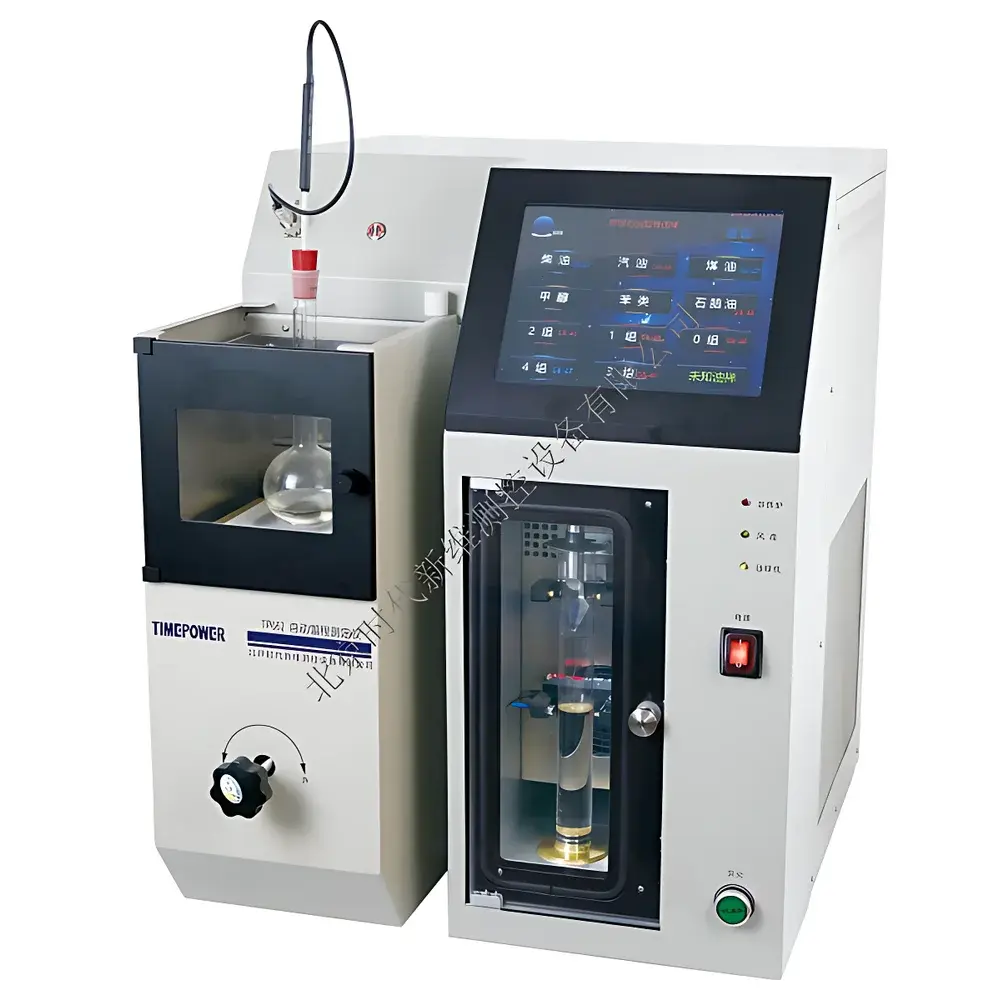
Timepower TP662 Automated Distillation Apparatus for Petroleum Products
| Brand | Timepower |
|---|---|
| Origin | Beijing, China |
| Manufacturer | Timepower |
| Model | TP662 |
| Temperature Range | 0–400 °C |
| Temperature Accuracy | ±0.1 °C |
| Cold Bath Temperature Range | 0–60 °C |
| Distillation Rate | 1–11 mL/min |
| Volume Detection Range | 1–111 mL |
| Volume Resolution | 0.1 mL |
Overview
The Timepower TP662 Automated Distillation Apparatus is a fully integrated, ASTM D86-23 and ISO 3405 compliant system engineered for precise determination of distillation characteristics in petroleum products and volatile organic liquids. It implements standardized batch distillation under atmospheric pressure (with automatic barometric correction), measuring key parameters including initial boiling point (IBP), final boiling point (FBP), and volume percent recovered at specified temperature intervals. The instrument employs a dual-sensor thermal architecture—featuring a Pt100 platinum resistance thermometer (traceable to NIST standards) for vapor-phase temperature measurement and a high-stability optical liquid-level tracking system for real-time condensate volume quantification. Its modular control firmware synchronizes heating ramp profiles, condenser cooling dynamics, reflux management, and data acquisition in strict accordance with regulatory test protocols. Designed for routine QC laboratories in refineries, fuel testing centers, and petrochemical R&D facilities, the TP662 delivers reproducible, audit-ready results without manual intervention beyond sample loading and method selection.
Key Features
- 10.4-inch capacitive color touchscreen interface with intuitive workflow navigation and real-time graphical display of temperature vs. volume curves
- Imported Danfoss (Secop) hermetic compressor for rapid, stable cold bath temperature control (0–60 °C) and consistent condensation efficiency
- Optical volume detection system with imported photoelectric sensor array, achieving ±0.1 mL volumetric accuracy across 1–111 mL range
- Automated barometric pressure compensation using integrated digital barometer; all reported temperatures are corrected to standard atmospheric pressure (101.3 kPa)
- Programmable termination logic: tests may be halted by either reaching a user-defined vapor temperature threshold or accumulating a target recovery volume
- Dual-zone thermal management: independent control of heating mantle (up to 400 °C) and recovery chamber (10–40 °C) to minimize thermal lag and improve repeatability
- Integrated nitrogen purge and manual emergency shutdown circuit for safe handling of low-flashpoint samples (e.g., gasoline, aviation turbine fuel)
- Compliance-ready firmware with timestamped audit trail, user access levels, and electronic signature support aligned with FDA 21 CFR Part 11 requirements
Sample Compatibility & Compliance
The TP662 is validated for use with a broad spectrum of hydrocarbon-based materials per international standards: gasoline (ASTM D86, D7215), jet fuels (ASTM D1655 Annex A1), diesel fuels (ASTM D975), naphthas (ASTM D2887), industrial solvents (ASTM D1078), and specialty distillates. It accommodates standard ASTM D86 glassware—including 125-mL distillation flasks, 100-mL graduated cylinders, and appropriate adapters—while supporting optional carbon-silicon heating plates for uniform thermal distribution. All operational parameters adhere to ISO/IEC 17025 calibration traceability requirements. Instrument validation documentation includes as-delivered temperature uniformity mapping, volume linearity verification, and pressure sensor NIST-traceable calibration certificates.
Software & Data Management
The embedded control software provides full GLP-compliant data handling: automatic generation of ASTM-formatted distillation reports (including IBP, 10%, 50%, 90%, FBP, and loss values), exportable CSV and PDF outputs, and secure local storage with 10,000-test history capacity. Data integrity safeguards include write-protected archives, operator ID logging, and change-tracking for all method parameters. Optional Ethernet/Wi-Fi connectivity enables remote monitoring via browser-based dashboard and integration into LIMS environments through standard OPC UA or MODBUS TCP protocols. Firmware updates are delivered via encrypted USB drive with SHA-256 checksum verification.
Applications
- Quality control of finished gasoline and blending components in refinery off-gas analysis
- Specification verification of aviation turbine fuel (Jet A/A-1) per DEF STAN 91-91 and NATO F-34
- Distillation curve profiling for diesel fuel compliance with EN 590 and ASTM D975
- Volatility assessment of biofuels (e.g., fatty acid methyl esters) and oxygenated blends
- Research-grade boiling point distribution analysis in petrochemical feedstock characterization
- Regulatory submission testing for EPA Tier 3 gasoline certification (40 CFR Part 80)
FAQ
Does the TP662 comply with ASTM D86 and ISO 3405?
Yes—the instrument’s hardware configuration, control algorithms, and reporting format are fully aligned with the latest editions of ASTM D86-23 and ISO 3405:2022.
Can it be used for low-boiling solvents such as acetone or ethanol?
Yes, provided appropriate safety protocols are followed; the nitrogen purge function and programmable low-temperature termination prevent overheating of highly volatile samples.
Is external calibration required after installation?
No—the system ships with factory calibration verified against NIST-traceable references; however, users must perform periodic verification using certified reference materials per ISO/IEC 17025 internal quality control procedures.
What maintenance is recommended for long-term accuracy?
Quarterly optical path cleaning of the photodetector window, annual refrigerant pressure check, and biannual verification of Pt100 sensor drift using dry-block calibrator.
How is data integrity ensured during power interruption?
The device features non-volatile memory with automatic save-on-failure; all active test data is preserved and resumes upon power restoration without loss of timestamp or measurement continuity.







