
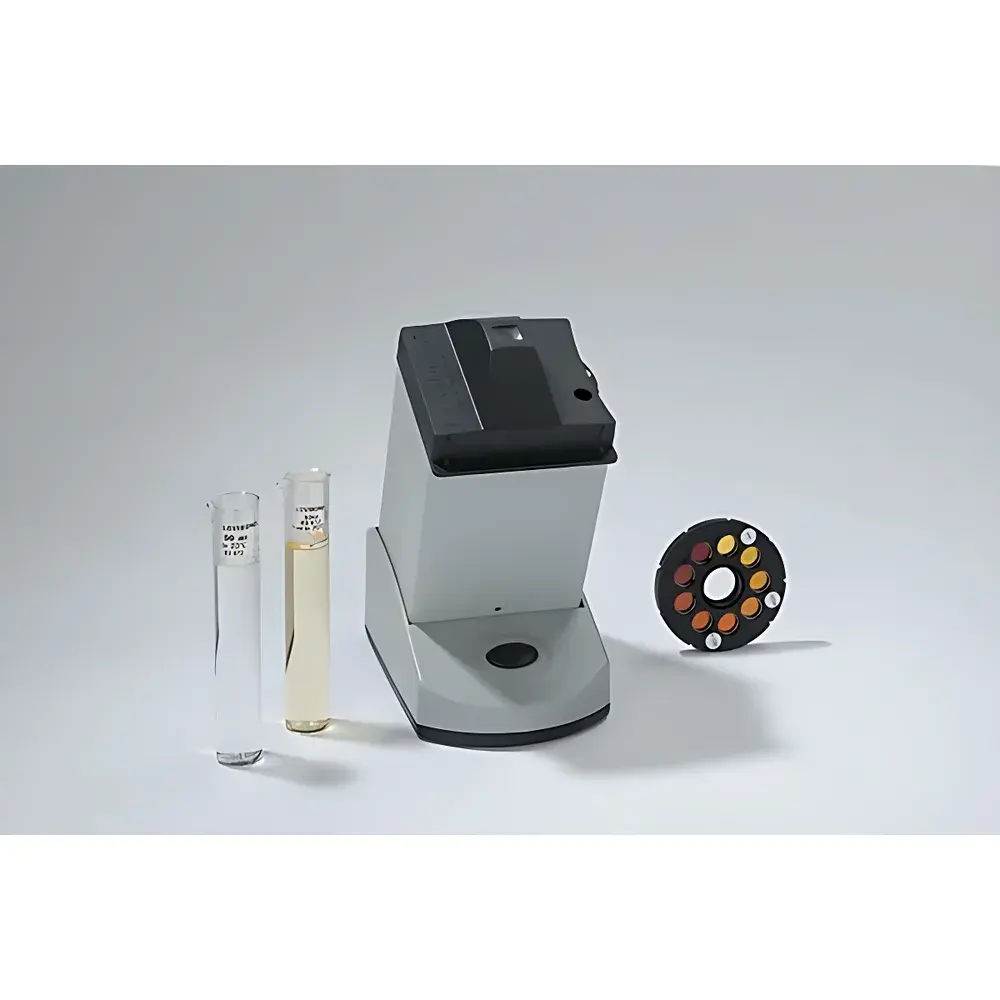
Lovibond AF325 Visual Platinum-Cobalt Colorimeter
| Brand | Lovibond (Tintometer Ltd.) |
|---|---|
| Origin | United Kingdom |
| Model | AF325 |
| Light Path | 113 mm |
| Standard Scale Range | 0–250 mg Pt/L (APHA/Hazen) |
| Compliant Standards | ASTM D1209, ISO 2211, ISO 6271, AOCS Td 1b-64, BS 5339 |
| Sample Compatibility | Clear, pale-yellow liquids |
| Calibration Method | Nessleriser 2150 comparator disc system |
| Scale Segments | NSH (10–90), NSB (70–250) |
Overview
The Lovibond AF325 Visual Platinum-Cobalt Colorimeter is a precision optical comparator engineered for the standardized visual assessment of color in transparent, low-turbidity liquid samples according to the Platinum-Cobalt (Pt-Co) scale—commonly referenced as the APHA (American Public Health Association) or Hazen color scale. Developed from the original 1892 methodology by Dr. Allen Hazen and codified in ASTM D1209, this instrument operates on the principle of matched-field visual comparison: the operator views the sample side-by-side with a series of stable, pre-calibrated Pt-Co reference standards under controlled illumination (CIE Standard Illuminant C or D65-equivalent white light). The AF325 employs a fixed 113 mm light path and integrates the Nessleriser 2150 comparator disc, enabling direct reading across two overlapping ranges—NSH (10–90 Pt-Co units) and NSB (70–250 Pt-Co units)—ensuring continuity and traceability across the full operational span. Its design adheres to fundamental photometric comparability requirements defined in ISO 2211 and ISO 6271, making it suitable for routine quality control and regulatory reporting in water treatment, petrochemical refining, pharmaceutical excipient testing, and specialty chemical manufacturing.
Key Features
- Fixed-path visual comparator with 113 mm optical path length, optimized for reproducible transmission geometry per ASTM D1209 and ISO 2211
- Nessleriser 2150 dual-scale disc assembly: NSH (10–90) and NSB (70–250) segments, enabling seamless interpolation across the full 0–250 Pt-Co range
- Internally calibrated Pt-Co reference solutions housed in sealed, UV-stabilized glass cells; certified traceable to NIST-traceable Pt-Co stock standards
- Integrated daylight-balanced viewing chamber with diffused illumination and neutral background to minimize metamerism and glare
- Robust anodized aluminum housing with corrosion-resistant finish, designed for laboratory and field-deployable use
- No electronics or software dependency—fully manual operation ensures long-term calibration stability and audit readiness
Sample Compatibility & Compliance
The AF325 is validated for use with clear, non-turbid liquids exhibiting minimal suspended solids and low absorbance outside the visible spectrum (400–700 nm). Typical applications include potable water, wastewater effluents, glycerin, plasticizers (e.g., dioctyl phthalate), chlorinated solvents (e.g., carbon tetrachloride), alcohols, and refined hydrocarbon fractions. It is not intended for opaque, fluorescent, or highly viscous media. The instrument satisfies method validation requirements for ISO/IEC 17025-compliant laboratories when used in conjunction with documented SOPs referencing ASTM D1209, AOCS Td 1b-64, and BS 5339. Its comparator-based architecture inherently supports GLP documentation workflows, as each measurement yields a discrete, observer-recorded integer value without digital interpolation or algorithmic smoothing—facilitating full traceability during regulatory audits.
Software & Data Management
The AF325 is a fully analog, observer-dependent instrument and does not incorporate embedded electronics, firmware, or data logging capabilities. All measurements are recorded manually by the analyst in laboratory notebooks or LIMS-integrated paper forms. This absence of digital components eliminates concerns related to software validation, cybersecurity, or 21 CFR Part 11 compliance—making it particularly suitable for environments where regulatory simplicity, long-term calibration integrity, and minimal validation overhead are prioritized. For laboratories requiring electronic record linkage, external digital logbooks or validated spreadsheet templates may be employed in accordance with internal data governance policies.
Applications
- Drinking water and wastewater color monitoring per EPA Method 180.1 and Standard Methods 2120B
- Quality release testing of pharmaceutical-grade glycerol, propylene glycol, and ethanol per USP and Ph. Eur. 2.2.49
- Color specification verification of industrial solvents including acetone, methyl ethyl ketone, and chloroform
- In-process control of hydrogenated vegetable oils and synthetic lubricant base stocks
- Raw material acceptance testing for plasticizer formulations (e.g., ATBC, DEHP) and surfactant intermediates
- Environmental compliance reporting under EU Directive 2000/60/EC (Water Framework Directive) Annex V parameter “color”
FAQ
Is the AF325 compliant with current ISO and ASTM colorimetry standards?
Yes—the AF325 conforms to ASTM D1209, ISO 2211, ISO 6271, AOCS Td 1b-64, and BS 5339 for visual Pt-Co color assessment.
Can the AF325 measure samples below 10 Pt-Co units?
While the NSH scale begins at 10, samples appearing lighter than 10 Pt-Co may be reported as “<10” with appropriate qualification in test records; quantitative sub-10 measurements require spectrophotometric methods per ASTM D5390.
How often must the Nessleriser disc be recalibrated?
The Nessleriser 2150 disc contains physically stable Pt-Co reference solutions sealed in borosilicate glass; no recalibration is required during normal use. Annual verification against a primary Pt-Co standard is recommended per ISO/IEC 17025 clause 6.4.10.
Does the AF325 require electrical power or battery operation?
No—it operates entirely passively using ambient or integrated daylight-simulating illumination; no power source is needed.
Is training required to operate the AF325?
Yes—ISO 2211 specifies that visual color comparison requires trained, color-normal observers; annual Ishihara testing and documented competency assessment are advised for regulated environments.




