
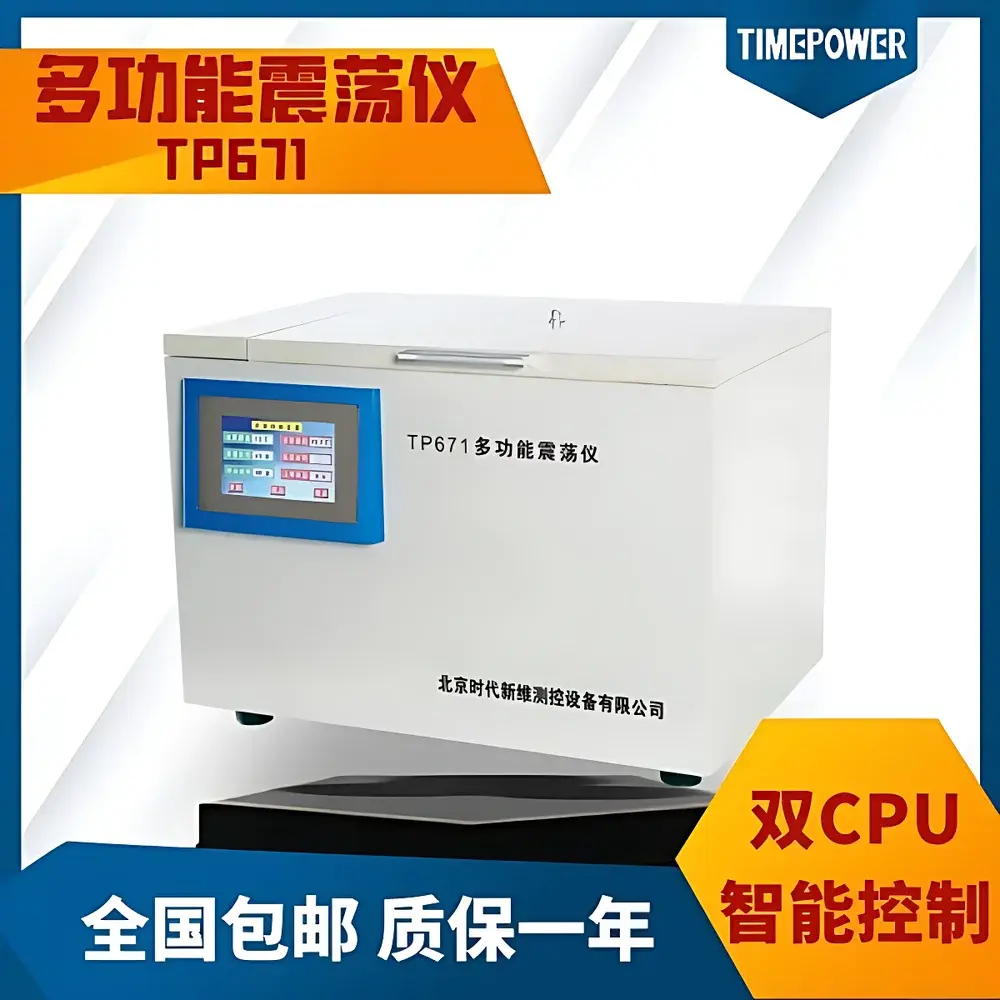
TimePower TP671 Multi-Function Orbital Shaker
| Brand | TimePower |
|---|---|
| Origin | Beijing, China |
| Manufacturer Type | Direct Manufacturer |
| Instrument Category | Benchtop Temperature-Controlled Orbital Shaker |
| Model | TP671 |
| Timing Range | 0–99 min (±10 s accuracy) for oscillation/standby cycles |
| Temperature Range | Ambient to 100 °C |
| Oscillation Frequency | 275 ± 3 rpm |
| Oscillation Amplitude | 35 mm |
| Platform Configuration | 8 × 100 mL syringes + 4 × 250 mL Erlenmeyer flasks |
| Control System | Dual-CPU microprocessor with self-diagnostic firmware |
| Display | LCD with icon-free tactile keypad |
| Safety | Overtemperature cutoff, real-time thermal fault detection |
| Heating Uniformity | ≤±0.5 °C at setpoint (measured at center of platform, steady-state) |
Overview
The TimePower TP671 Multi-Function Orbital Shaker is an integrated benchtop instrument engineered for precise, repeatable thermal and mechanical agitation of liquid samples in analytical and preparatory laboratory workflows. Unlike conventional shakers limited to ambient operation or basic heating, the TP671 implements a synchronized orbital oscillation mechanism—operating at a fixed amplitude of 35 mm and a tightly regulated frequency of 275 ± 3 rpm—combined with active resistive heating and PID-based temperature control across a range from ambient to 100 °C. Its core design addresses standardized sample preparation protocols requiring both controlled thermal input and uniform mechanical mixing, particularly in gas-phase extraction (e.g., headspace degassing prior to GC analysis), acid dissociation kinetics (per ASTM D974 and IEC 62028 for water-soluble acidity in insulating oils), and solvent equilibration steps in environmental and pharmaceutical QC testing. The dual-CPU architecture enables independent real-time monitoring of thermal and motion subsystems, ensuring compliance with GLP-aligned operational integrity.
Key Features
- Orbital shaking platform with calibrated 35 mm displacement and stable 275 ± 3 rpm output—engineered to minimize vortexing-induced shear while maximizing interfacial mass transfer.
- Wide-range temperature control (ambient to 100 °C) with ±0.5 °C uniformity at steady state; heating elements embedded beneath the aluminum alloy platform ensure rapid thermal response and minimal gradient across load positions.
- Programmable dual-phase timing: users define sequential oscillation and rest intervals within a 0–99 minute window, with ±10 second timing fidelity—critical for reproducible kinetic incubation (e.g., timed acid hydrolysis or gas liberation cycles).
- Dual-CPU microcontroller system provides hardware-level fault isolation: independent thermal sensors feed dedicated safety CPU that triggers immediate power cutoff upon exceeding user-defined or factory-set temperature thresholds.
- Icon-free LCD interface with tactile membrane keypad supports unambiguous operation under glove use or in low-light environments; all parameters—including elapsed time, current temperature, and remaining cycle duration—are simultaneously visible without menu navigation.
- Modular platform layout accommodates heterogeneous vessel configurations: eight vertically oriented 100 mL syringe holders (for sealed gas-phase sampling) and four recessed 250 mL triangular flask positions—designed to prevent slippage during high-frequency agitation.
Sample Compatibility & Compliance
The TP671 supports standard laboratory glassware and polymer vessels compliant with ISO 8573-1 (compressed air purity) and ASTM D3487 (mineral insulating oil specifications) handling requirements. Its platform geometry and clamping design are validated for use with Class A borosilicate glass syringes and ISO-standard conical flasks. While not certified as a medical device, the instrument meets IEC 61010-1:2010 safety standards for electrical equipment used in laboratory environments. Its timing and thermal control architecture supports audit-ready process documentation when paired with external data loggers compliant with FDA 21 CFR Part 11 requirements for electronic records.
Software & Data Management
The TP671 operates as a standalone instrument with no proprietary software dependency. All operational parameters are configured directly via front-panel controls, eliminating driver installation or OS compatibility constraints. For laboratories requiring traceable calibration history, the unit logs internal thermal sensor readings and runtime events (e.g., overtemperature interrupts, power-on cycles) in non-volatile memory—accessible via USB service port using TimePower’s certified diagnostic utility (v2.3+). Exported logs include timestamps, sensor IDs, and CRC-verified checksums, supporting ISO/IEC 17025-compliant equipment verification protocols.
Applications
- Headspace degassing of aqueous and organic solvents prior to gas chromatographic analysis (per EPA Method 502.2 and ASTM D3695).
- Standardized water-soluble acidity determination in transformer oils using oscillatory heating per IEC 62028 and ASTM D974.
- Controlled dissolution testing of solid dosage forms under USP conditions where temperature-stabilized agitation is required.
- Pre-analytical sample homogenization for environmental water extracts (e.g., PAHs, PCBs) before SPE cleanup and LC-MS/MS quantification.
- Accelerated stability studies involving thermal-mechanical stress on emulsions, suspensions, and colloidal formulations.
FAQ
Does the TP671 support external temperature probe input for sample-core monitoring?
No—the unit relies on integrated surface-mounted platinum RTD sensors beneath the platform; it does not provide auxiliary thermocouple or Pt100 input channels.
Can the oscillation be disabled while maintaining temperature control?
Yes—users may select “Heat Only” mode, decoupling motion actuation from thermal regulation.
Is the platform compatible with custom fixtures for non-standard vessel geometries?
The mounting holes conform to ISO 2768-mK general tolerances; third-party adapter plates may be affixed using M4 stainless steel hardware (not included).
What maintenance intervals are recommended for long-term calibration stability?
Annual verification of thermal accuracy using NIST-traceable dry-block calibrators and frequency validation with optical tachometry are advised per ISO/IEC 17025 Clause 6.4.3.
Does the instrument meet electromagnetic compatibility (EMC) requirements for shared lab environments?
Yes—it complies with EN 61326-1:2013 for laboratory equipment emission and immunity profiles.





