
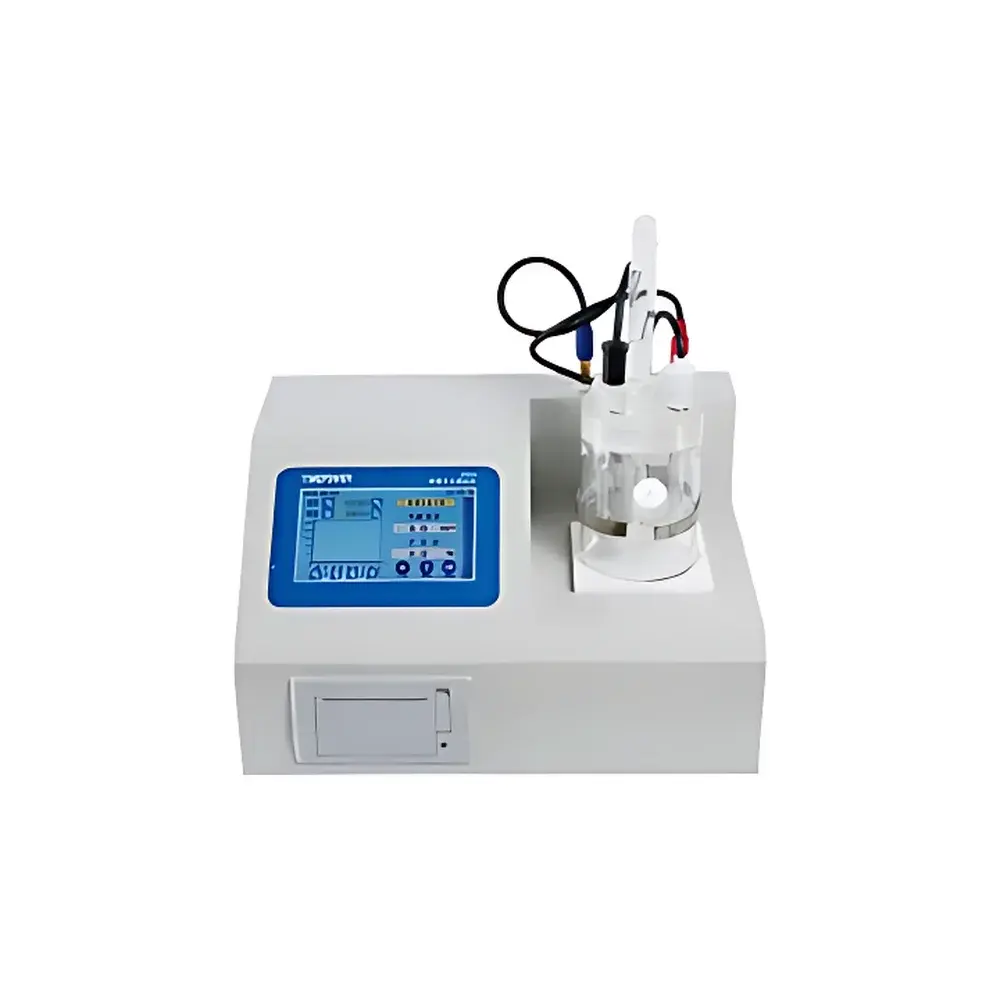
Timepower TP553 Micro Coulometric Karl Fischer Moisture Analyzer
| Brand | Timepower |
|---|---|
| Origin | Beijing, China |
| Manufacturer Type | Direct Manufacturer |
| Country of Origin | China |
| Model | TP553 |
| Pricing | Available Upon Request |
| Measurement Principle | Coulometric Karl Fischer Titration |
| Compliance Standards | GB/T 7600, GB/T 6283, SH/T 0246, SH/T 0255 |
| Display | 128×64 Graphic LCD |
| Resolution | 0.1 µg |
| Detection Range | 3 µg – 100 mg H₂O |
| Accuracy | ±20% at 3 µg, ±10% at 10 µg, ±5% at 100 µg, ±0.5% above 100 µg (excluding sampling error) |
| Max. Electrolysis Rate | 2.4 mg/min |
| Electrolysis Current Range | 0–400 mA |
| Stirring Speed Adjustment | 10 steps |
| Electrolysis Gain Adjustment | 10 steps |
| Data Storage | 256 timestamped records with 10-year power-loss retention |
| Interface | RS232 serial port |
| Environmental Operating Conditions | 20–30 °C, ≤85% RH |
| Power Supply | AC 220 V ±10%, 50 Hz ±10% |
| Max. Power Consumption | ≤30 W |
| Dimensions | 320 × 240 × 200 mm |
| Weight | 5 kg |
| Electrode Fault Detection | Automatic open-circuit & short-circuit diagnostics |
| Electrolyte Compensation | Blank current compensation & endpoint drift correction |
| Cell Design | Waterproof sealed coulometric electrolytic cell with rapid equilibration |
| Safety Features | On-screen warnings for reagent exhaustion, electrode faults, and out-of-range conditions |
Overview
The Timepower TP553 Micro Coulometric Karl Fischer Moisture Analyzer is an engineered solution for trace-level water quantification in laboratory and industrial quality control environments. It operates on the fundamental electrochemical principle of coulometric Karl Fischer titration—where iodine is generated *in situ* via controlled electrolysis at the anode, reacting stoichiometrically with water according to the Faraday law (1 mole of I₂ ≡ 1 mole of H₂O). Unlike volumetric KF systems, the TP553 eliminates burette calibration drift and reagent standardization variability by directly correlating consumed charge (coulombs) to absolute water mass. This enables high reproducibility in the sub-microgram range, making it suitable for applications demanding metrological rigor—including pharmaceutical raw material release, transformer oil moisture verification per IEC 60814, and solvent purity assessment in GMP-compliant synthesis workflows.
Key Features
- High-resolution detection down to 0.1 µg H₂O, with validated accuracy across three decades of measurement (3 µg to 100 mg), adhering to ISO 8573-2 and ASTM E203 performance expectations for coulometric systems.
- Intelligent electrolyte management: real-time blank current subtraction and dynamic endpoint drift compensation ensure stability during extended analysis sequences, especially critical for low-water matrices such as lithium battery electrolytes or anhydrous solvents.
- Robust coulometric cell architecture featuring hermetic sealing and optimized electrode geometry—reducing equilibration time to under 90 seconds and extending electrolyte service life beyond 300 analyses under routine use.
- Dual-parameter user tuning: independent 10-step adjustment for magnetic stirring intensity and electrolysis gain allows method optimization for viscous samples (e.g., polymers, greases) or volatile matrices (e.g., acetone, THF) without hardware modification.
- Comprehensive diagnostic suite: automatic detection and on-screen alerting for electrode open/short faults, insufficient electrolyte volume, and out-of-specification cell resistance—supporting preventive maintenance and audit-ready operational logs.
- Regulatory-ready data handling: timestamped results stored internally (256 entries, non-volatile memory), RS232 interface compliant with legacy LIMS integration protocols, and configurable calculation modes (wt%, ppm, %RSD) satisfying internal SOPs and external inspection requirements.
Sample Compatibility & Compliance
The TP553 accommodates liquid, solid, and gaseous samples through standardized injection protocols using supplied syringes (0.5 µL, 50 µL, 1 mL) and optional gas-tight adapters. It meets national standard methods including GB/T 7600 (for insulating oils), GB/T 6283 (general chemical products), SH/T 0246 (light petroleum fractions), and SH/T 0255 (additive packages). While not pre-certified to USP or ASTM D6304, its coulometric architecture and documented linearity (R² > 0.9998 over 10–1000 µg range) support method validation per ICH Q2(R2) guidelines. The instrument’s design incorporates safety interlocks aligned with CLP/GHS labeling conventions for pyridine-containing reagents and mandates fume hood operation per OSHA 1910.1200—ensuring safe handling of toxic, flammable KF reagents.
Software & Data Management
No proprietary PC software is bundled; however, the RS232 port supports ASCII-based data export compatible with third-party platforms (e.g., LabWare LIMS, Empower, custom Python/Excel automation scripts). Each stored record includes date/time stamp, sample ID (user-entered), water mass (µg), calculated concentration, and system status flags. Internal memory retains all entries for ≥10 years after power loss, fulfilling GLP documentation integrity requirements for raw data preservation. Audit trail functionality is implemented via immutable timestamped logs—no post-acquisition editing permitted. Firmware updates are performed via serial terminal commands, with version history accessible through diagnostic mode.
Applications
- Power industry: moisture quantification in transformer oils, turbine oils, and SF₆ gas per IEEE C57.106 and IEC 60429 specifications.
- Petrochemical QA/QC: water content verification in jet fuels (ASTM D6304), biodiesel (EN 14103), and hydrocarbon feedstocks.
- Pharmaceutical manufacturing: residual solvent analysis in APIs, lyophilized products, and excipients per USP Stage III validation protocols.
- Electronics materials: moisture screening in lithium hexafluorophosphate (LiPF₆) electrolytes and encapsulation resins where <10 ppm H₂O impacts battery cycle life.
- Food & flavor chemistry: water activity correlation studies in essential oils, emulsifiers, and powdered dairy ingredients.
FAQ
What is the recommended maintenance interval for the electrolytic cell?
Routine cleaning with dry nitrogen purge is advised after every 50 analyses; full cell reconditioning (electrode polishing, seal replacement) is recommended every 300–500 runs or when baseline current exceeds 2 µA.
Can the TP553 be used for Karl Fischer titration of aldehydes or ketones?
Yes—provided methanol-free KF reagents (e.g., imidazole-based two-component systems) are employed and method validation confirms absence of side reactions per ASTM D7118.
Is the instrument compliant with FDA 21 CFR Part 11?
The TP553 does not include electronic signature capability or audit-trail encryption; however, its immutable timestamped storage and RS232 output enable integration into Part 11–compliant enterprise systems when paired with validated middleware.
How is calibration verified without certified reference standards?
Traceable verification is achieved using gravimetrically prepared water standards (e.g., 1.00 ± 0.02 mg H₂O in dry methanol) or commercially available certified KF standards (e.g., Merck Hydranal® CertiPUR®), following a three-point linearity check per ISO/IEC 17025 clause 7.7.
What precautions apply when analyzing samples containing reactive amines?
Amine interference is mitigated by lowering electrolysis gain, reducing injection volume, and using stabilized reagents with added buffer agents—method development should follow SH/T 0255 Annex B guidance for nitrogenous compounds.





