
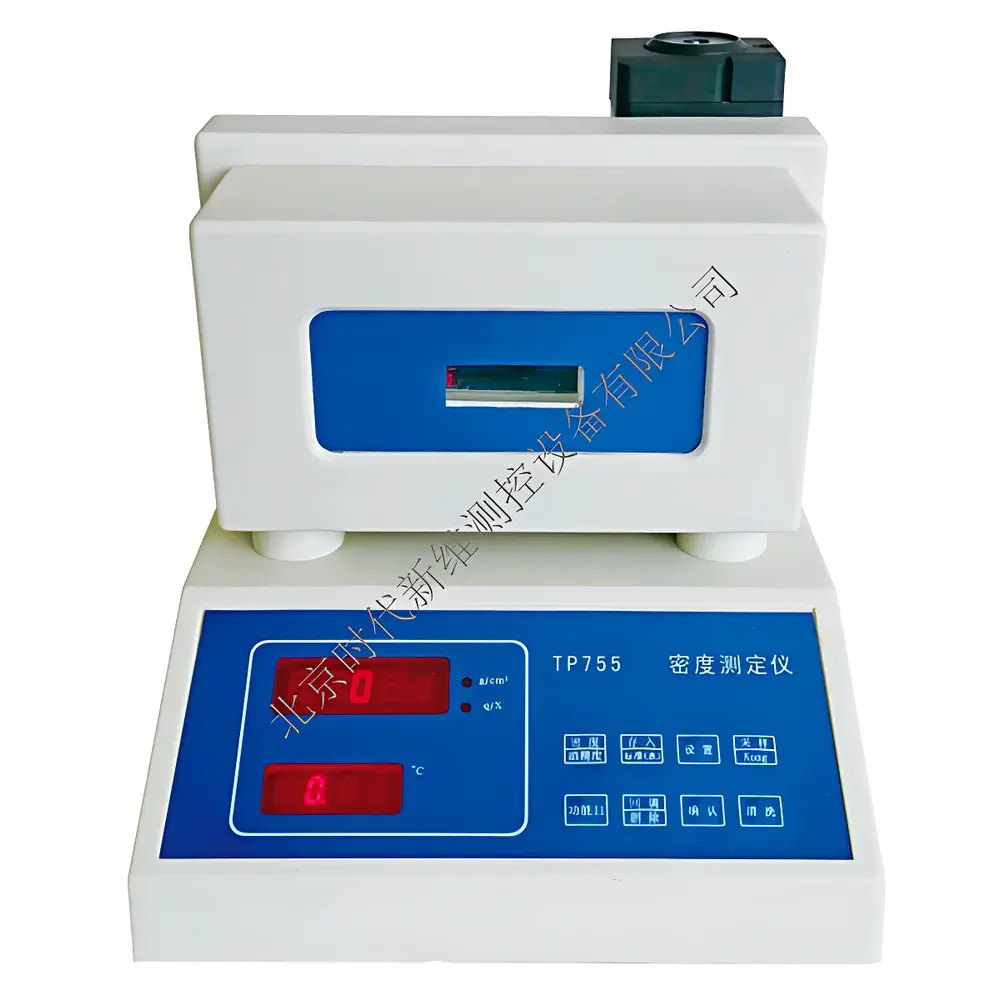
Timepower TP755 Automatic Liquid Density Analyzer
| Brand | Timepower |
|---|---|
| Model | TP 755 |
| Instrument Type | Oscillating U-tube Densimeter |
| Form Factor | Benchtop Laboratory Instrument |
| Sample Type | Liquids |
| Density Range | 0–1999.9 kg/m³ |
| Density Accuracy | ±0.5 kg/m³ (±0.0005 g/cm³) |
| Temperature Control Range | 5–40 °C |
| Controlled Measurement Temperature | 20.0 ± 0.1 °C |
| Minimum Sample Volume | 2 mL per measurement (auto- or manual injection) |
| Sample Handling | Integrated automatic liquid handling with acid/alkali-resistant tubing option |
| Data Storage Capacity | 80 measurement records |
| Power Supply | AC 220 V ±10%, 50 Hz ±10% |
| Dimensions | 265 × 210 × 205 mm |
| Weight | 3.4 kg |
Overview
The Timepower TP755 Automatic Liquid Density Analyzer is a benchtop oscillating U-tube densimeter engineered for high-reproducibility density determination of homogeneous liquids across research, quality control, and regulatory-compliant laboratory environments. It operates on the fundamental principle of resonant frequency shift in a precisely machined U-shaped glass tube filled with sample fluid: the natural oscillation frequency of the tube is inversely proportional to the square root of the fluid’s density, enabling direct, non-invasive, and rapid quantification without reliance on buoyancy or hydrostatic pressure methods. This physical principle—standardized in ASTM D4052, ISO 12185, and SH/T 0604–2000—ensures traceable, SI-aligned measurements fully compatible with international metrological frameworks. The instrument maintains thermal equilibrium via dual-chamber Peltier-based temperature stabilization, holding the measurement cell at a tightly regulated 20.0 ± 0.1 °C—critical for minimizing thermal expansion artifacts in density reporting. Designed for operational continuity in regulated settings, the TP755 delivers stable performance across ambient conditions from 5 to 40 °C while consuming minimal bench space and sample volume.
Key Features
- Oscillating U-tube sensor with fused-silica measurement cell for long-term dimensional stability and chemical inertness
- Dual-zone active temperature control system ensuring ±0.1 °C stability at 20 °C setpoint, compliant with ISO 5725 precision requirements
- Integrated micro-pump auto-sampling module supporting both automated and manual liquid introduction (2 mL per analysis)
- Chemically resistant fluid path options: standard fluoropolymer tubing (for organic solvents, hydrocarbons) and optional acid/alkali-rated perfluoroelastomer (FFKM) tubing for aggressive media including concentrated HCl, NaOH, or H₂SO₄ solutions
- Onboard calibration routine using certified pure water (≥18.2 MΩ·cm resistivity) with bubble-detection logic to prevent erroneous baseline establishment
- Real-time simultaneous display of density (kg/m³ or g/cm³) and actual cell temperature (°C), with configurable units and decimal resolution
- Non-volatile memory storing up to 80 sequential measurement records with timestamp, temperature, and density values—exportable via USB interface for audit trail generation
Sample Compatibility & Compliance
The TP755 is validated for use with Newtonian and near-Newtonian liquids exhibiting kinematic viscosities below 200 mm²/s at 20 °C—including petroleum distillates, crude oil fractions, ethanol–water blends, pharmaceutical excipients, food-grade syrups, and aqueous electrolyte solutions. Its compliance architecture supports adherence to multiple industry-specific standards: NB/SH/T 0870–2013 (petroleum density and kinematic viscosity correlation), DB13/T 1231–2010 (industrial chemical density testing), and SH/T 0604–2000 (U-tube method for crude and refined products). For GLP/GMP-regulated laboratories, the instrument supports manual audit log review and satisfies foundational data integrity expectations under FDA 21 CFR Part 11 when paired with controlled procedural documentation—though full electronic signature functionality requires external LIMS integration.
Software & Data Management
The TP755 operates autonomously via embedded firmware with no host PC dependency. All user interaction occurs through a backlit LCD interface with tactile membrane keys. Measurement data are stored locally in a cyclic buffer; historical entries include date/time stamp, measured density, actual sensor temperature, and operator ID field (manually entered). A USB-B port enables raw data dump in CSV format for post-processing in Excel, MATLAB, or statistical process control (SPC) platforms. While the device does not feature real-time network connectivity or cloud synchronization, its deterministic storage protocol ensures deterministic record sequencing—facilitating retrospective verification during internal audits or technical assessments.
Applications
- Petroleum refining: Density grading of naphtha, kerosene, diesel, and lubricant base oils per API MPMS Chapter 11.2
- Pharmaceutical manufacturing: Excipient solution density verification for formulation batch release (e.g., propylene glycol, glycerin, PEG 400)
- Food & beverage QA: Alcohol content estimation in spirits via density–ethanol correlation tables (OIML R 22); sugar concentration screening in fruit juices and soft drinks
- Academic research: Teaching physical chemistry labs on equation-of-state modeling, partial molar volume determination, and binary mixture thermodynamics
- Regulatory metrology: Routine verification of volumetric dispensing accuracy in NIST-traceable quantitative packaging control programs
FAQ
What is the recommended calibration frequency for routine QC use?
Calibration using high-purity water is advised before each analytical session or after every 10 consecutive samples—whichever occurs first—to mitigate drift from thermal hysteresis or residual contamination.
Can the TP755 measure slurries or suspensions?
No. The oscillating U-tube principle requires optically clear, particle-free liquids; suspended solids will dampen resonance and induce measurement error or sensor blockage.
Is temperature correction applied automatically if ambient lab temperature fluctuates?
The instrument actively regulates its internal measurement cell to 20.0 ± 0.1 °C regardless of ambient variation between 5–40 °C; no external compensation algorithm is required.
How is cleaning performed between incompatible samples?
A three-step rinse protocol is implemented: first with miscible solvent (e.g., isopropanol), then deionized water, and finally air purge—executed manually via the front-panel rinse function.
Does the TP755 support ASTM D1298 or IP 160 reference methods?
It does not implement hydrometer-based procedures; however, its U-tube results are metrologically equivalent to those obtained under ASTM D4052 and ISO 12185, which supersede older hydrometric standards for precision applications.



