
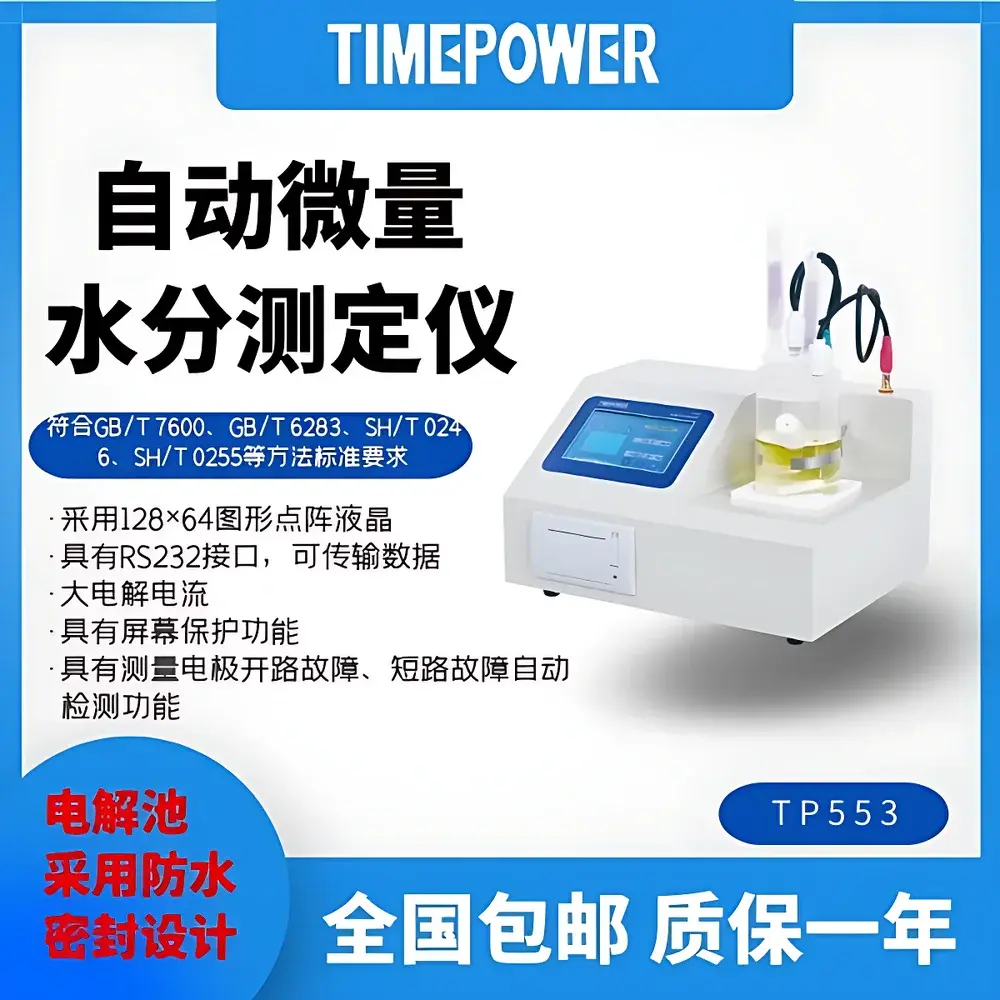
TimePower TP553 Coulometric Karl Fischer Moisture Titrator
| Brand | TimePower |
|---|---|
| Origin | Beijing, China |
| Manufacturer Type | Direct Manufacturer |
| Country of Origin | China |
| Model | TP553 |
| Pricing | Available Upon Request |
Overview
The TimePower TP553 Coulometric Karl Fischer Moisture Titrator is a precision laboratory instrument engineered for trace-level water quantification in liquid, solid, and gaseous samples. It operates on the fundamental electrochemical principle of coulometric Karl Fischer titration—where iodine is generated *in situ* via controlled electrolysis of iodide ions in the KF reagent, and stoichiometrically reacts with water according to the classic Karlsruhe reaction (I₂ + SO₂ + H₂O + 3RN + CH₃OH → 2RN·HI + RN·HSO₄CH₃). This method delivers high sensitivity (detection limit typically <0.1 µg H₂O), excellent reproducibility (RSD <0.3% for repeat injections), and minimal reagent consumption—making it ideal for low-moisture matrices such as lithium battery electrolytes, pharmaceutical excipients, and high-purity solvents. The TP553 complies with internationally recognized standard methods including GB/T 7600 (for insulating oils), GB/T 6283 (general chemical products), SH/T 0246 (light petroleum fractions), and SH/T 0255 (additives), ensuring data integrity across regulated industrial QC environments.
Key Features
- High-resolution 128×64 graphical LCD display with icon-free tactile keypad interface for intuitive operation under glovebox or cleanroom conditions
- Integrated blank current compensation and endpoint drift correction algorithms to minimize baseline drift and enhance measurement accuracy over extended run times
- Optimized dual-electrode coulometric cell with hermetic moisture barrier design—reducing ambient humidity ingress and extending electrolyte service life beyond 300 tests per fill
- Dual-parameter fine-tuning: 10-step adjustable stirring speed (100–1200 rpm) and 10-level electrolytic gain control (1–10 µA range) for optimal response across viscous, volatile, or low-conductivity samples
- Real-time endpoint detection via high-stability potentiometric signal processing circuitry with built-in short-circuit and open-circuit electrode fault diagnostics
- Onboard non-volatile memory storing up to 256 test records with ISO 8601 timestamping; data retention guaranteed for ≥10 years without power
- Configurable calculation modes: three standardized moisture content formulas (wt%, ppm, mg/g) selectable per analysis sequence
- RS-232 serial interface compliant with IEEE 488.2 command syntax for integration into LIMS or automated QA workflows
Sample Compatibility & Compliance
The TP553 accommodates diverse sample types—including hygroscopic solids (e.g., APIs, catalysts), thermally labile liquids (e.g., ethanol, THF, DMF), and compressed gases (via optional gas sampling kit)—without requiring solvent pre-drying or derivatization. Its sealed cell architecture prevents external moisture contamination during analysis of low-water-content materials (<10 ppm). Method validation support aligns with GLP and GMP documentation requirements: audit trail functionality (via external PC logging), user-access levels, and electronic signature readiness satisfy FDA 21 CFR Part 11 foundational expectations. Routine calibration verification adheres to ASTM E203 and ISO 12937 protocols.
Software & Data Management
While the TP553 operates autonomously via embedded firmware, its RS-232 port enables bidirectional communication with Windows-based data acquisition software (supplied separately). Raw titration curves, endpoint voltages, charge integrals (µC), and calculated moisture values are exportable in CSV format. Timestamped records include operator ID, sample ID, method ID, ambient temperature/humidity (if connected to optional environmental sensor), and system diagnostic flags—facilitating full traceability per ISO/IEC 17025 Clause 7.7.
Applications
- Power industry: moisture analysis in transformer oil, turbine lubricants, and SF₆ gas per IEC 60814
- Pharmaceutical manufacturing: residual solvent verification in lyophilized powders and final drug product release testing per USP
- Petrochemical QC: water content in jet fuel (ASTM D6304), biodiesel (EN 14971), and refinery process streams
- Electronics materials: quantification of H₂O in Li-ion battery electrolytes and semiconductor-grade solvents (SEMI F57)
- Agrochemical R&D: stability assessment of wettable powders and emulsifiable concentrates
FAQ
What is the minimum detectable water mass using the TP553?
The instrument achieves a theoretical lower detection limit of 0.1 µg H₂O based on Faraday’s law and coulometric charge resolution.
Can the TP553 analyze samples containing ketones or aldehydes?
Yes—when used with methanol-free KF reagents (e.g., imidazole-based anhydrous electrolytes) and appropriate sample pretreatment protocols.
Is compliance with 21 CFR Part 11 achievable out-of-the-box?
The device provides essential technical controls (audit trail-capable data export, user authentication via password, and electronic record integrity); full Part 11 compliance requires validated third-party software and procedural SOPs.
How often must the electrolyte be replaced?
Under typical usage (20–30 tests/day), the electrolyte remains stable for ≥300 analyses or 4–6 weeks—monitored automatically via real-time blank current trending.
Does the TP553 support automatic sample changers?
It does not feature native autosampler integration; however, RS-232 handshake signals allow synchronization with external XYZ robotic liquid handlers via custom scripting.



