
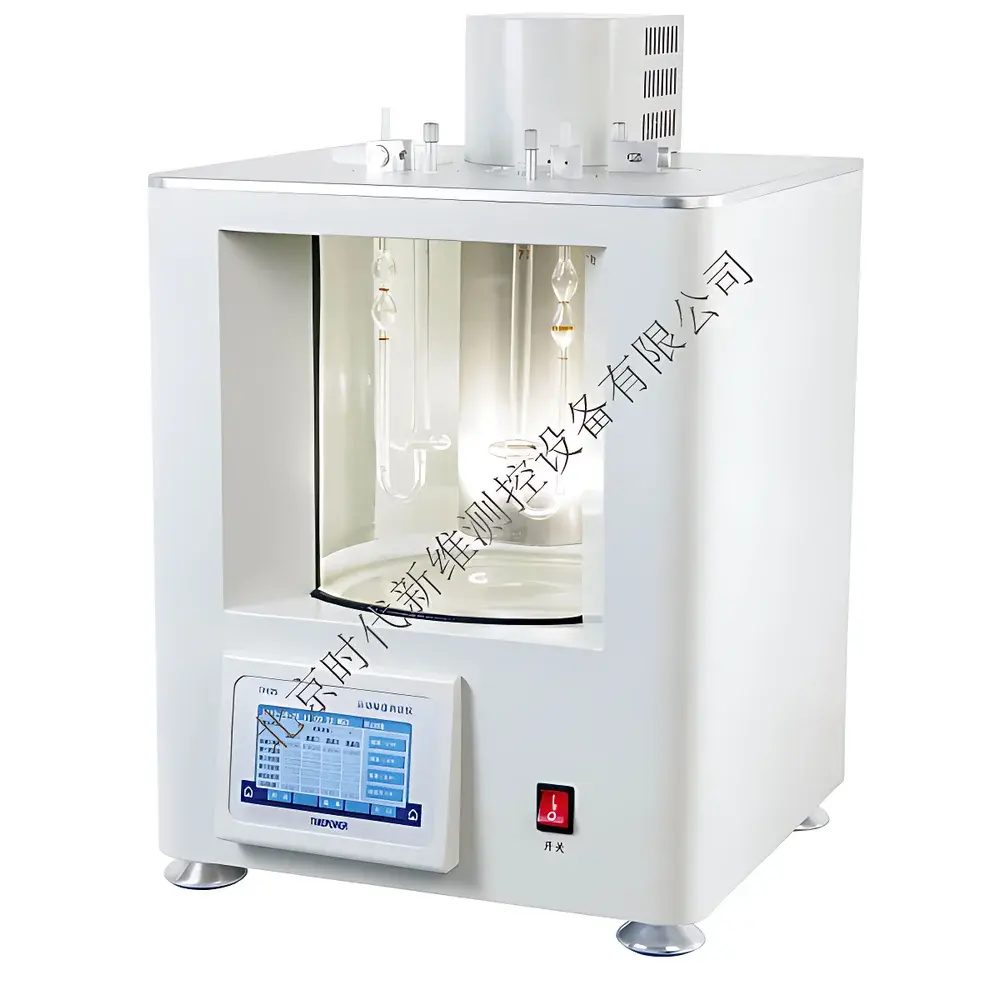
Timepower TP625 Automatic Kinematic Viscosity Tester
| Brand | Timepower |
|---|---|
| Model | TP625 |
| Origin | Beijing, China |
| Manufacturer | Timepower (Domestic Producer) |
| Application Standards | ASTM D445, ISO 3104, GB/T 265–1988 |
| Temperature Control Range | 0–120 °C (with optional chiller for sub-ambient operation) |
| Temperature Stability | ±0.05 °C |
| Temperature Resolution | 0.01 °C |
| Bath Capacity | 4 capillary positions |
| Heating Power | <1400 W |
| Stirring Speed | 1200 ± 12 rpm |
| Display | 5.0″ color LCD (480 × 272), Chinese UI with touch keypad |
| Data Storage | Internal non-volatile memory with timestamped records |
| Power Supply | AC 220 V ±10%, 50 Hz ±5 Hz |
| Dimensions | 400 × 400 × 620 mm |
| Weight | 20 kg |
Overview
The Timepower TP625 Automatic Kinematic Viscosity Tester is a precision-engineered instrument designed for the standardized determination of kinematic viscosity in petroleum products and related hydrocarbon-based fluids. It operates on the fundamental principle of capillary flow viscometry, where the time required for a fixed volume of liquid to flow under gravity through a calibrated glass capillary tube—immersed in a thermally stabilized bath—is measured. This time, combined with the capillary’s calibration constant and the fluid’s density at test temperature, yields kinematic viscosity in mm²/s (cSt), in full compliance with internationally recognized test methods including ASTM D445, ISO 3104, and GB/T 265–1988.
Engineered for laboratory environments in power generation, petrochemical refining, quality control laboratories, customs inspection agencies, and academic research institutions, the TP625 delivers repeatable, traceable, and auditable results. Its microprocessor-controlled architecture ensures thermal equilibrium prior to measurement initiation, minimizing drift and operator-dependent variability. The system supports both Ubbelohde-type (Ostwald) and reverse-flow capillaries, enabling flexibility across sample types—from low-viscosity naphthas to high-viscosity residual fuels—without hardware modification.
Key Features
- Four-position thermostatic bath with independent capillary alignment slots, optimized for parallel or sequential testing while maintaining strict thermal uniformity (±0.05 °C).
- PID-based digital temperature regulation with real-time feedback from dual platinum resistance thermometers (PRTs), ensuring rapid stabilization and long-term drift suppression.
- Integrated 5.0-inch high-resolution color LCD display (480 × 272 pixels) featuring intuitive Chinese-language menu navigation, on-screen prompts, and dynamic graphical tracking of bath temperature ramping and elapsed test time.
- Automated timing sequence: initiates flow measurement only after thermal equilibrium is confirmed; calculates kinematic viscosity using built-in calibration constants and user-entered density values (or preloaded standard densities).
- Non-volatile internal memory stores up to 1,000 test records with full metadata—including date/time stamp, operator ID (optional), capillary ID, bath temperature, efflux time, and final viscosity result—retained during power loss.
- Optional chiller interface supports sub-ambient testing down to 0 °C, extending applicability to low-temperature aviation fuels (e.g., Jet A-1 per ASTM D1655 Annex A1) and cold-flow behavior assessment.
- Integrated LED illumination system enhances visual verification of meniscus movement during manual timing fallback or method validation procedures.
Sample Compatibility & Compliance
The TP625 accommodates standard glass capillary viscometers conforming to ASTM D446 specifications—including Cannon-Fenske Routine, Ubbelohde, and reverse-flow types—with nominal diameters ranging from 0.4 mm to 1.2 mm. It is validated for use with transparent and mildly opaque petroleum liquids such as lubricating oils, transformer oils, diesel fuels, kerosene, base stocks, and synthetic esters. Opaque or highly viscous samples requiring vacuum aspiration or pressure-assisted flow are outside its operational scope and require alternative instrumentation (e.g., rotational viscometers).
All firmware logic and data handling routines adhere to principles aligned with GLP and GMP documentation requirements. Timestamped audit trails, uneditable test records, and password-protected configuration access support regulatory readiness for ISO/IEC 17025-accredited laboratories. While the instrument itself does not provide FDA 21 CFR Part 11-compliant electronic signatures, its raw data export capability (via USB) enables integration into validated LIMS or ELN platforms that enforce electronic record integrity.
Software & Data Management
The TP625 operates autonomously without external PC dependency. All test execution, calculation, and storage occur onboard via embedded firmware compliant with IEC 61508 functional safety guidelines for laboratory equipment. Data export is supported via USB 2.0 port in CSV format, preserving column headers (Test ID, Date/Time, Capillary Constant, Efflux Time, Temp, Density, νkin), compatible with Excel, MATLAB, and statistical process control (SPC) software.
No proprietary drivers or cloud connectivity are implemented—ensuring air-gapped operation where required. Firmware updates are performed via FAT32-formatted USB flash drive, with version checksum verification prior to installation. Configuration parameters—including default density lookup tables, capillary calibration coefficients, and alarm thresholds—are editable only via administrator-level access, logged with timestamp and user identifier.
Applications
- Quality assurance of insulating oils in electrical utilities per IEC 60296 and ASTM D877.
- Batch release testing of turbine oils (ISO 8573-1 Class 2) and hydraulic fluids (ISO 4406).
- Refinery process monitoring of distillate fractions and blending stock viscosity blending models.
- Research-grade characterization of biofuel blends (e.g., FAME-diesel mixtures) under varying temperature conditions.
- Compliance verification for marine fuel specifications (ISO 8217:2017, Table 2—Residual Fuels) and aviation turbine fuels (ASTM D1655).
FAQ
What capillary viscometer types are supported?
Ubbelohde (Ostwald), Cannon-Fenske Routine, and reverse-flow capillaries meeting ASTM D446 dimensional tolerances. Standard Ubbelohde capillaries are supplied; reverse-flow types are optional.
Is external calibration required before first use?
Yes. Prior to routine operation, users must verify bath temperature accuracy using a NIST-traceable mercury-in-glass or PRT reference thermometer per ASTM E77. Deviations >±0.03 °C require adjustment via the calibration offset function.
Can the instrument operate unattended overnight?
Yes, provided ambient conditions remain within 5–40 °C and relative humidity ≤85% RH (non-condensing). The device maintains clock functionality and retains all settings during power interruption.
How is data integrity ensured during power failure?
All test records are written to EEPROM with atomic write operations. Timestamps derive from an integrated RTC with battery backup, preserving year/month/day/hour/minute resolution independent of mains power.
Does the TP625 meet ASTM D445 repeatability criteria?
When operated with certified capillaries, calibrated reference oils (e.g., NIST SRM 2783), and strict adherence to sample preparation protocols (degassing, temperature equilibration), the system achieves repeatability within ±0.35% RSD for kinematic viscosity—meeting the precision limits defined in ASTM D445 Section 13.







