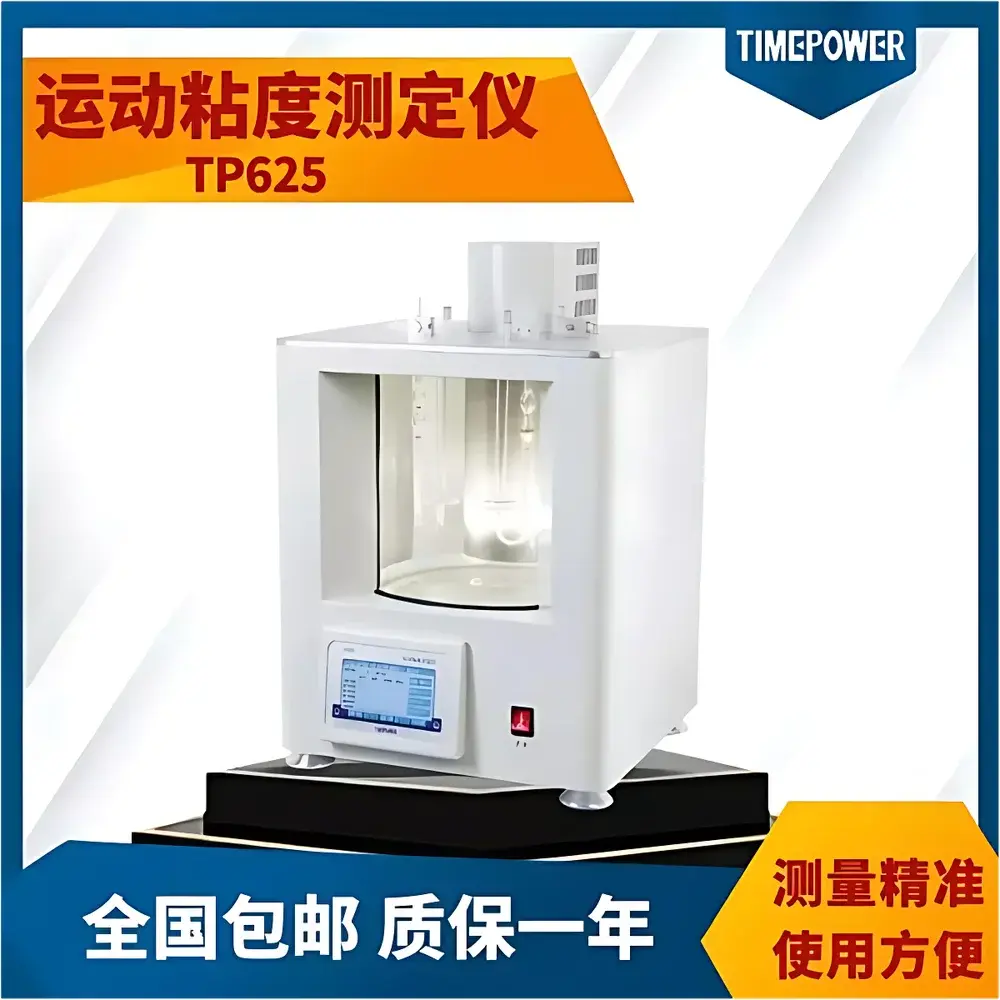
TimePower TP625/TP725 Automatic Kinematic Viscosity Tester
| Brand | TimePower |
|---|---|
| Model | TP625 / TP725 |
| Temperature Control Method | PID-based thermostatic control |
| Compliance Standard | GB/T 265–1988 (equivalent to ASTM D445, ISO 3104) |
| Sample Handling | Capillary tube viscometer immersion in constant-temperature bath |
| Output | Automated viscosity calculation and reporting |
| Origin | Beijing, China |
| Manufacturer Type | Direct manufacturer |
| Category | Petroleum-specific analytical instrument |
Overview
The TimePower TP625 and TP725 Automatic Kinematic Viscosity Testers are precision-engineered instruments designed for the standardized determination of kinematic viscosity in petroleum products and related hydrocarbon-based fluids. Based on the capillary efflux principle defined in GB/T 265–1988 — which is technically aligned with ASTM D445 and ISO 3104 — these testers measure the time required for a fixed volume of liquid to flow under gravity through a calibrated glass capillary tube immersed in a precisely controlled constant-temperature bath. Kinematic viscosity (ν), expressed in mm²/s (cSt), is calculated as the product of the capillary constant (K) and the measured efflux time (t): ν = K × t. The system integrates high-stability PID temperature regulation to maintain bath uniformity within ±0.01 °C over extended test durations, ensuring repeatability and compliance with international laboratory accreditation requirements.
Key Features
- PID-controlled thermostatic bath with dual-sensor feedback loop for rapid thermal equilibration and long-term stability at setpoints ranging from 20 °C to 100 °C (±0.01 °C tolerance)
- Automated timing initiation via front-panel directional key, eliminating operator-dependent start delays
- Onboard microprocessor calculates kinematic viscosity in real time using preloaded capillary constants and user-entered calibration data
- Dual-model platform: TP625 supports single-capillary operation; TP725 enables parallel testing of two independent capillaries with synchronized temperature control
- Stainless-steel bath chamber with corrosion-resistant coating, optimized for water/glycol or silicone oil media
- Compliance-ready firmware architecture supporting audit trails, user-level access control, and timestamped result logging
Sample Compatibility & Compliance
The TP625/TP725 series accommodates standard Ubbelohde, Cannon-Fenske, and Ostwald-type capillary viscometers (e.g., sizes 0.4–2.0 mm bore). It is validated for use with mineral oils, transformer oils, turbine oils, diesel fuels, lubricating base stocks, and synthetic ester-based fluids. All operational parameters conform to the procedural constraints of GB/T 265–1988, including bath depth ≥150 mm, vertical alignment tolerance ≤0.5°, and immersion depth per capillary specification. The instrument satisfies prerequisite conditions for ISO/IEC 17025-compliant laboratories and supports documentation traceability required under GLP and GMP frameworks. While not inherently 21 CFR Part 11–certified, its data export functionality (CSV/USB) enables integration into validated LIMS environments where electronic records are governed by organizational SOPs.
Software & Data Management
The embedded control interface provides intuitive navigation via membrane keypad and LCD display. Test parameters—including bath setpoint, capillary ID, constant value, and sample identification—are stored in non-volatile memory. Each test record includes: efflux time (s), calculated kinematic viscosity (mm²/s), temperature reading (°C), operator ID, date/time stamp, and pass/fail flag against method-defined repeatability limits (e.g., ≤0.35% RSD per ASTM D445). Data export is supported via USB 2.0 to external storage devices in comma-separated format. No proprietary software installation is required; raw output files are compatible with Excel, LabArchives, and ELN platforms. Firmware updates are delivered via downloadable HEX files and programmed using standard ISP protocols.
Applications
- Quality assurance of insulating oils in power generation and transmission facilities (per IEC 60296 and DL/T 429.6)
- Routine monitoring of turbine oil degradation in fossil-fueled and nuclear power plants
- Batch release testing of lubricants and hydraulic fluids in OEM manufacturing
- Research-grade characterization of biofuels and alternative jet fuels (ASTM D7462)
- Contract testing services accredited to CNAS (China National Accreditation Service) and equivalent regional bodies
- Academic studies involving temperature-dependent flow behavior of viscous hydrocarbons
FAQ
What standards does the TP625/TP725 comply with?
It implements GB/T 265–1988, which mirrors ASTM D445 and ISO 3104 for kinematic viscosity measurement using capillary viscometers.
Can the instrument be used with solvents or non-petroleum fluids?
Yes—provided the fluid wets the capillary bore, exhibits Newtonian behavior in the test range, and does not chemically attack glass or bath media. Validation per ASTM D2161 is recommended for non-standard samples.
Is external PC connectivity required for operation?
No. All functions—including setup, execution, calculation, and data review—are fully self-contained. PC connectivity is optional and limited to data export.
How is temperature uniformity verified during calibration?
Users perform bath mapping using NIST-traceable PT100 probes at multiple radial and axial positions, referencing the procedure outlined in ASTM D97 and ISO 17025 Clause 6.4.2.
Does the system support multi-user authentication?
Operator ID entry is manual and unencrypted; however, full access control and electronic signatures require integration with third-party LIMS or ELN systems.