
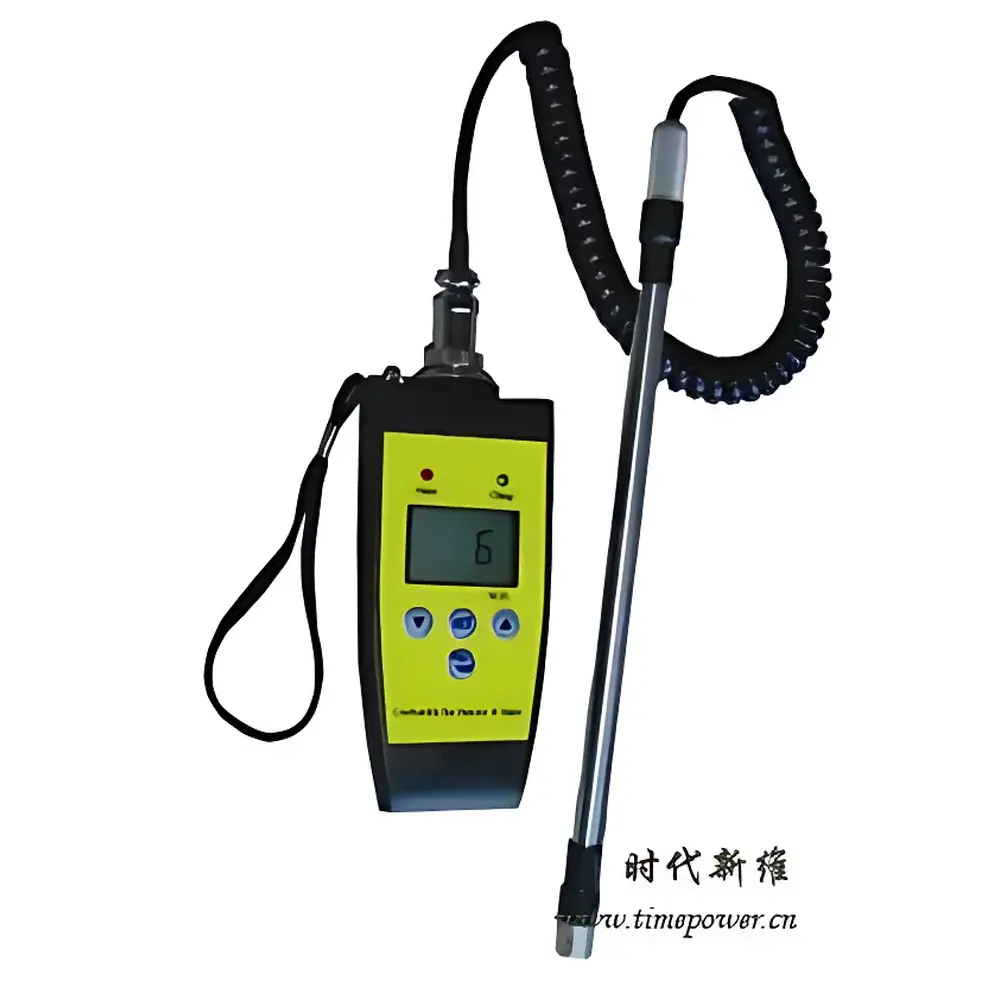
TimePower TP201 Portable Combustible Gas Leak Detector
| Brand | TimePower |
|---|---|
| Origin | Beijing, China |
| Manufacturer Type | Direct Manufacturer |
| Regional Classification | Domestic (China) |
| Model | TP201 |
| Pricing | Available Upon Request |
| Detection Principle | Catalytic Bead (Pellistor) Sensor |
| Operating Environment | −5 °C to +40 °C |
| Relative Humidity Range | Up to 95% RH |
| Storage Humidity | −20 °C to +50 °C |
| Power Supply | Rechargeable Ni-MH Battery (8+ hours continuous operation) |
| Detection Range | 0–100% LEL (Lower Explosive Limit) |
| Accuracy | ±5% FS |
| Response Time (T90) | ≤40 s |
| Static Current Draw | ≤110 mA |
| Alarm Current Draw | ≤160 mA |
| Backlight Current Draw | ≤130 mA |
| Dimensions | 127 × 58 × 29 mm |
| Weight | 300 g |
| Display | Backlit LCD with Digital Concentration Readout |
| Alarm Mode | Audible (≥75 dB at 30 cm) |
| Intrinsic Safety Certification | ia IICT3 |
| Sample Intake | Diffusion-based |
| Sensor Type | High-Stability Catalytic Bead (Pellistor) |
| Key Target Gases | H₂, CH₄, i-C₄H₁₀, C₃H₈, C₅H₁₂, acetylenes, alkenes, gasoline vapor, ethanol, methanol, xylene, and other combustible hydrocarbon vapors |
Overview
The TimePower TP201 Portable Combustible Gas Leak Detector is an intrinsically safe, diffusion-sampling instrument engineered for real-time detection and quantitative monitoring of combustible gases and vapors in ambient air. It employs a calibrated catalytic bead (pellistor) sensor — a proven, field-deployed transduction technology compliant with international standards for flammability hazard assessment (IEC 60079-29-1, EN 50194-1). The sensor operates on the principle of catalytic oxidation: when combustible gas contacts the heated, catalyst-coated filament, an exothermic reaction occurs, altering the filament’s resistance proportionally to gas concentration. This analog signal is digitized and processed by a low-power microcontroller with embedded temperature and humidity compensation algorithms, ensuring stable performance across varying environmental conditions (−5 °C to +40 °C; ≤95% RH). Designed for frontline safety verification rather than laboratory-grade analysis, the TP201 delivers rapid T90 response (<40 s), high repeatability, and robust immunity to mechanical shock and electromagnetic interference — critical attributes for use in oil & gas infrastructure, confined-space entry, pipeline maintenance, and industrial process safety audits.
Key Features
- Intrinsically safe design certified to ia IICT3 per IEC 60079-0 and IEC 60079-11 — suitable for Zone 0/1 hazardous areas where explosive atmospheres may be continuously present
- Diffusion-mode sampling eliminates need for external pumps or tubing, enabling immediate deployment and reducing maintenance points
- Backlit, high-contrast LCD display with real-time digital readout (0–100% LEL) and status icons for battery, alarm, and sensor health
- Dual-stage audible alarm (≥75 dB at 30 cm) triggered at user-configurable threshold levels — supports both pre-alarm and full alarm activation
- Integrated low-voltage battery warning and auto-shutdown protection to preserve charge integrity and extend service life
- SMD-assembled PCB architecture with conformal coating ensures long-term reliability in dusty, humid, or vibration-prone environments
- Compact ergonomic housing (127 × 58 × 29 mm; 300 g) optimized for belt-clip carry, one-handed operation, and extended shift use
Sample Compatibility & Compliance
The TP201 is validated for qualitative and semi-quantitative detection of gases and vapors whose lower explosive limits (LEL) fall within the instrument’s 0–100% LEL range and which react catalytically on palladium/platinum-doped ceramic beads. Confirmed interferents include hydrogen (H₂), methane (CH₄), propane (C₃H₈), isobutane (i-C₄H₁₀), pentane (C₅H₁₂), acetylene (C₂H₂), ethylene (C₂H₄), gasoline vapor, ethanol, methanol, and xylene isomers. It is not intended for inert gas detection, toxic gas quantification (e.g., CO, H₂S), or oxygen deficiency monitoring. The device complies with GB 15322.1–2019 (Chinese standard for combustible gas detectors), meets EMC requirements per GB/T 18268.1–2010, and supports traceable calibration using certified span gases (e.g., 50% LEL methane in air). Its ia IICT3 rating permits use in Class I, Division 1 locations under NEC 500 and ATEX Directive 2014/34/EU Annex II.
Software & Data Management
The TP201 operates as a standalone field instrument without Bluetooth, USB, or cloud connectivity. All configuration (alarm setpoints, backlight timeout, zero calibration) is performed via tactile keypad navigation. Calibration data — including date, gas type, concentration, and technician ID — is stored in non-volatile memory and retrievable via on-device menu. While no proprietary PC software is provided, the unit supports audit-ready documentation per ISO/IEC 17025 and OSHA 1910.120 requirements: each unit ships with a factory calibration certificate (traceable to NIM, China), a calibration logbook template, and a GLP-compliant calibration procedure aligned with USP analytical instrument qualification principles. Firmware updates are performed exclusively by authorized TimePower service centers.
Applications
- Pre-entry verification of pipelines, manholes, storage tanks, and LNG transfer arms prior to hot work or confined-space entry
- Routine leak surveys along natural gas distribution networks, compressor stations, and refinery flare headers
- Post-maintenance validation after valve replacement, flange re-torquing, or instrument air system commissioning
- Emergency response triage during VOC releases, fuel spills, or chemical transport incidents
- Periodic safety inspections in boiler rooms, paint spray booths, solvent recovery units, and pharmaceutical clean utilities
- Verification of ventilation effectiveness in underground parking garages, tunnels, and utility vaults
FAQ
What gases does the TP201 detect?
The TP201 detects combustible gases and vapors that oxidize catalytically on its pellistor sensor, including hydrocarbons (e.g., methane, propane), hydrogen, and common organic solvents (e.g., ethanol, gasoline, xylene). It does not detect non-combustible or non-catalytically reactive gases such as CO₂, N₂, or SF₆.
Is the TP201 suitable for use in Zone 0 areas?
Yes — its ia IICT3 intrinsic safety certification permits operation in Zone 0 (continuous hazard presence) per IEC 60079-0 and IEC 60079-11, provided ambient temperature remains within −5 °C to +40 °C and relative humidity does not exceed 95% RH.
How often must the sensor be calibrated?
TimePower recommends full span calibration every 6 months or after exposure to >100% LEL concentrations, sensor poisoning events (e.g., silicones, leaded fuels), or mechanical shock. Zero calibration should be performed before each shift in stable ambient air.
Can the TP201 be used for compliance reporting under OSHA or EPA regulations?
While the TP201 provides reliable pass/fail screening and semi-quantitative trending, formal regulatory compliance (e.g., OSHA 1910.120, EPA Method 21) requires documented calibration records, certified span gas, and adherence to site-specific SOPs — all supported by the device’s built-in logging and traceable certification chain.
Does the instrument support data export or remote monitoring?
No — the TP201 is a self-contained, single-purpose detector with no wireless interface, USB port, or memory card slot. Data recording is limited to on-device event logs and manual transcription from the LCD display.



