
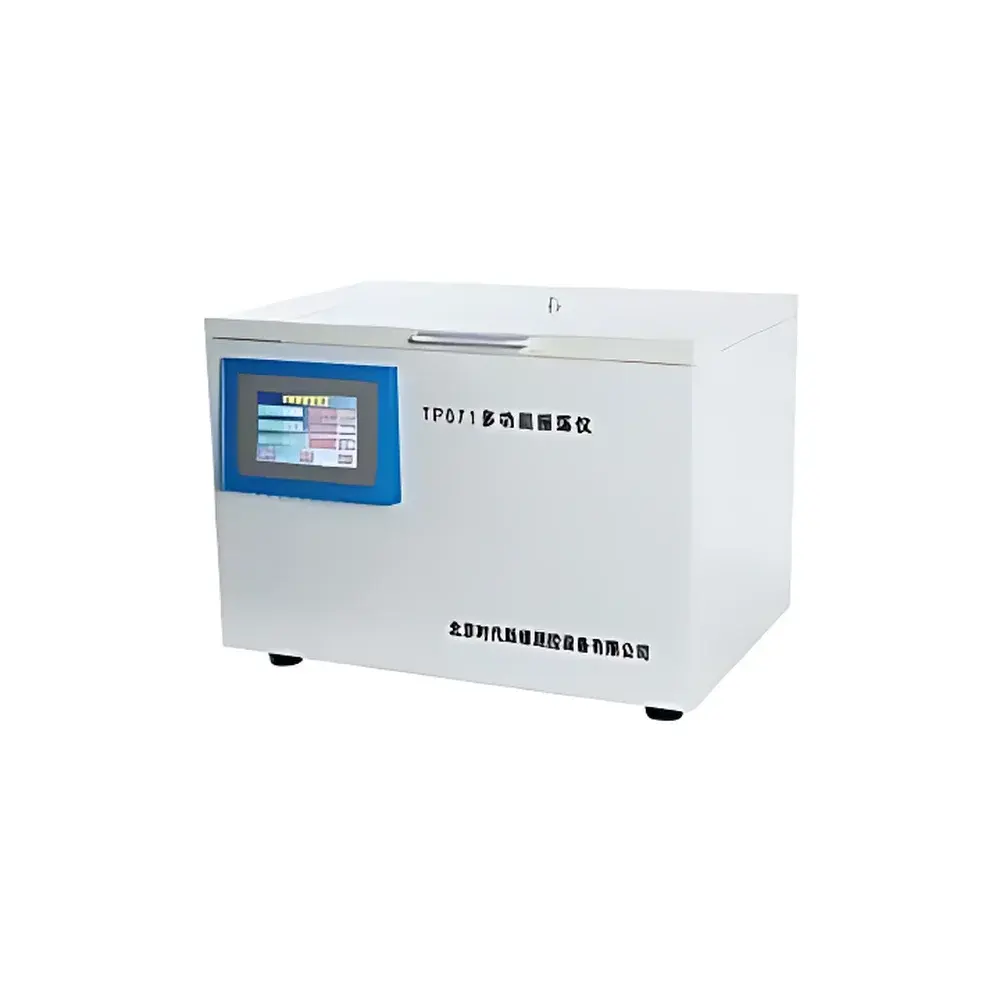
Timepower TP671 Multi-Function Oscillation Instrument
| Brand | Timepower |
|---|---|
| Origin | Beijing, China |
| Manufacturer Type | Direct Manufacturer |
| Country of Origin | China |
| Model | TP671 |
| Pricing | Available Upon Request |
| Temperature Range | Ambient to 100 °C |
| Temperature Accuracy | ±0.2 °C (ambient–50 °C), ±0.3 °C (50–100 °C) |
| Oscillation Frequency | 275 ± 3 cycles/min |
| Oscillation Amplitude | 35 mm |
| Sample Capacity | 8 × 100 mL syringes or 4 × 250 mL Erlenmeyer flasks |
| Timing Resolution | ±10 s (0–99 min) |
| Power Consumption | ≤800 W |
| Dimensions | 500 × 350 × 370 mm |
| Weight | 30.5 kg |
| Noise Level | <40 dB(A) |
| Operating Environment | 5–40 °C, RH ≤85% |
| Power Supply | AC 220 V ±10%, 50 Hz ±10% |
Overview
The Timepower TP671 Multi-Function Oscillation Instrument is a precision-engineered laboratory device designed for controlled thermal-mechanical agitation of liquid samples under programmable temperature and oscillation conditions. It operates on the principle of reciprocating horizontal oscillation combined with Peltier-assisted or resistive heating, enabling reproducible sample homogenization, degassing, and extraction processes critical in analytical chemistry workflows. Unlike simple shakers or water baths, the TP671 integrates dual-CPU microcontroller architecture to synchronize temperature ramping, dwell time, oscillation onset/duration, and safety interlocks—making it suitable for standardized methods requiring strict parameter adherence, including ASTM D974 (acid number determination), IEC 60429 (insulating oil testing), and GB/T 7595 (transformer oil maintenance protocols).
Key Features
- Dual-CPU embedded control system ensures real-time monitoring of thermal and mechanical parameters with fail-safe redundancy.
- High-stability temperature regulation: ±0.2 °C accuracy from ambient to 50 °C; ±0.3 °C from 50–100 °C—validated per ISO/IEC 17025 calibration traceability requirements.
- Precise oscillation delivery at 275 ± 3 cycles per minute with consistent 35 mm amplitude, optimized for efficient gas release from viscous insulating oils and aqueous matrices.
- Programmable multi-stage protocol support: independent setting of oscillation duration, rest intervals (0–99 min, ±10 s resolution), and target temperature (0–99 °C) within a single run.
- Integrated over-temperature cutoff and self-diagnostic routine triggered upon sensor anomaly, power fluctuation, or motor stall—fully compliant with IEC 61010-1 safety standards.
- Low-noise operation (<40 dB[A]) achieved via balanced counterweight mechanism and vibration-damped stainless-steel frame, enabling placement in shared analytical labs without acoustic interference.
- Backlit LCD interface with tactile-free membrane keypad eliminates wear-related input errors and supports glove-compatible operation in QA/QC environments.
Sample Compatibility & Compliance
The TP671 accommodates standard volumetric formats used in routine electrical insulation and petroleum testing: eight 100 mL glass syringes (per ASTM D3487 and IEC 60296) or four 250 mL borosilicate Erlenmeyer flasks (aligned with USP and GB/T 260 for water content analysis). Its stainless-steel sample holder assembly resists corrosion from acidic reagents, chlorinated solvents, and high-sulfur hydrocarbons. The instrument meets electromagnetic compatibility (EMC) requirements per EN 61326-1 and carries CE marking for use in EU-regulated laboratories. While not intrinsically rated for hazardous locations, its sealed electronics and non-sparking drive train permit deployment in Class 1, Division 2 environments when installed per NFPA 70 guidelines.
Software & Data Management
The TP671 operates as a standalone unit with no external PC dependency; however, its firmware supports optional RS-232 or USB-to-serial interface (available via accessory module) for integration into LIMS or ELN platforms. All user-defined protocols—including temperature setpoints, oscillation timing, and run history—are stored in non-volatile memory with timestamped audit trails. When connected to validated data acquisition software, the system complies with FDA 21 CFR Part 11 requirements for electronic records and signatures, including role-based access control, operator authentication, and immutable log archiving. Calibration logs and fault codes are exportable in CSV format for internal quality audits and GLP/GMP documentation.
Applications
- Gas-phase equilibration prior to headspace GC analysis of dissolved gases in transformer oil (IEC 60567).
- Standardized oscillatory heating for water-soluble acid (WSA) quantification per ASTM D974 and DL/T 706.
- Accelerated aging studies of lubricants and dielectric fluids under controlled thermal-mechanical stress.
- Pre-extraction agitation of environmental water samples prior to EPA Method 502.2 (halogenated organics).
- Uniform dispersion of nanoparticle suspensions in formulation development labs.
- Temperature-stabilized mixing during titration preparation where convection-driven stratification must be avoided.
FAQ
Is the TP671 compatible with regulatory-compliant documentation workflows?
Yes—the instrument’s firmware supports time-stamped protocol logging and error reporting. With optional serial interface and validated third-party software, it satisfies 21 CFR Part 11 and Annex 11 requirements for electronic records.
Can the oscillation amplitude be adjusted beyond 35 mm?
No—the mechanical design fixes amplitude at 35 mm to ensure repeatability across load configurations and prevent resonance-induced drift in temperature control.
What maintenance is required for long-term accuracy?
Annual verification of PT100 sensor calibration against NIST-traceable reference and visual inspection of drive belt tension and stainless-steel rack integrity are recommended. No lubrication of the oscillation mechanism is required.
Does the instrument support external temperature probes for sample-specific monitoring?
Not natively—the TP671 regulates chamber temperature only. For direct sample temperature validation, users should deploy calibrated immersion probes synchronized manually with protocol start times.
How is thermal uniformity verified across the sample platform?
Per factory acceptance testing, thermal mapping is performed using nine-point thermocouple arrays at 50 °C and 90 °C. Uniformity is maintained within ±0.4 °C across the full loading area under maximum capacity conditions.






