
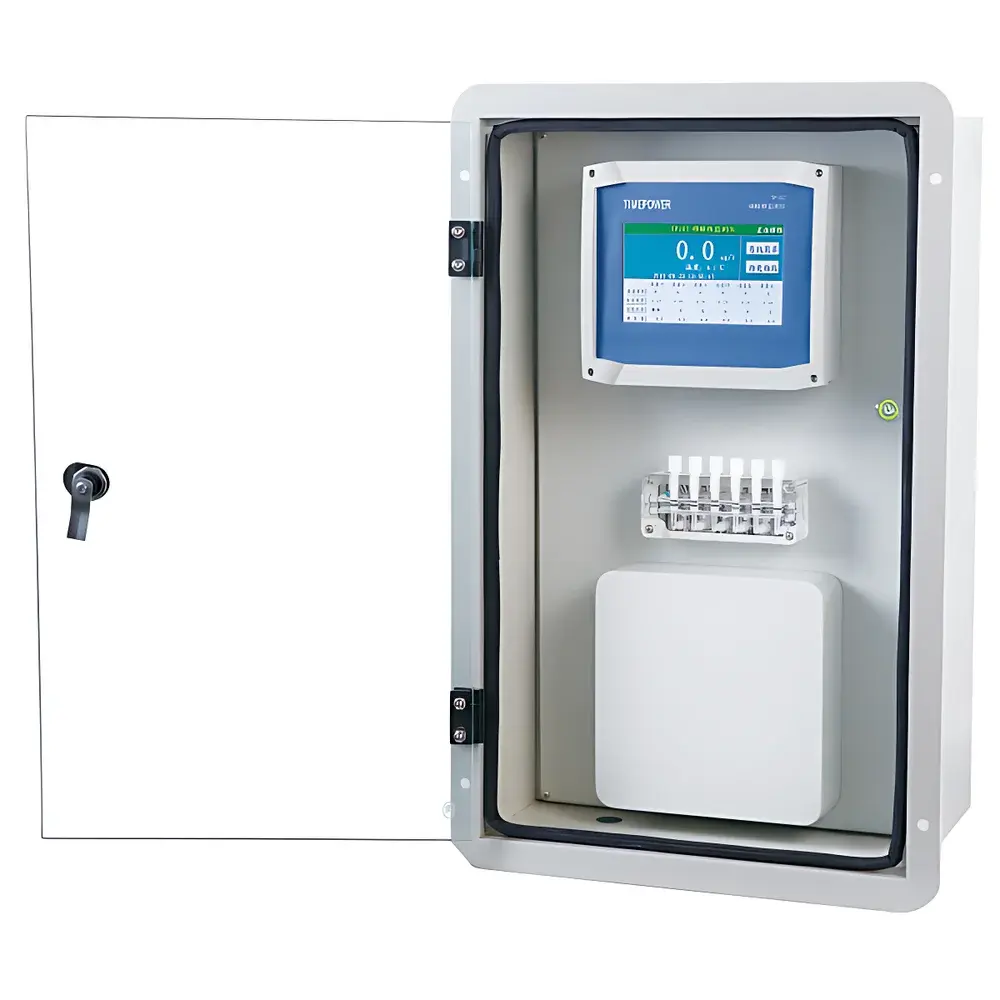
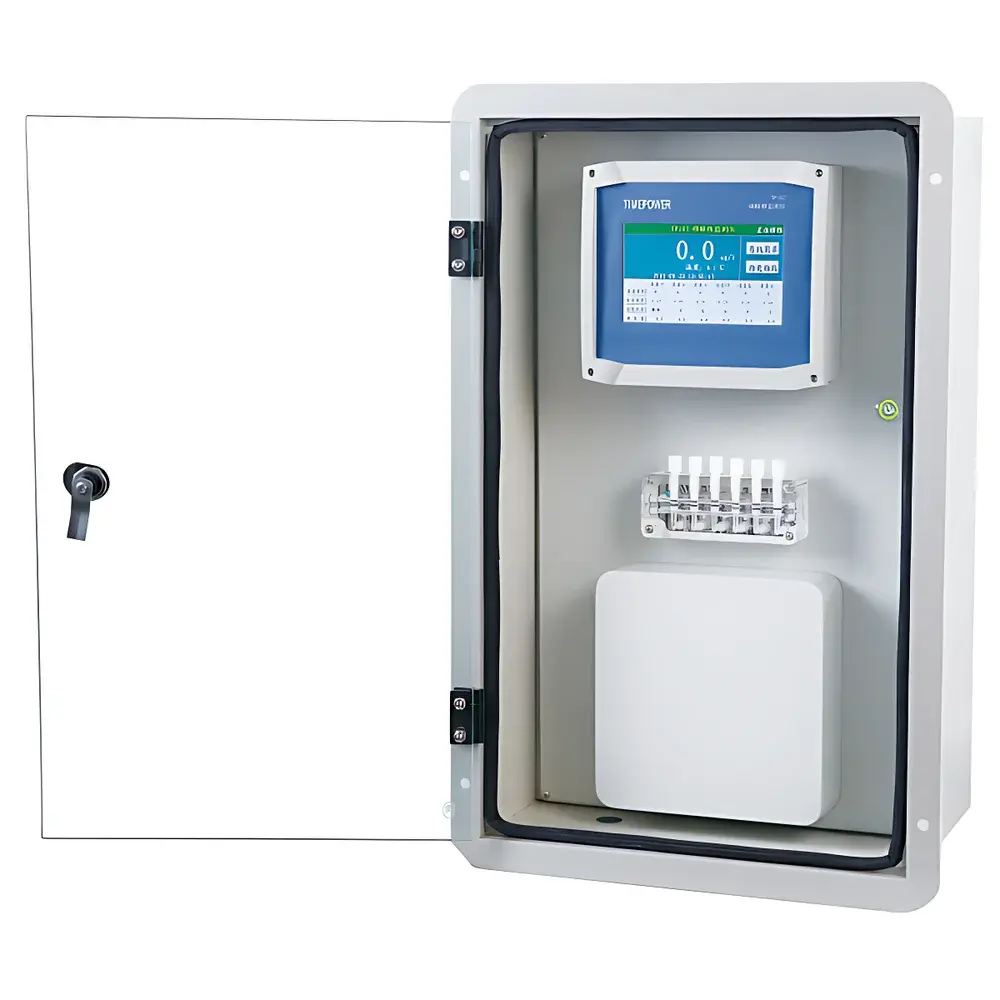
TimePower TP107 Online Phosphate Analyzer
| Brand | TimePower |
|---|---|
| Origin | Beijing, China |
| Manufacturer Type | Manufacturer |
| Product Category | Domestic |
| Model | TP107 |
| Instrument Type | Online Analyzer |
| Measurement Principle | Vanadomolybdophosphoric Yellow Colorimetry (Acidic Medium) |
| Display | 7.0-inch Color LCD Touchscreen (Chinese Interface) |
| Measurement Range | 0.00–20.00 mg/L or 0.00–50.00 mg/L (selectable) |
| Accuracy | ±2% F.S. |
| Repeatability | ≤±1% F.S. |
| Drift | ≤±1% F.S./24 h |
| Response Time | < 4 min |
| Cycle Time | ~3 min per channel |
| Sample Flow Rate | 10–40 L/h |
| Sample Temperature | 5–50 °C |
| Sample Particulates | < 5 µm, no colloidal matter |
| Ambient Temperature | 5–45 °C |
| Ambient Humidity | ≤90% RH (non-condensing) |
| Reagent Consumption | ~3 L/month |
| Output Signals | Isolated 0–20 mA / 4–20 mA / 0–10 mA (configurable) |
| Alarm Outputs | Independent per channel (flow loss, high/low limit) |
| Power Supply | AC 85–265 V, 45–65 Hz |
| Power Consumption | ≤100 W |
| Dimensions (W×H×D) | 460 × 720 × 280 mm |
| Panel Cutout | 670 × 410 mm |
| Weight | 22 kg |
| Channel Configuration | 1–6 channels (user-selectable) |
Overview
The TimePower TP107 Online Phosphate Analyzer is a dedicated photometric instrument engineered for continuous, real-time monitoring of orthophosphate (PO43−) concentration in aqueous process streams. It operates on the vanadomolybdophosphoric acid colorimetric method—performed under controlled acidic conditions—where orthophosphate reacts with ammonium metavanadate and ammonium molybdate to form a stable yellow heteropolyacid complex. Absorbance of this complex is measured at a fixed wavelength using a monochromatic cold light source, and quantified via the Lambert–Beer law. This principle ensures trace-level sensitivity and robustness in industrial water matrices. Designed for unattended operation in demanding environments, the TP107 meets the analytical requirements of GB/T 6913–2008 for boiler feedwater and cooling water analysis, and serves as a critical control point in phosphate dosing loops where precise stoichiometric management is essential to prevent scale formation and corrosion.
Key Features
- Modular multi-channel architecture supporting 1–6 independent measurement paths—enabling cost-effective parallel monitoring of multiple sample points without redundant hardware.
- High-reliability imported solenoid valves with calibrated actuation cycles ensure repeatable reagent metering, sample aspiration, and waste discharge—critical for long-term accuracy and low maintenance burden.
- Automated dual-point calibration at user-defined intervals (e.g., daily or weekly), using certified standard solutions, maintains measurement integrity across extended deployment periods without manual intervention.
- Integrated data logger retains 30 days of timestamped concentration values, flow status, calibration events, and alarm logs—supporting root-cause analysis during process excursions or regulatory audits.
- Stable monochromatic cold-light source delivers consistent spectral output over >10,000 hours, minimizing photometric drift and eliminating thermal noise associated with incandescent lamps.
- Configurable analog outputs (0–20 mA, 4–20 mA, or 0–10 mA) provide seamless integration with distributed control systems (DCS), PLCs, or automated chemical dosing controllers for closed-loop phosphate management.
- Front-accessible panel-mount design with standardized cutout dimensions simplifies field installation and routine servicing—no disassembly required for filter replacement or tubing inspection.
- 7.0-inch capacitive touchscreen interface displays real-time trend curves, channel-specific alarms, and system diagnostics in intuitive Chinese-language menus—optimized for plant floor operators.
Sample Compatibility & Compliance
The TP107 is validated for use with clarified, low-turbidity aqueous samples meeting defined physical specifications: suspended solids < 5 µm, absence of colloidal organics or precipitated silica, and temperature stability between 5 °C and 50 °C. It complies with national standard GB/T 6913–2008 for phosphate determination in thermal power plant water chemistry applications. While not certified to ISO/IEC 17025 for accredited testing, its performance characteristics—including repeatability ≤±1% F.S. and 24-hour drift ≤±1% F.S.—align with GLP-aligned operational validation protocols used in regulated utilities and pharmaceutical water systems. The analyzer supports traceability through audit-ready event logs and configurable digital signatures for calibration records.
Software & Data Management
Data acquisition and system control are managed by embedded firmware with non-volatile memory storage. All measurements, calibration timestamps, reagent lot tracking (via manual entry), and alarm triggers are time-stamped and stored locally. Historical data can be exported via USB interface in CSV format for offline trending or compliance reporting. Although the TP107 does not implement FDA 21 CFR Part 11-compliant electronic signatures or role-based access control, its logging architecture satisfies basic ALCOA+ principles (Attributable, Legible, Contemporaneous, Original, Accurate) when operated within documented SOPs. Optional Modbus RTU communication enables remote readout and basic configuration via serial interface for integration into legacy SCADA platforms.
Applications
- Boiler feedwater and condensate polishing circuits in fossil-fueled and nuclear power plants—ensuring phosphate residual remains within ASME PTC 19.11 and EPRI guidelines to mitigate caustic gouging and hideout.
- Cooling tower make-up and recirculating water systems—supporting dynamic phosphate-based corrosion inhibition programs in petrochemical and refinery facilities.
- Pharmaceutical purified water (PW) and water-for-injection (WFI) distribution loops—monitoring for phosphate ingress from pretreatment resins or heat exchanger leaching.
- Municipal drinking water treatment—verifying orthophosphate dosing for lead/copper corrosion control per U.S. EPA Lead and Copper Rule requirements.
- Fertilizer production effluent streams—compliance monitoring against local discharge limits for total phosphorus (as PO4).
- Food and beverage process rinse waters—validating cleaning-in-place (CIP) efficacy and preventing phosphate carryover into final product streams.
FAQ
What sample filtration is required prior to analysis?
A 5-µm inline particulate filter is mandatory; colloidal silica or biofilm fragments must be excluded to prevent optical path fouling and valve clogging.
Can the TP107 measure total phosphorus, or only orthophosphate?
The TP107 measures only reactive orthophosphate; total phosphorus requires acid digestion pretreatment, which is outside its scope.
Is remote software update supported?
Firmware updates require physical USB drive loading—no over-the-air or network-based update capability is provided.
How often must reagents be replaced?
At nominal flow and cycle settings, reagent consumption averages ~3 liters per month; actual usage varies with measurement frequency and range selection.
Does the analyzer support automatic zero/slope verification using blank water?
Yes—automated zero checks using deionized water are performed before each measurement cycle; slope verification requires manual introduction of calibration standards.
Related Products







